The documentary evidence behind three official narratives, with the accessibility of each original noted. Two points belong at the top rather than inside a card. This dispute has three state parties, and the third one's claim does not run through the other two's — China's case is a Qing-era frontier argument about the corridor between Xinjiang and Tibet, and folding it into the India–Pakistan quarrel would misdescribe it. And the Kashmiri section is not a subsection of any of the three: it carries cards that disagree with each other, because Kashmiri is not one position. Cards are labelled with what their principal source is — what a government asserts, what is documented, or what an international body has determined. Every card in the three narratives carries the other parties' rebuttals; where the research behind this page records no position for a party, the card says so instead of supplying one. Third-party and Kashmiri cards state their own limits instead. This document endorses no claim.
VOTEWhich story do you find more convincing?↓Naming rule There is no neutral vocabulary here and this page has not found one. It says Indian-administered Kashmir and Pakistan-administered Kashmir, the convention of the United Nations human-rights office — whose 2019 report is titled in those exact words — and of the BBC and Reuters. Those terms say who administers and say nothing about who holds title, which is the question this page declines to settle. The choice is not costless and this page will not present it as costless. It is rejected by India, and it is the precise formulation that has drawn regulatory action against foreign outlets there: a five-day broadcast ban, customs stickers over tens of thousands of imported copies. India's Pakistan-occupied Kashmir (PoK / PoJK) and Pakistan's Indian Illegally Occupied Jammu and Kashmir (IIOJK) are each attributed to the government that uses them, in every edition of this page including that government's own. No edition of this page is in Kashmiri · The order of the three narrative sections below is randomized on every visit; the Kashmiri section follows all three and is not randomized, because it belongs to none of them
India leads onPakistan leads onChina leads onread in opposite ways, or carried by the Kashmiri section
Current status — as of August 2026 Status as of 2026-08
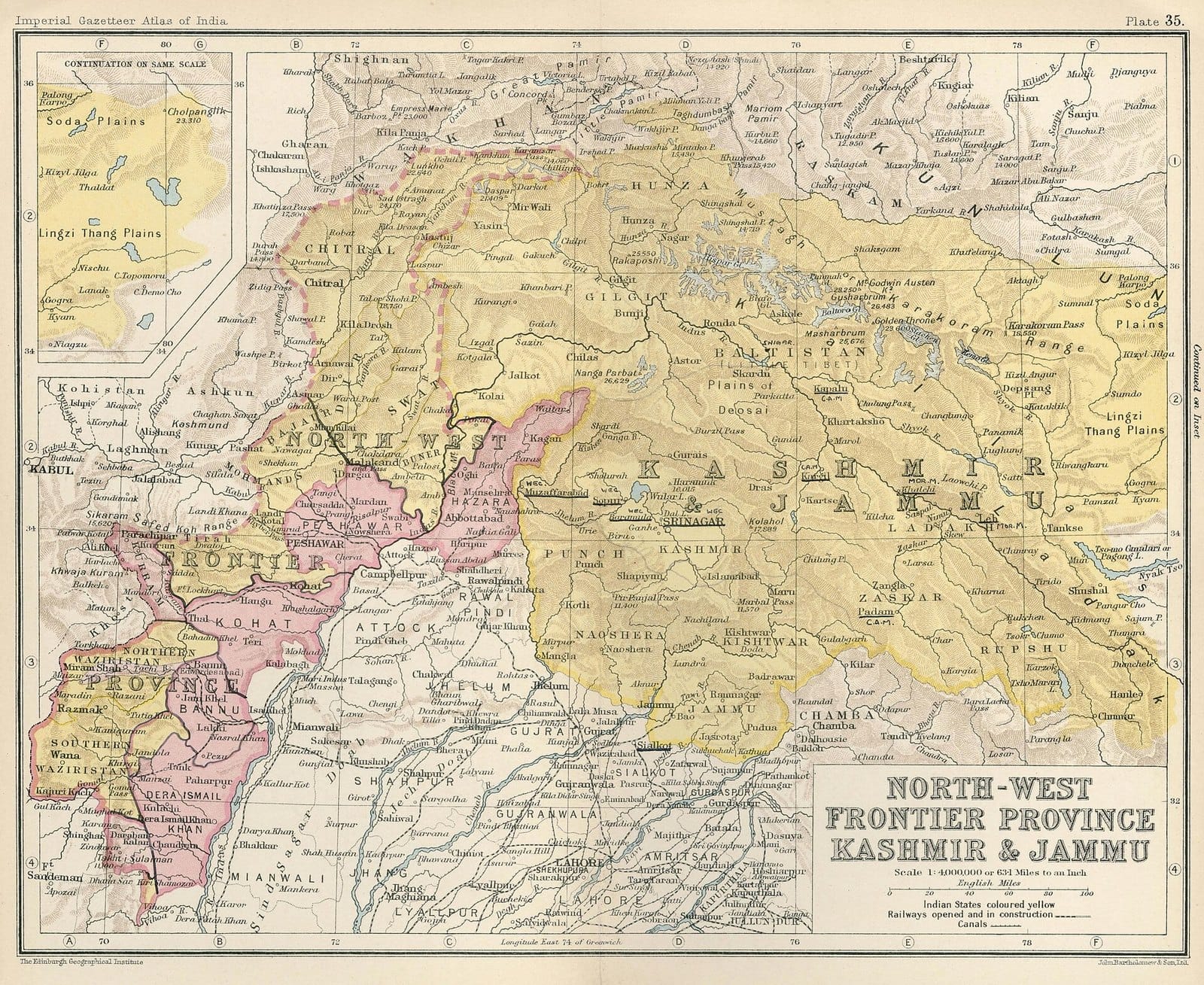
De facto control divided three ways since 1963, and unchanged in outline since then. 🇮🇳 India administers about 55% of the former princely state — the Jammu division, the Kashmir Valley, most of Ladakh and the Siachen–Saltoro area — holding about 70% of its population. 🇵🇰 Pakistan administers about 30%. 🇨🇳 China administers about 15%2026-08
Area of the former princely state about 222,200 km² in total. Azad Jammu and Kashmir 13,297 km²; Gilgit-Baltistan 72,496 km²; Aksai Chin about 38,000 km²; the Trans-Karakoram Tract about 5,180–5,200 km². The tract's area is given differently by different parties, and India recognises no transfer of it at all2026-08
Trans-Karakoram Tract, low≈5,180 km²
Trans-Karakoram Tract, high≈5,200 km²
Nehru's 1963 protest, wider alignment12,810.87 sq mi
Population Azad Jammu and Kashmir about 4.33 million, capital Muzaffarabad; Gilgit-Baltistan about 1.7 million, capital Gilgit. Aksai Chin has no permanent settled population. India's portion holds roughly 70% of the region's people2026-08
India's administrative designation the Union Territory of Jammu and Kashmir, with a legislature, and the Union Territory of Ladakh, with none, both effective 31 October 2019. On the Survey of India political map of November 2019, Pakistan-administered Kashmir sits inside the first and Gilgit-Baltistan inside the second2019-10
Pakistan's administrative designation Azad Jammu and Kashmir, with an elected assembly, prime minister and president under the Interim Constitution of 1974; and Gilgit-Baltistan, called the Northern Areas until 2009, never constitutionally integrated and holding a status usually described as semi-provincial2026-08
China's administrative designation Aksai Chin is administered within Hotan Prefecture in Xinjiang and Rutog County in Tibet; the Trans-Karakoram Tract is administered as part of Xinjiang. China does not describe either as part of the Kashmir dispute2026-08
Statehood not restored. The Supreme Court of India upheld the 2019 measures unanimously on 11 December 2023 and in the same judgment directed that statehood be restored as soon as possible. In October 2025 the Court gave the central government four further weeks to respond to petitions on the point. Jammu and Kashmir remains a Union Territory2026-08
Elected government Omar Abdullah of the National Conference has been Chief Minister since 16 October 2024, following elections on 18 and 25 September and 1 October 2024 with a turnout of 63.88% — National Conference 42 of 90 seats, BJP 29, Congress 6, PDP 3. The Lieutenant Governor holds police and land2026-08
The Line of Control resulting from the ceasefire of 17 December 1971 and governed by Article 4(ii) of the Simla Agreement, which obliges both sides to respect it without prejudice to either's position. The Directors-General of Military Operations understanding of 25 February 2021 largely held for four years and did not survive the 2025 crisis. The ceasefire of 10 May 2025 has no published written terms2026-08
Simla Agreement suspended by Pakistan on 24 April 2025 and not reinstated. India's position is unchanged: the dispute is bilateral, and no third-party route is open unless both governments agree to it2026-08
Indus Waters Treaty placed in abeyance by India on 23 April 2025 and still in abeyance. The Court of Arbitration held in June 2025 that a unilateral abeyance has no legal effect, that the treaty remains in force and that the Court retains jurisdiction despite India's non-participation; a further award followed on 15 May 2026. India rejects the Court as illegally constituted and its awards as void, and the Ministry of External Affairs reaffirmed the abeyance on 3 July 20262026-07
UNMOGIP still deployed. India treats the mandate as lapsed with Simla, has stopped filing complaints and required the mission to vacate its Srinagar premises in January 2014; Pakistan continues to file complaints and facilitate observers. Only the Security Council could terminate the mission, and it has not2026-08
Conflict death toll the four figures in circulation do not measure the same thing and none is adopted here2026-08
Indian government≈41,000
Human Rights Watch (2006), civilians≥20,000
JKCCS≈70,000
Hurriyat≈80,000
Kashmiri Pandit displacement, from January 1990 the estimates diverge by a factor of three and are given by source2026-08
most scholarly accounts≈90,000–100,000
mid-range estimates≈150,000
higher estimates≈190,000 of 200,000
CIA World Factbook300,000
2025 aircraft losses contested, and reported here as claims rather than as a count2025-05
Pakistan's claim5–6 Indian aircraft
India's CDSlosses, number rejected
Washington Quarterly assessmentIndia ≥3; Pakistan also lost aircraft
reported US assessment≥2 downed by J-10s
2025 crisis casualties, each government's own count India: 21 civilians and 8 security personnel killed. Pakistan: 40 civilians and 13 military. Each side's claims about the other's losses are far higher2025-05
Violence trend in Indian-administered Kashmir 2025 was the least violent year in over two decades — 92 killed by one count, against a breakdown of 28 civilians, 17 security personnel and 46 militants that sums to 91 — the figures are the Combating Terrorism Center's, working from Indian government data, and are given here as published — despite the Pahalgam attack. Violence has shifted from the Valley to the Jammu division, in Poonch, Rajouri and Udhampur, with a reported decline of about 94% in local recruitment since 20212025-12
India–China line disengagement at Depsang and Demchok on 21 October 2024 restored patrolling there to pre-2020 levels and complete disengagement was declared in December 2024, but buffer zones and a patrolling moratorium persist at Galwan and Pangong and no troop drawdown has taken place. The 24th round of Special Representatives talks on 19 August 2025 produced a ten-point consensus; the 25th round is being held in Beijing in 20262026-08
Detentions and press Khurram Parvez of the JKCCS, arrested under the Unlawful Activities (Prevention) Act on 22 November 2021, remains detained; United Nations special rapporteurs and major rights organisations call the detention arbitrary. Kashmir Times offices were sealed and The Kashmir Walla was blocked and shut in 20232026-08
⚠ Four cautions about this page. The naming is itself contested and the convention used here is not neutral to everyone — Indian-administered Kashmir and Pakistan-administered Kashmir follow OHCHR, the BBC and Reuters and describe administration rather than title, and they are the exact formulation that has drawn regulatory action against foreign outlets in India. This dispute has three state parties, and China's claim does not run through the other two's: it is a frontier argument about the corridor between Xinjiang and Tibet, and China treats its own portion as a bilateral boundary question rather than as part of the Kashmir dispute. Several figures above are contested and are given by source rather than resolved — the death toll, the displacement counts, the 2025 aircraft losses and casualties. And the 2025–26 items move: the abeyance, the suspension, the ceasefire and the statehood question are all live and are stamped accordingly.2026-08
Change log
India's Ministry of External Affairs reaffirms that the Indus Waters Treaty stays in abeyance until Pakistan credibly and irrevocably abandons cross-border terrorism.
The Gilgit-Baltistan assembly again asks for provisional provincial status, phrased as without prejudice to Pakistan's position on the Kashmir dispute. India claims the territory as part of the Union Territory of Ladakh.
A further award of the Court of Arbitration is issued on storage on the western rivers. India, which does not participate and rejects the Court as illegally constituted, treats it as void.
The Supreme Court gives the central government four more weeks to respond to petitions seeking restoration of statehood. Statehood has not been restored.
Defence Minister Rajnath Singh calls the American claim of credit for the 10 May ceasefire baseless; India's position is that it was arranged bilaterally. Washington and Islamabad say otherwise. Who stopped the war is itself in dispute.
Pakistan launches Operation Bunyan-um-Marsoos; a ceasefire takes effect at about 17:00 IST after a call from Pakistan's Director-General of Military Operations. No written terms have been published.
Operation Sindoor: Indian strikes on nine sites in Pakistan-administered Kashmir and Punjab province. India states that only <i>terror infrastructure</i>, in India's own term, was hit; Pakistan states that civilian areas and mosques were. Aircraft losses are claimed and counter-claimed and are not settled.
Pakistan suspends the Simla Agreement, closes the Wagah crossing and expels Indian military diplomats — removing, in the same act, the instrument that protects the Line of Control from unilateral alteration.
India places the Indus Waters Treaty in abeyance. Pakistan calls it an act of war.
Gunmen kill 26 civilians, most of them Hindu men, at Baisaran meadow near Pahalgam.
India and China agree disengagement at Depsang and Demchok, restoring patrolling there to pre-2020 levels. Buffer zones and a patrolling moratorium remain at Galwan and Pangong.
Omar Abdullah is sworn in as Chief Minister after the first assembly elections since 2014. The territory remains a Union Territory.
The Supreme Court of India upholds the 2019 measures unanimously and, in the same judgment, directs that statehood be restored as soon as possible.
The Jammu and Kashmir Reorganisation Act takes effect, creating two Union Territories. China calls the Union Territory of Ladakh unlawful and void; Pakistan calls the measures illegal and unilateral.
⇄ The order of the three narrative sections below is randomized on every visit. The Kashmiri section follows all three and is not randomized, because it belongs to none of them.
India's narrative 6 sources
A standard Instrument of Accession executed by a legally competent ruler and accepted without condition; a parliamentary resolution claiming the whole of the former princely state and not the part India administers; a bilateral treaty that on India's reading closed every route but bilateral negotiation; and a unanimous judgment of India's own Supreme Court — which in the same paragraph directed the restoration of a statehood that has not been restored.
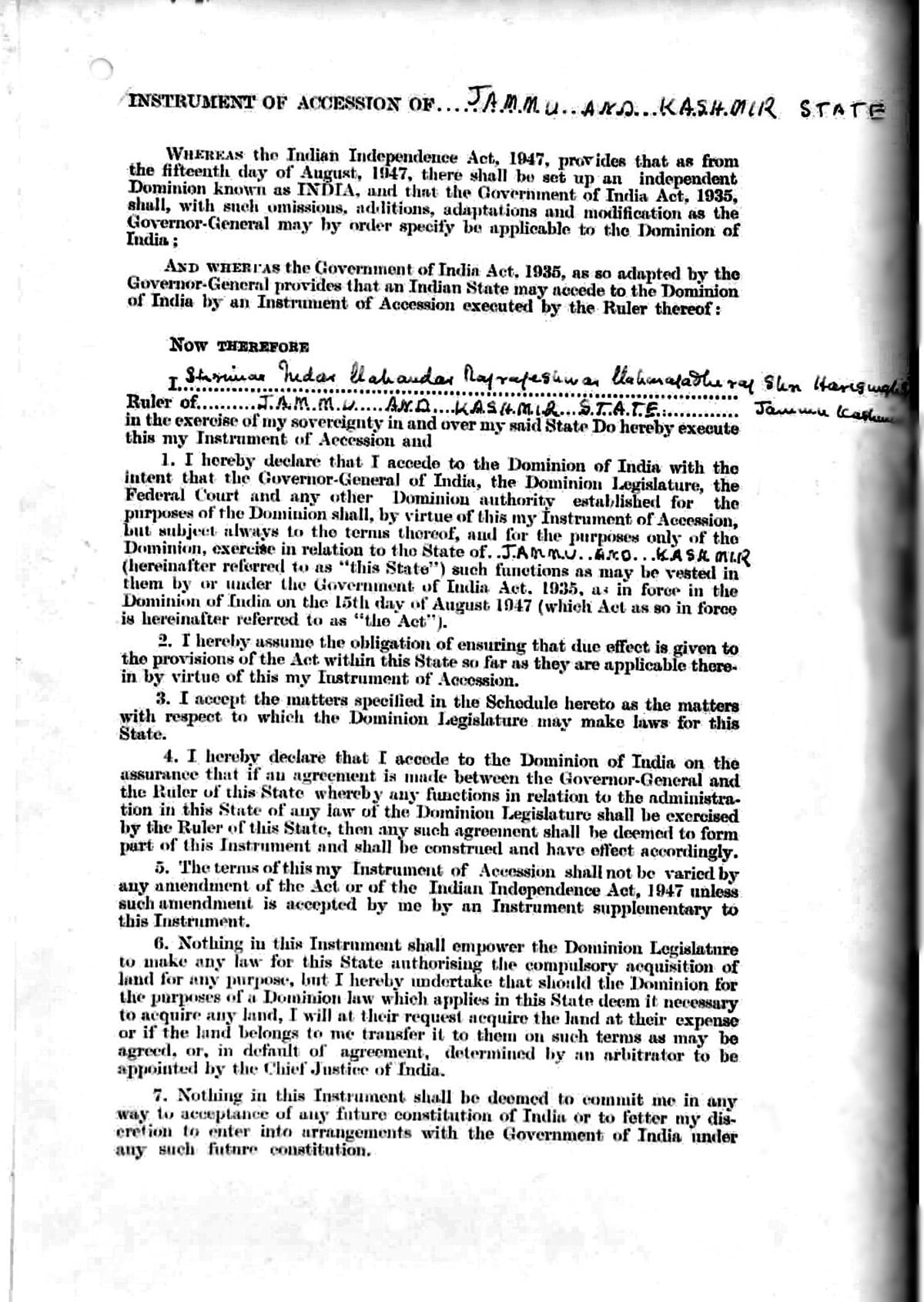
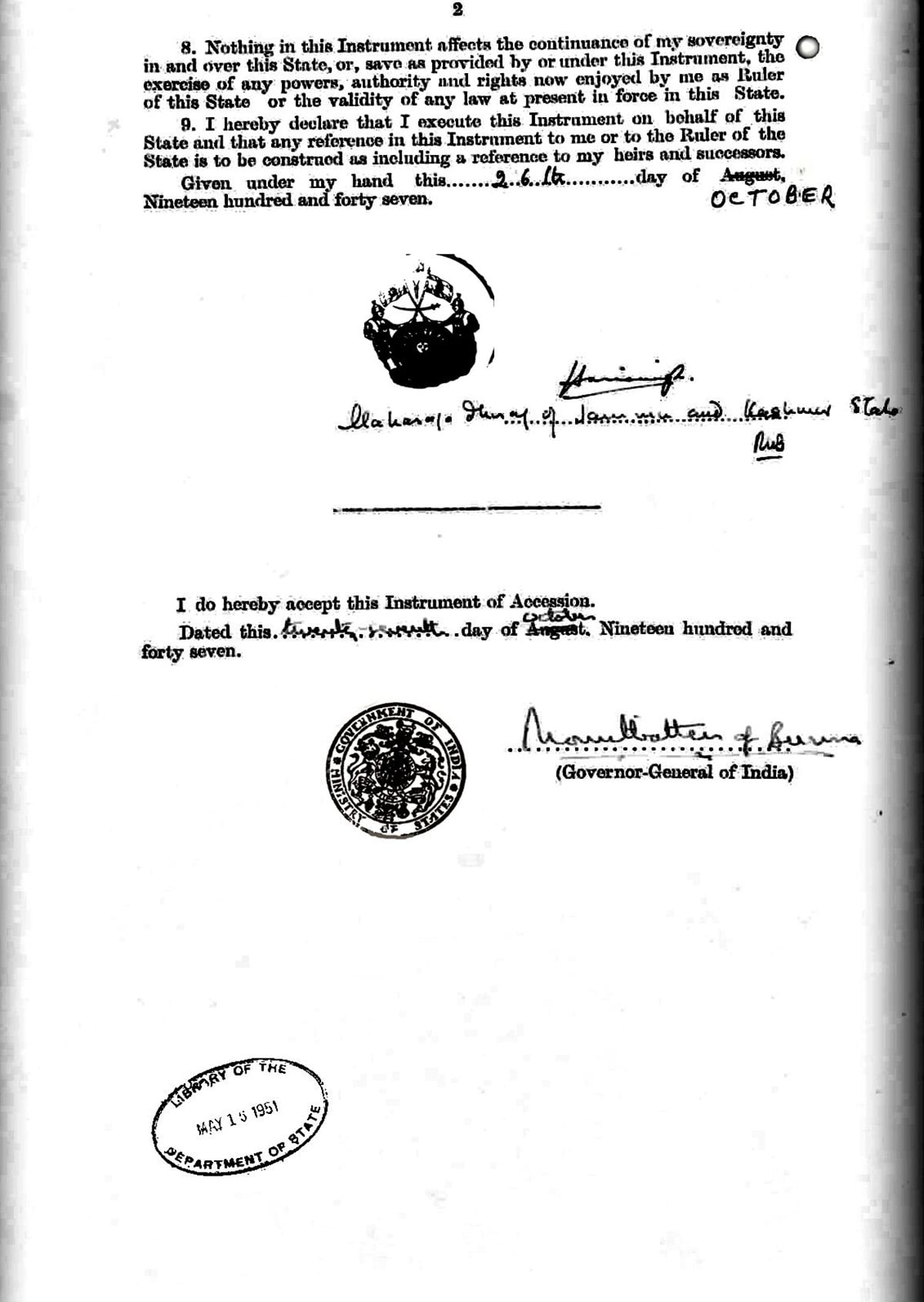
The Instrument of Accession, Articles 7 and 8 signed 26 October 1947 · accepted 27 October 1947
Maharaja Hari Singh executed the same standard Instrument as the rulers of some 560 other princely states. The document is signed "this 26th day of October"; the acceptance is dated the twenty-seventh, and two published copies agree on both. A well-known online host of the text gives 26 October for the acceptance in its own headnote, contradicting the document it is publishing — this page quotes the document and not the headnote. The acceptance carries no condition. It reads, in full, that the Governor-General does hereby accept this Instrument of Accession. The sentence about settling the question of accession by "a reference to the people" is in a separate covering letter, not in the Instrument and not in the acceptance.
Article 7: "Nothing in this Instrument shall be deemed to commit me in any way to acceptance of any future constitution of India or to fetter my discretion to enter into arrangements with the Government of India under any such future constitution." · Article 8: "Nothing in this Instrument affects the continuance of my Sovereignty in and over this State…" · the acceptance, in its entirety: "I do hereby accept this Instrument of Accession." — dated, on the same sheet, "this Twenty-Seventh day of October"
Meaning
India's argument is that sovereignty over defence, external affairs and communications was transferred by a legally competent ruler in a completed instrument that required no ratification, and that everything afterwards — plebiscite proposals, Security Council resolutions — is at most a political undertaking rather than a condition precedent. Articles 7 and 8 are why the argument is narrower than it sounds: the Instrument expressly preserved the Ruler's sovereignty in and over the State and reserved his discretion on any future constitution. Every party's case about what accession did and did not transfer runs through Article 8, which is why it is printed here alongside Article 7 rather than instead of it.
Pakistan rebuts
Two answers of different kinds, and Pakistan makes both. The first is factual: the Maharaja had already lost control of Poonch to his own rebelling subjects, and a ruler in flight cannot validly cede what he no longer holds. The second is legal, and it is not a denial of what the documents say. Pakistan's position is that the covering letter, in which the Governor-General wrote that the question of accession should be settled by "a reference to the people," has legal effect on the accession it accompanies. India's answer is that a covering letter's political aspiration is not a term of the Instrument. Whether a covering letter can qualify the instrument it accompanies is a question of legal interpretation, and the documents do not settle it in either direction.
China's position
China has never argued about the accession and no Chinese position on it was located. Its claim does not run through the princely state's succession at all: Aksai Chin is claimed on a Qing-era frontier argument, and Beijing's standing position is that the western section of the China–India boundary is a boundary question with India. Nothing on this card bears on the Chinese claim in either direction, and nothing is supplied here to make the page look symmetrical.
original publisheddocumentedArticle 7 circulates in two forms. The version quoted here is the archive form, which reads commit me and enter into arrangements; a widely reproduced variant drops the object of the verb and is ungrammatical, and is not used hereArticle 8 is quoted only to the end of its first clause and the ellipsis is deliberate. The remainder — saving the Ruler's existing powers and the laws then in force except as the Instrument provides — was not reproduced verbatim from an archive copy in this compilation and is given in substance rather than in quotation marksThe whereabouts of the original have been questioned; the National Archives of India copy surfaced through a Right to Information applicationInstrument of Accession (Jammu and Kashmir)National Archives copy, 5 pp. — Wikimedia Commons
The parliamentary resolution of 22 February 1994 22 February 1994 · reaffirmed in official replies since
India's standing formula — that Jammu and Kashmir is an integral part of India — descends from a resolution passed unanimously by both Houses of Parliament on 22 February 1994. Its substance is in two parts: that the State of Jammu and Kashmir has been, is and shall be an integral part of India and that attempts to separate it will be resisted; and that Pakistan must vacate the areas of the State that it holds. This page does not print the operative text as a quotation. The existence, the date and the continuing standing of the resolution are confirmed from an official record — the Ministry of Home Affairs' reply to Rajya Sabha unstarred question 2957 of 21 March 2018, which states India's position and says it was reaffirmed by the resolution of 22 February 1994. The operative clauses were not obtained from an official record in this compilation. What circulates is a widely reprinted text; it is reported here in substance and not reproduced.
Meaning
India is not the claimant of part of the Kashmir region — it is the claimant of all of it, including Azad Jammu and Kashmir, Gilgit-Baltistan and Aksai Chin. There is no Indian position in which the Line of Control is a border. That is why every Indian answer on this page runs to the whole and not to the portion India administers, and why a settlement at the line has never been an Indian offer.
Pakistan rebuts
A domestic parliamentary resolution cannot dispose of a matter that sits on the Security Council's agenda; a unilateral declaration is not title, and only the Council can remove an item it has placed there. Note that the two positions do not meet head-on: India's is a claim about title to the whole, and Pakistan's standing position is a claim about procedure — that the disposition is unresolved pending a plebiscite — so each can be maintained without answering the other.
China's position
No Chinese statement responding to the 1994 resolution was located in this compilation. What is on record is the standing formula — the Kashmir issue is "an issue left over from history" between India and Pakistan — and, separately, that the western section of the China–India boundary belongs to China. The demand that occupied areas be vacated extends on its face to Aksai Chin and to the Trans-Karakoram Tract, and China has answered the claim to that territory repeatedly without ever answering this resolution.
copies publishedasserted by a governmentThe resolution is invoked annually as Sankalp Diwas. Automated retrieval of the parliamentary record was blocked during the research behind this page; the 2018 Rajya Sabha reply, which is the official record relied on here, confirms the resolution's date and standing but does not reproduce its operative clauses. The grading on this card reflects that and nothing elseThe widely reprinted text — secondary, not an official record
Amit Shah in the Lok Sabha, and the map that followed 6 August 2019 · Survey of India political map, November 2019
The Survey of India political map published in November 2019 put the statement into an instrument: the areas India calls Pakistan-occupied Kashmir were placed inside the Union Territory of Jammu and Kashmir, and Gilgit-Baltistan inside the Union Territory of Ladakh. In India the official map is not a graphic but a legal standard — under section 2(2) of the Criminal Law Amendment Act 1961 it is an offence to publish a map of India that does not conform to the maps published by the Survey of India.
I want to put this on record that whenever I have said J&K, it means with PoK and Aksai Chin. — Union Home Minister Amit Shah, moving the resolution on Article 370 and the Reorganisation Bill
Meaning
The 2019 reorganisation was framed not as a consolidation of what India holds but as an assertion over the whole. It is also the point at which naming becomes operative rather than rhetorical: Pakistan-occupied Kashmir is the label on the official sheet, and this page attributes the term to India for that reason rather than despite it.
Pakistan rebuts
Pakistan rejects both the statement and the map, and its own official map places the territory it calls Indian Illegally Occupied Jammu and Kashmir on its side of the argument. The formulation each government uses of the other's cartography is close to identical — India called Pakistan's political map of August 2020 an exercise in political absurdity with neither legal validity nor international credibility, and Pakistan says the equivalent of India's November 2019 sheet. Neither map has been accepted by anyone but its publisher.
China rebuts
Beijing answered on the day India announced it. At the ministry's press conference of 6 August 2019 the spokesperson said India was undermining China's territorial sovereignty by unilaterally changing its domestic law, and that the practice was "unacceptable and will not come into force." The sharper wording came when the Union Territory took effect on 31 October 2019, when the ministry called the step unlawful and void and said it would not change the fact that the area is under Chinese actual control. The second half is the part India does not answer. The first half is the part China does not press, because Beijing treats its own portion as a boundary question rather than as a piece of the Kashmir dispute.
original publishedasserted by a governmentA Hindi remark delivered in the same debate — that the boundary of Kashmir includes the areas India calls Pakistan-occupied Kashmir, and that lives would be given for them — is widely reported across Indian outlets. It is given here in substance because no official transcript was obtained in this compilationThePrint — the Lok Sabha statementOutlook
Article 370, the Reorganisation Act, and the judgment of 11 December 2023 5–6 August 2019 · 31 October 2019 · 11 December 2023
Article 370 was read down by Presidential Order together with a parliamentary resolution on 5–6 August 2019; the Jammu and Kashmir Reorganisation Act received assent on 9 August 2019 and took effect on 31 October 2019, splitting the state into two Union Territories — Jammu and Kashmir, with a legislature, and Ladakh, with none. On 11 December 2023 the Supreme Court of India upheld the measures unanimously. In the same judgment it directed that statehood be restored as soon as possible, and that elections be held. Elections were held on 18 and 25 September and 1 October 2024, on a turnout of 63.88%; the National Conference won 42 of 90 seats, the BJP 29, Congress 6 and the PDP 3, and Omar Abdullah was sworn in as Chief Minister on 16 October 2024. Jammu and Kashmir is still a Union Territory in August 2026.
Meaning
India's position is that the constitutional question is closed, and was closed by its own highest court after argument. The direction on statehood is the half of the same judgment that has not been carried out, and it is the most-cited grievance of the Kashmiri parties that accept the Indian constitutional framework — which is to say, of the parties that framework depends on. This page carries the two halves together; neither is available on its own.
Pakistan rebuts
Pakistan's position is that the measures of 5 August 2019 were illegal and unilateral, in violation of Security Council resolutions and — because Pakistan characterises the territory as occupied — of the Fourth Geneva Convention. India's answer is that the Geneva argument presupposes an occupation it denies, and that another state has no standing on a domestic court's reading of a domestic constitutional provision. The two positions do not meet: one is about Indian constitutional law, the other about the status of the territory that law was applied to.
China rebuts
China objected to the Union Territory of Ladakh specifically and not to the rest, which is the shape of its whole involvement. After the December 2023 ruling the Chinese foreign ministry restated that the western section of the China–India border belongs to China. Beijing has taken no position on Article 370 as a question of Indian constitutional law, and none is supplied for it here.
original publisheddocumentedIn October 2025 the Supreme Court gave the central government four further weeks to respond to petitions seeking restoration of statehood. The Jammu and Kashmir assembly has passed a resolution seeking restoration of the territory's special status. The Lieutenant Governor holds police and landJammu and Kashmir Reorganisation Act, 2019
The Simla Agreement — India's reading 2 July 1972 · in force 4 August 1972
Signed by Indira Gandhi and Zulfikar Ali Bhutto after the 1971 war, with some 93,000 Pakistani prisoners of war in Indian hands, and in force from 4 August 1972. India's reading is that Simla converted Kashmir into a bilateral matter, superseding United Nations machinery and leaving UNMOGIP with a lapsed mandate. India has declined third-party mediation on that basis ever since, including after the ceasefire of 10 May 2025. The Kargil conflict of 1999 was fought across the line the agreement protects and did not alter it.
1(ii): "That the two countries are resolved to settle their differences by peaceful means through bilateral negotiations or by any other peaceful means mutually agreed upon between them. Pending the final settlement of any of the problems between the two countries, neither side shall unilaterally alter the situation…" · 4(ii): "In Jammu and Kashmir, the line of control resulting from the cease-fire of December 17, 1971 shall be respected by both sides without prejudice to the recognized position of either side. Neither side shall seek to alter it unilaterally…" — the date form and the spelling of recognized are the instrument's own
Meaning
India's core legal claim after 1972 and the one it has been most consistent about. The two words that carry it are mutually agreed: on India's reading no route to a settlement exists that both governments have not agreed to, which forecloses referral, mediation and arbitration alike. The hinge is a single phrase and it is set out in full in battleground ③ below.
Pakistan rebuts
Pakistan reads the same clause the other way. Or by any other peaceful means preserves routes other than bilateral negotiation, and nothing in the text repeals an item on the Security Council's agenda — only the Council can remove one. The Pakistani lawyer Ahmer Bilal Soofi put the practical form of it after April 2025: suspension lets Pakistan revert to Security Council mechanisms to internationalise the dispute. Pakistan's own suspension of the agreement is a card in its section of this page.
China's position
China's standing formula names both routes in one sentence: the issue should be resolved "in accordance with the UN Charter, relevant UN Security Council resolutions and bilateral agreements." That endorses neither reading and was plainly drafted not to. It is also where China's two positions become visible in a single line — the resolutions and the bilateral agreements are precisely what India and Pakistan disagree about, and China cites both while treating its own portion as a boundary question with India alone.
Operation Sindoor, and the Indus Waters Treaty placed in abeyance 22 April – 10 May 2025 · abeyance maintained through 2026
The sequence, with the contested elements marked as claims. On 22 April 2025 gunmen killed 26 civilians, most of them Hindu men, at Baisaran meadow near Pahalgam. On 23 April India placed the Indus Waters Treaty in abeyance. Pakistan called that an act of war and on 24 April suspended the Simla Agreement. On 7 May, between about 01:05 and 01:30 IST, India struck nine sites in Pakistan-administered Kashmir and in Punjab province in Operation Sindoor; India stated that only terror infrastructure, India's own term, was hit, Pakistan that civilian areas and mosques were. An air battle of roughly 52 minutes involving more than 114 aircraft followed. On 10 May Pakistan launched Operation Bunyan-um-Marsoos and a ceasefire took effect at about 17:00 IST, after a call from Pakistan's Director-General of Military Operations. Aircraft losses are contested and no figure is adopted here: Pakistan claimed five or six Indian aircraft including Rafales; India's Chief of Defence Staff acknowledged losses but rejected the number; an independent assessment in the Washington Quarterly judged that India likely lost at least three and that Pakistan likely lost aircraft too; a United States assessment was reported to hold with high confidence that Pakistani J-10s downed at least two Indian fighters, one of them a Rafale. Casualty counts are each government's own: India gave 21 civilians and 8 security personnel killed, Pakistan 40 civilians and 13 military. Each side's claims about the other's losses are far higher.
Meaning
India's stated doctrine after May 2025 — the new normal — is that a mass-casualty attack draws conventional retaliation on Pakistani soil, and that nuclear signalling will not deter it. Coupled with the water abeyance it moves India from diplomatic to structural coercion, and it reframes the dispute from a question of self-determination into a question of cross-border terrorism. The reframing is the point, and it is what Pakistan's entire case is built to resist.
Pakistan rebuts
Three answers. The strikes killed civilians and hit mosques; India produced no public evidence tying the Pahalgam attack to the Pakistani state; and placing a water treaty in abeyance is collective punishment of some 240 million people, on an instrument containing no unilateral exit. On the last point Pakistan now holds a ruling — see the Court of Arbitration among the third-party sources, and note that India does not recognise the Court. A separate dispute about the facts is live and belongs on this page as a dispute: Washington announced the ceasefire first and claims credit for it, and Pakistan credits Washington; India insists the ceasefire was arranged bilaterally, and Defence Minister Rajnath Singh called the American claim baseless on 29 July 2025. Who stopped the war is itself unresolved.
China's position
China commented on the day. At the ministry's regular press conference of 7 May 2025 the spokesperson called India's military operation of that morning regrettable, said China was concerned at the situation, opposed all forms of terrorism, and urged both sides to exercise restraint — a position that endorses neither government's account of the strikes. The one Chinese connection in the record is a claim rather than a position: the reported United States assessment concerns Chinese-built J-10 aircraft flown by Pakistan, which is a contested claim about equipment and not a Chinese view of the crisis.
original publishedasserted by a governmentThe ceasefire of 10 May 2025 has no published written terms. The Directors-General of Military Operations understanding of 25 February 2021, which had largely held on the Line of Control for four years, did not survive the crisis2025 India–Pakistan conflictCarnegie — Military Lessons from Operation Sindoor
Pakistan's narrative 6 sources
A claim made about procedure rather than title — that the disposition of the state is unresolved until its people choose — pressed through the Security Council, through an annual General Assembly resolution, and through the sharpest available argument that India applied two incompatible tests in 1947. And, in the same section rather than in a footnote, the constitutional clause that forbids one of the three choices in the territory Pakistan administers.
Pakistan's Foreign Ministry — the final disposition of the state standing position
The frame everything else in this section hangs from: Jammu and Kashmir is disputed territory whose status is unresolved pending a plebiscite under United Nations auspices, and India's measures of 5 August 2019 were illegal and unilateral, in breach of Security Council resolutions, international law and the Fourth Geneva Convention. Pakistan's term for the territory India administers is Indian Illegally Occupied Jammu and Kashmir, official since about 2019 in place of the earlier Indian-Held Kashmir. On this page that term is attributed to Pakistan in every edition and is never the page's own.
A number of UN Security Council resolutions… categorically state that the final disposition of the state of Jammu and Kashmir will be made in accordance with the will of the Kashmiri people expressed through the democratic method of a free and impartial plebiscite conducted under the auspices of the United Nations. — Ministry of Foreign Affairs, Islamabad
Meaning
Pakistan does not principally claim the territory for itself in its legal filings. It claims the right of the people to choose — a procedural claim, advanced in the expectation that a Muslim-majority vote would favour Pakistan. That framing is the strongest thing Pakistan has, and it is also the source of its single deepest vulnerability, which is four cards down in this same section.
India rebuts
Two limbs. Resolution 47 was adopted under Chapter VI and is a recommendation; and its conditions were sequenced, with Pakistani withdrawal first, so on India's account the condition precedent failed and nothing downstream matured. India adds that the accession was completed in 1947 and ratified by an elected constituent assembly in 1954. Whether recommendatory settles what follows from it is exactly what battleground ② is about, and this page does not treat the word as deciding it.
China's position
China's standing formula invokes "relevant UN Security Council resolutions" for the India–Pakistan portion, and Pakistan cites that as third-power endorsement. The same sentence also names bilateral agreements, which is India's route; China has never adopted the plebiscite demand as its own; and China's own portion is handled as a boundary question with India, to which the resolutions are not applied at all.
The annual General Assembly resolution on self-determination sponsored annually since 1970 · adopted by consensus in the 80th session, December 2025
Pakistan's flagship instrument in the General Assembly is the resolution on the Universal Realization of the Right of Peoples to Self-Determination, sponsored annually since 1970 and adopted by consensus again in the eightieth session in December 2025. Its operative text names no territory. Pakistan reads it as covering what it calls Indian Illegally Occupied Jammu and Kashmir, alongside Palestine; that reading is Pakistan's national commentary and is not United Nations language. This page keeps the two apart, in every edition.
Meaning
With the Security Council route blocked, Pakistan's strategy is to keep Kashmir alive as a self-determination case in general international fora, where the vote arithmetic is not against it. The resolution is real and it is adopted by consensus. It says nothing about Kashmir.
India rebuts
India's answer is the one this card has already conceded — the resolution is generic and names no territory in its operative text, so Pakistan's gloss is national commentary rather than an adoption by the Assembly. India exercises its right of reply on the point, calling the annual invocation a misuse of the platform. Where the two governments differ is only on whether the gloss matters, not on what the text says.
China's position
The resolution is adopted by consensus, so no state is recorded as voting on it, China included, and nothing in that procedure amounts to a Chinese position on Kashmir. No separate Chinese statement attaching this resolution to the Kashmir region was located in this compilation.
original publisheddocumentedThis is the point at which this site's own glossary is most explicit: Pakistan's reading of the resolution may never be allowed to stand as United Nations language on this page, in any edition, including the Urdu oneMOFA — press release on the resolutionDawn
Junagadh and Hyderabad — the reciprocity argument 1947–48
Three princely states, three different tests. Junagadh, Hindu-majority with a Muslim ruler, acceded to Pakistan; India refused to accept the ruler's signature, demanded the people's will, took the state and held a plebiscite in 1948 that returned about 99% for India. Hyderabad, Hindu-majority with a Muslim ruler, was annexed. Kashmir, Muslim-majority with a Hindu ruler, acceded to India — and there India's position is that the ruler's signature is conclusive. Mountbatten and Gopalaswami Ayyangar are reported to have conceded that Junagadh's accession to Pakistan was strictly and legally correct; Vallabhbhai Patel demanded that the people decide instead.
Meaning
Pakistan's strongest single argument, and not the one usually attributed to it. It is not that India's Kashmir claim is legally void. It is that India applied two incompatible tests in the same year and chose, each time, whichever test delivered the territory. Contemporary Indian records show the trap was understood at the time: India's representative at the Security Council was advised to avoid legalistic accession arguments because of what they would do to the Kashmir case.
India rebuts
Junagadh was not contiguous with Pakistan and its ruler fled, and the plebiscite of 1948 ratified the outcome democratically; in Kashmir, India's position is that the elected constituent assembly ratified the accession in 1954, which it treats as the equivalent ratification. India adds that contiguity and demographic composition were never legal criteria under the Indian Independence Act — the criterion was the ruler's decision, and Pakistan's argument requires reading in a test the statute does not contain.
China's position
None, and none is invented here. China's claim does not run through the princely states, the accession or the Independence Act, and the argument on this card has no purchase on Aksai Chin in either direction. This is the clearest single illustration of why the third narrative on this page is a narrative and not a column of rebuttals.
original publishedasserted by a governmentThe double-standard framing is an interpretive argument and not a legal finding. The underlying events are well documented; the characterisation of them is Pakistan'sAnnexation of JunagadhScroll.in — Patel and Junagadh
The domicile rules after Article 35A Grant of Domicile Certificate (Procedure) Rules, 2020
With Article 35A gone, the 2020 rules opened domicile in Jammu and Kashmir to anyone resident there for fifteen years, or who studied there for seven, or whose parent served the central government there for ten — and to West Pakistan refugees and the Valmiki community, two groups the previous permanent-resident regime excluded. Pakistan and a body of scholarship frame this as engineered demographic change; a note in the Harvard Law Review argues that it constitutes settler colonialism.
Meaning
Pakistan's argument shifts here from 1947 title to a live claim: that India is altering the demographic facts any future plebiscite would measure. If established, that would raise a question under Article 49 of the Fourth Geneva Convention — but only on the premise that the territory is occupied, which is the premise India denies. The argument cannot be reached without first deciding the thing in dispute, which is why it has never been adjudicated anywhere.
India rebuts
India's answer is a civil-rights answer. The permanent-resident regime was a discriminatory relic that disenfranchised West Pakistan refugees, the Valmiki community and women who married outside the state; equalising rights with the rest of India corrects that rather than colonising. India also says that settlement from outside has in fact been minimal. Many Kashmiris accept Pakistan's factual claim about the rules while rejecting Pakistan's standing to make it — that position is in the Kashmiri section and not here.
China's position
None located. China administers Aksai Chin through Hotan Prefecture in Xinjiang and Rutog County in Tibet and has never engaged the domicile question in Indian-administered Kashmir.
original publisheddocumentedSettler colonialism is a contested academic characterisation, not a legal finding. The citation is 134 Harv. L. Rev. 2530; automated retrieval of the publisher's page was blocked during the research behind this pageHarvard Law Review — From Domicile to DominionMiddle East Eye
Part 7(2) of the Azad Jammu and Kashmir Interim Constitution 1974, in force
This card belongs in Pakistan's own section and not in a footnote. Candidates for office in Azad Jammu and Kashmir must swear loyalty to accession to Pakistan, and government employment is conditioned on it. Human Rights Watch documented that the Jammu Kashmir Liberation Front and the All Parties National Alliance — which do not support accession to Pakistan — were barred from contesting, with arrests and ill-treatment when members tried in 2001 and 2006. Its characterisation is that the provisions eliminate every political choice except supporting accession to Pakistan, creating an irreconcilable contradiction. Gilgit-Baltistan is a separate case again and has never been constitutionally integrated at all.
No person or political party in Azad Jammu and Kashmir shall be permitted to propagate against or take part in activities prejudicial or detrimental to the ideology of the State's accession to Pakistan.
Meaning
Pakistan's international case rests on the right of a people to choose. Its domestic law on the territory it administers forbids one of the three things they might choose. The two propositions are held at the same time, and the contradiction is not incidental to Pakistan's position — it is the shape of it.
India rebuts
India's answer is the whole argument in one clause: Pakistan's self-determination is a ballot with an option removed, and Gilgit-Baltistan's progressive absorption is annexation by instalment. Pakistan's answer, which belongs here too, is that Azad Jammu and Kashmir is provisional by design — a base camp rather than a settlement — that its interim character is deference to a pending plebiscite, and that it has an elected assembly, prime minister and president, unlike a Union Territory run by a Lieutenant Governor. India's exposure to the mirror of the charge, that it removed the constitutional guarantee its accession was said to rest on, is on the Article 370 card in its own section.
China's position
No Chinese statement on the internal constitutional arrangements of Pakistan-administered Kashmir was located. What is on the record is the 1963 boundary agreement concluded with Pakistan, whose Article 6 provides for renegotiation with the sovereign authority once the Kashmir dispute is settled — which records that China treats the question as open, without saying anything about how it should be decided or by whom.
Pakistan suspends the Simla Agreement 24 April 2025
Two days after the Pahalgam attack and one day after India placed the Indus Waters Treaty in abeyance, Pakistan announced the suspension of the Simla Agreement, closed the Wagah crossing and expelled Indian military diplomats. The stated purpose was to reopen the United Nations route: with the agreement suspended, on Pakistan's reading, the bilateral-only construction of the 1972 text no longer binds and the Security Council's standing agenda item is again the forum. The instrument Pakistan suspended is also the one that protects the Line of Control from unilateral alteration. Article 4(ii) obliges both sides to respect the line resulting from the ceasefire of 17 December 1971 and forbids either from seeking to alter it unilaterally.
Meaning
Pakistan's position moved in 2025, and that is what makes battleground ③ live rather than historical. The suspension is a bet that reopening the international route is worth more than the only treaty protection the line has. It also leaves India in an awkward posture: the instrument India relies on to make the dispute exclusively bilateral is the one Pakistan has stepped out of.
India rebuts
No specific Indian government response to the suspension was located in this compilation, and none is supplied here. India's standing position is on the Simla card in its own section: the dispute is bilateral, no third-party route is open unless both governments agree to it, and UNMOGIP's mandate lapsed in 1972. India has continued to refuse mediation since, including on the ceasefire of 10 May 2025.
China's position
No Chinese restatement addressing the suspension was located. The standing formula names bilateral agreements alongside the Security Council resolutions, so the suspension of a bilateral agreement cuts across one half of the sentence Beijing has used for decades; Beijing has not said so, and this page does not say it for Beijing.
original publishedasserted by a governmentA commentator's warning, recorded without being adopted: the Indian defence analyst Ajai Shukla argued that with no treaty imposing peace, both sides would be incentivised to change the ground position of the Line of Control by forceAl Jazeera — why the threat to suspend Simla matters
China's narrative 5 sources
A claim that does not run through Kashmir at all: a Qing-era frontier argument about the corridor between Xinjiang and Tibet, a highway built through it in 1956–57, a war that settled the line in 1962, and a boundary agreement with Pakistan that both parties call provisional. China invokes the Security Council resolutions for the India–Pakistan portion and treats its own portion as a bilateral boundary question. This page reports both positions and does not call the combination inconsistent in its own voice.
Aksai Chin — the Macartney–MacDonald line and the highway 1865 · 1899 · 1956–57
China administers about 38,000 km² of the Aksai Chin plateau, through Hotan Prefecture in Xinjiang and Rutog County in Tibet. Zhou Enlai's position was that the western border "had never been delimited," and that the Macartney–MacDonald line of 1899 — on China's account "the only line ever proposed to a Chinese government" — placed Aksai Chin on the Chinese side. China built the Xinjiang–Tibet highway, now the G219, in 1956–57; some 179 km of it ran south of the Johnson Line that India claims. India learned of the road in 1957 and confirmed it from Chinese maps in 1958.
Meaning
The single most important fact about the Chinese claim is that it does not run through Kashmir. It is a Qing-era frontier argument about the corridor between Xinjiang and Tibet, and about the road that makes the corridor usable. That is why China resists being folded into an India–Pakistan dispute, and why this page gives it a narrative of its own rather than a footnote inside someone else's.
India rebuts
India's line is the Johnson Line of 1865, which placed Aksai Chin in Ladakh. Nehru's position was that the region had been part of the Ladakh region of India for centuries and that the border there was firm and definite, and India's charge is that China built a road through Indian territory in secret and that India learned of it from Chinese maps. India also refuses to treat Aksai Chin as separable from the Kashmir question — the exact proposition this card records China rejecting.
Pakistan's position
Silence, and it is a chosen silence rather than an absence of record. Pakistan's 1963 boundary agreement with China depends on not contesting the Chinese position here, and Pakistan has not contested it — while continuing to describe the whole of the former princely state as disputed territory whose disposition is unresolved. That is a Pakistani position on Aksai Chin; it is simply not a Pakistani claim to it.
original publishedasserted by a governmentThe historical alignments are genuinely unsettled among historians. Both the Johnson Line and the Macartney–MacDonald line were British proposals and neither was ever agreed by both governmentsAksai ChinSino-Indian War
The war of 1962 October – November 1962
China framed the war as a defensive response to what it called India's forward policy; the foreign minister Chen Yi's formulation was that Nehru's forward policy was a knife aimed at China's heart. Zhou Enlai's informal package deal of 1960 — India to drop Aksai Chin, China to drop what was then the North-East Frontier Agency — was rejected by Nehru, who required Chinese withdrawal first. The recorded casualties: China 722 killed and 1,697 wounded; India 1,383 killed, 1,696 missing and 3,968 captured. China declared a unilateral ceasefire on 20 November 1962, withdrew in the east — and kept Aksai Chin.
Meaning
China's territorial position in the Kashmir region was settled by force in 1962 and has not moved since. Every negotiation between India and China begins from that fact, and no Chinese card on this page has to argue for the line it holds — which is the deepest structural difference between this narrative and the other two.
India rebuts
India's account is of unprovoked aggression and a betrayal of the professed friendship of the 1950s, and of a package deal that was an offer to legitimise a land grab. Neville Maxwell's revisionist account, which assigns responsibility to India, remains influential outside India and is fiercely rejected within it; this page flags it rather than adopting it. Causation in 1962 is among the most contested questions in South Asian historiography and is not settled here.
Pakistan's position
Pakistan took no part in the war and no Pakistani position on its causes was located in this compilation. What is on the record is the sequence: the boundary agreement between China and Pakistan was signed on 2 March 1963, some three months after the ceasefire, and it is the next card in this section.
Chen Yi and Zulfikar Ali Bhutto signed an agreement placing about 5,180–5,200 km² of the Trans-Karakoram Tract under Chinese administration. Both parties describe the arrangement as provisional: Article 6 provides for renegotiation with the sovereign authority once the Kashmir dispute is settled. Nehru's protest put the loss at over 12,810.87 square miles — a figure covering the wider alignment rather than the tract alone.
Meaning
The agreement does two opposite things at once and both of them matter. It is the concrete proof that China and Pakistan coordinate on the Kashmir region. And it is a written admission by both of them that the present lines are not final: an agreement providing for renegotiation with a sovereign authority yet to be identified is an agreement that the sovereignty is unsettled.
India rebuts
Pakistan had no title to cede, so the agreement is illegal and void; India protested formally at the time and has never recognised the transfer, calling the area the Shaksgam Valley and treating it as illegally ceded Indian territory. A 2019 commentary argues the agreement is unlawful in the light of the International Court of Justice's Chagos advisory opinion — that is scholarship rather than a finding, and no tribunal has ruled on the 1963 agreement.
Pakistan's position
Pakistan agrees with China on the character of the instrument and uses the same word for it: the cession is provisional, pending settlement of the Kashmir dispute, and Article 6 is Pakistan's protection as much as China's. It is the one point in this dossier where a Pakistani and a Chinese position are identical in substance and in wording, and the reason is that the two governments drafted it together.
"An issue left over from history" — and the two positions China holds at once standing formula · 2019 · 2023
On the day India announced the Union Territory of Ladakh, 6 August 2019, the ministry said the practice was "unacceptable and will not come into force." When the Union Territory took effect on 31 October it went further, calling the step unlawful and void and saying it would not change the fact that the area is under Chinese actual control — that wording belongs to October and not to August. After the Indian Supreme Court's ruling of December 2023 it restated that the western section of the China–India border belongs to China. China holds two positions at the same time, and holds them deliberately. For the India–Pakistan portion it invokes the Security Council resolutions. For its own portion it invokes neither the resolutions nor the Kashmir dispute, and treats the matter as a bilateral boundary question with India. This page reports both and does not call the combination inconsistent in its own voice.
The Kashmir issue is an issue left over from history between India and Pakistan, and should be properly resolved peacefully in accordance with the UN Charter, relevant UN Security Council resolutions and bilateral agreements. — Chinese Ministry of Foreign Affairs, standing formulation
Meaning
The formula does precise work. Calling the dispute an issue left over from history places it outside the present order without conceding anything about it. Naming the resolutions and the bilateral agreements in one breath endorses neither India's reading nor Pakistan's. And reserving the western section as a boundary question keeps Aksai Chin off the table the other two are arguing across.
India rebuts
India's answer has two limbs that pull against each other, and India makes both. Invoking Security Council resolutions is interference in what India says is a bilateral matter; and China is illegally occupying Indian territory in Jammu and Kashmir and Ladakh, which India dates to 1962 and 1963. India also refuses to let Aksai Chin be treated as separable from the Kashmir question — the position this formula is built to avoid.
Pakistan's position
Pakistan welcomes the formula and cites it as third-power endorsement of its own case. The same sentence names bilateral agreements, and China has never adopted the plebiscite demand. Pakistan also does not press the second half of China's position, because its own 1963 agreement depends on that half standing.
Galwan, disengagement, and the Special Representatives' consensus 15 June 2020 · 21 October 2024 · 19 August 2025
Twenty Indian soldiers were killed in the Galwan valley on 15 June 2020 — the first fatalities on the Line of Actual Control since 1975; China acknowledged at least four of its own. Disengagement followed in stages: Pangong Tso in February 2021, Gogra–Hot Springs later that year, and Depsang and Demchok on 21 October 2024, which restored patrolling in those two areas to pre-2020 levels. Complete disengagement was declared in December 2024. Buffer zones and a patrolling moratorium persist at Galwan and Pangong, and de-escalation — a drawdown of troops — has not happened. The twenty-fourth round of Special Representatives talks, in New Delhi on 19 August 2025, produced a ten-point consensus including an expert group on early-harvest boundary delimitation and the reopening of three border trade markets; the twenty-fifth round is being held in Beijing in 2026.
Meaning
China's portion of this dispute is the only one of the three where a negotiating process is actually running, and the only one where the parties have agreed to discuss delimitation at all. That is a fact about structure rather than about merits: the pair of parties furthest from a shared account of history has the working channel, and the pair with a shared treaty text has none.
India rebuts
India's account of the same sequence stresses what has not happened: buffer zones and the patrolling moratorium remain at Galwan and Pangong, troop levels have not come down, and restored patrolling in two sectors is not a settlement of a boundary. India's position on the territory is unchanged — Aksai Chin is Indian territory under Chinese occupation, and the 1963 cession by Pakistan is void.
Pakistan's position
Pakistan is not a party to the India–China boundary talks, and no Pakistani position on the disengagement or on the Special Representatives' consensus was located in this compilation. The three-way structure of this dispute is asymmetric in exactly this way: each pair of parties has a channel that the third is not in.
This section is not a subsection of any of the three narratives, and it does not follow one of them — it follows all three, and it is not randomized. Its cards disagree with each other, which is the point of having it. The pro-independence, the pro-Pakistan, the autonomy-and-electoral, the Kashmiri Pandit and the Gilgit-Baltistani positions are incompatible with one another, and the armed wings of the first two spent the early 1990s killing each other. Two limits belong at the top of the section rather than inside a card. This page reaches Kashmiris at second hand — through documentation, survey work, court records and reporting, and not through a Kashmiri source of its own. And no edition of this page is in Kashmiri. The self-designation is koshur, कॉशुर / کٲشُر, and the Valley's own name for itself is Kasheer; this page is written for publication in English, Hindi, Urdu and Chinese — the language of the international convention, and the languages of the three states — and none of those is the language of the people this section is about.
1947 from the inside: Poonch, Jammu, and the provisional government June – November 1947
Poonch Muslims, heavily represented among veterans of the Second World War, rose against Dogra taxation and neglect from June 1947. Sardar Muhammad Ibrahim Khan escaped to Murree and secured Pakistani backing; a provisional Azad Jammu and Kashmir government was proclaimed at Rawalpindi on 3 October 1947 — before the tribal invasion of 22 October and before the accession — and reconstituted on 24 October with Ibrahim as president. In the same autumn the killing and expulsion of Jammu's Muslims transformed the province's demography. Estimates of that killing run from about 20,000 to about 237,000, the upper figures drawn from a contemporary report in The Times; the range is fiercely contested, the event is largely absent from Indian public memory, and this page carries the range rather than a number. Christopher Snedden's argument is that the dispute began as an internal Kashmiri movement, and that the Maharaja's crackdown turned a political revolt into a communal war. India's answer is that Operation Gulmarg was planned from August 1947 and deployed some twenty tribal lashkars of about a thousand Pashtuns each with Pakistani state authorisation, and that the internal-revolt framing launders an invasion.
Value / limits
Why this matters to the rest of the page and not only to itself: if the state had already lost control of Poonch before 26 October, the Maharaja's competence to sign is in question as a matter of fact and not only of morality — which is battleground ① approached from a third direction. Its limits. Snedden's thesis is scholarship and is contested. The massacre figures are not a range of estimates around a central value but two irreconcilable orders of magnitude from different kinds of source, and no midpoint of them means anything. And the provisional government proclaimed on 3 October was proclaimed at Rawalpindi, inside Pakistan, which is a fact both readings have to accommodate rather than one that decides between them.
Independence: the position both states have banned 1977 · 1984 · 1994 · 2019 · 2022
The Jammu Kashmir Liberation Front was founded on 29 May 1977 in Birmingham, England, by Amanullah Khan and Maqbool Bhat. Its goal is the independence of the whole of the former princely state from both India and Pakistan. Bhat was hanged in Tihar Jail on 9 February 1984 and became the movement's martyr. Yasin Malik declared an indefinite unilateral ceasefire in 1994 and turned to unarmed politics, splitting the organisation, with Amanullah Khan opposing. India banned the JKLF under the Unlawful Activities (Prevention) Act in March 2019; Malik was convicted on terror-financing charges and sentenced to life in 2022. In Pakistan-administered Kashmir the organisation cannot lawfully campaign at all, by force of Part 7(2) of the 1974 Interim Constitution — the card for which is in Pakistan's own section above, where it belongs.
Value / limits
This is the position that breaks the two-state frame, and it is the position with no state behind it: proscribed in India, barred from electoral politics in Pakistan-administered Kashmir by constitutional text, and hunted through the 1990s by the pro-Pakistan armed groups in the next card. In the 2010 Chatham House survey, independence for the whole of Kashmir was the preference of 43% across the areas surveyed — the largest single option — and a majority, in Jammu and Kashmir, in only four districts, all of them in the Kashmir Valley. This card disagrees directly with the next one, and the disagreement was settled by killing rather than by argument. Its limits: an organisation's programme is not a measure of opinion; the JKLF's own following has never been counted; and a proscription makes any current assessment of support unreliable in both directions, because it suppresses the expression it would be measured by.
Accession to Pakistan: the 1987 election, and Hizbul Mujahideen March 1987 · 1989 – present
The Muslim United Front won four seats on about 31% of the vote in the Jammu and Kashmir election of March 1987, in polls widely held to have been rigged. Two consequences carry names: the Front's polling agent Mohammad Yusuf Shah became Syed Salahuddin, chief of Hizbul Mujahideen, and his campaign worker Yasin Malik became the JKLF's most prominent commander. Hizbul Mujahideen is pro-accession to Pakistan and was backed by Jamaat-e-Islami and Pakistan's Inter-Services Intelligence. In the early 1990s it systematically killed JKLF cadres. The pro-independence armed strand was destroyed largely by the pro-Pakistan one rather than by India. The corresponding political position was Syed Ali Shah Geelani's, who led the hardline faction after the All Parties Hurriyat Conference split in 2003, left it in June 2020 and died in September 2021.
Value / limits
The fact that breaks the binary hardest, and it is a Kashmiri fact rather than an Indian or a Pakistani one: the movement's two wings fought each other, and the wing that wanted neither India nor Pakistan lost. S. Paul Kapur's account of the origins is worth carrying whole, because each half of it is quoted by a different readership — the discontent came largely from chronic mismanagement, and Pakistan played a crucial role in transforming spontaneous, decentralised opposition into a full-fledged insurgency. Its limits. Militant is used here as the flat descriptive term; India says terrorists, and parts of Pakistani and Kashmiri usage say mujahideen or freedom fighters — each of those is attributed rather than adopted, in every edition. And an armed group's programme is not a measure of the position's support. The survey figure is on this page, on the Chatham House card: 15% across both administrations would vote to join Pakistan — 2% in Jammu and Kashmir, and 50% in Azad Jammu and Kashmir, where it outpolls independence at 44%. This is the one position here whose support is concentrated on the Pakistani side of the line, and the survey is from 2009–10.
Autonomy, and the statehood that was directed and not restored 1944 · 1953 · 1975 · 2024 – present
The oldest Kashmiri mass politics on this page. Sheikh Abdullah co-authored the Naya Kashmir manifesto in 1944 — land reform, universal suffrage, a women's charter — launched Quit Kashmir against the Maharaja in May 1946 and was jailed until 29 September 1947. He backed accession to India, defended it at the Security Council in February 1948, and held constituent-assembly elections on universal adult suffrage. In 1953 India dismissed and jailed him for eleven years, in the Kashmir Conspiracy Case; the charges were dropped in 1964. The Indira–Sheikh Accord of 1975 returned him as Chief Minister on terms requiring him to accept the state's position under the Indian Constitution and to abandon the plebiscite demand; he governed until his death in 1982. The present-day form of the position: the National Conference won 42 of 90 seats in the elections of September and October 2024 on a turnout of 63.88%, Omar Abdullah was sworn in on 16 October 2024, and the assembly has passed a resolution seeking restoration of the territory's special status. The Peoples Democratic Party under Mehbooba Mufti, reduced to three seats, takes a harder line on Article 370.
Value / limits
The central grievance of this position is not the abrogation but the direction that followed it. The Supreme Court upheld the 2019 measures and, in the same judgment, directed that statehood be restored as soon as possible. It has not been restored, and the Lieutenant Governor holds police and land in a territory that has an elected Chief Minister. That grievance is held by the Kashmiri parties which accept the Indian constitutional framework — which is to say by the parties whose participation the framework depends on. Its limits, and they are the reason this card cannot be read as the Kashmiri position: it accepts the framework the card above rejects outright and the card below it rejects from the other direction. And the Kashmiri reading of Sheikh Abdullah's own career cuts against the framework even so — India jailed its strongest pro-accession Kashmiri for eleven years, and the accession's popular legitimacy has never recovered from it.
The Kashmiri Pandits January 1990 · 1998 · 2003 · 1991 – present
Targeted killings escalated through 1989; Jagmohan was appointed Governor on 18 January 1990, and security forces killed at least fifty and likely more than a hundred people at Gawkadal on 21 January. The Kashmiri Pandit population left the Valley from January 1990. Every number here diverges by source, and this page carries the divergence rather than a figure. Displaced: about 90,000–100,000 of a population of 120,000–140,000 on most scholarly accounts; about 150,000; about 190,000 of 200,000; 300,000 in the CIA World Factbook. Killed: 30 to 80 by mid-1990 on several scholarly accounts; 217 Hindu civilian deaths in 1988–91 per the Indian Ministry of Home Affairs; 219 in 1989–2004 per the Jammu and Kashmir government; 357 in 1990 alone in a Pandit organisation's survey of 2008–09. Later killings at Wandhama in January 1998 and Nadimarg in March 2003. Return has barely happened: about 808 Hindu families — 3,445 people — remained in the Valley by 2010, and about 1,800 young people had returned under the 2008 package by 2016. Panun Kashmir has demanded a separate Union Territory homeland within the Valley since its Margdarshan Resolution of 1991.
Value / limits
This card is in the Kashmiri section because the Pandits are Kashmiri, and it disagrees with every other card here. Panun Kashmir's demand for a separate Union Territory inside the Valley is incompatible with independence, with accession to Pakistan and with the restoration of a single state of Jammu and Kashmir alike. Its limits are severe and they run in more than one direction. Whether the word for what happened is exodus, forced migration or ethnic cleansing is itself contested, and each is attributed rather than adopted. The question whether the Governor's administration facilitated the departure is asserted by many Kashmiri Muslims and by some Pandits and denied by others; this page presents it as contested and does not adjudicate it. And Panun Kashmir is one organisation, not the community — displaced Pandit opinion is no more single than any other opinion on this page.
Gilgit-Baltistan is its own case 1 November 1947 · 2009 · July 2026
Gilgit-Baltistan has never been part of the Valley's politics. The Gilgit Scouts under Major William Brown staged a bloodless coup on 1 November 1947 and asked for Pakistani administration. The territory — 72,496 km², population about 1.7 million — was called the Northern Areas until 2009 and has never been constitutionally integrated into Pakistan, holding a status usually described as semi-provincial: an elected assembly, and no provincial standing. Pakistan's own Attorney General told the Supreme Court that full provincehood is not feasible because Gilgit-Baltistan is part of the Kashmir dispute. The assembly asked again for provisional provincial status in July 2026, phrased as without prejudice to Pakistan's Kashmir position. India claims the territory as part of the Union Territory of Ladakh.
Value / limits
Reported local opinion is the part that fits nothing else on this page: it is said to lean toward becoming Pakistan's fifth province and against merger with Kashmir, with a distinct Gilgit-Baltistani nationalist strand alongside it. If that is right, the largest single piece of Pakistan-administered territory contains a majority who want neither of the two outcomes the plebiscite would have offered — and not the third one either. Its limits are the reason every sentence of that paragraph is hedged. No survey of Gilgit-Baltistani opinion was obtained in this compilation, and the characterisation rests on reporting rather than measured data. The 2010 Chatham House survey did not cover Gilgit-Baltistan at all; it covered Azad Jammu and Kashmir and Jammu and Kashmir. The constitutional facts on this card are solid and the opinion is not, and the two are marked apart deliberately.
The Hurriyat renunciations of 2024–25, and who announced them 31 July 1993 · 2003 · 2024–2025
The All Parties Hurriyat Conference was founded on 31 July 1993 as a united political front for Kashmiri self-determination, and split in 2003 into a moderate faction under Mirwaiz Umar Farooq and a hardline faction under Syed Ali Shah Geelani. Since 2019 it has been effectively dismantled: leaders detained, funds investigated by the National Investigation Agency. Through 2024 and into 2025 a series of constituent organisations publicly renounced separatism — twelve organisations by April 2025. That is real and it is well documented. The most important fact about it is not the number but who announced it: in every report located for this page, the announcements were made by India's Home Minister, and not by the organisations themselves. No primary statement by any of the organisations was obtained in this compilation.
Value / limits
Two readings are on offer and this page adopts neither. The Indian government presents the renunciations as vindication — the separatist project collapsing under its own weight. The widespread Kashmiri reading is that they were coerced, in a territory where these organisations' leaders have been detained and their finances investigated. This page can establish that the renunciations happened and that Delhi announced them; it cannot establish why, and it does not guess. The absence of a primary statement is itself the finding, and it is why no verbatim wording appears on this card. Note the asymmetry that absence creates: an announcement by one government about the internal decisions of organisations it has proscribed is the only source available, and a source of that shape cannot settle the question it is being used to settle.
copies publishedasserted by a governmentThe research behind this page flagged the renunciations as unverified and asked that they be checked before publication. They were checked: the events are documented, the announcing party is Delhi in every report located, and the grading on this card reflects the missing primary statementAll Parties Hurriyat Conference
Same document, two readings 3 battlegrounds
Three points where the parties read the same words in opposite directions. Pick a reading and watch the highlighter move; the initial selection is random. Two cautions specific to this page. Each item names whose reading is on offer, and where the third party has no reading it is not given one — China's claim does not run through any of these three documents. And the first item contains two different kinds of dispute in one instrument: a question of fact that historians have not settled, and a question of legal interpretation that the documents cannot settle. The note there separates them, because conflating them is how both governments argue.
① The Instrument of Accession — signed before or after the troops landed?
…this 26th day of October — the Maharaja's signature · I do hereby accept this Instrument of Accession. · Dated this Twenty-Seventh day of October — the acceptance · …the question of the State's accession should be settled by a reference to the people — the covering letter, which is a separate document
A completed instrument, accepted without condition. A legally competent ruler executed the same standard Instrument as some 560 others on 26 October; the acceptance is dated the 27th and reads, in its entirety, that the Governor-General accepts it. A covering letter transmitting a document is not a term of the document. Troops followed accession; they did not precede it. Everything downstream — plebiscite proposals, Security Council resolutions — is political undertaking, not a condition precedent to a transfer that was already complete.
A ruler who had already lost his state, and an acceptance that came with a promise. Poonch had risen against the Maharaja from June; a ruler in flight cannot validly cede what he no longer controls. And the Governor-General's own letter said the question of accession should be settled by a reference to the people — a promise made in the act of accepting, by the person accepting, on the same day. Whether the promise was drafted into the Instrument is a matter of form; that India gave it is a matter of record.
Two disputes, and they are not the same kind of thing. The date is genuinely unresolved among historians. India's account is that V. P. Menon flew to Srinagar on 25 October and returned to Jammu on 26 October with the signed Instrument, and that Indian troops were airlifted on 27 October, after accession made intervention lawful. Alastair Lamb argued the Instrument was signed on 27 October, after the airlift — which would make the intervention an entry into a state India did not yet have title to — and Srinath Raghavan credits Lamb with establishing that 27 October is the likelier date. Lamb overreached in 1994 by claiming the Maharaja never signed at all, an argument few accept. Prem Shankar Jha dates the signing to 25 October, before Hari Singh left Srinagar; David Taylor's assessment is that Jha offers plausible alternative readings without fully refuting Lamb. This page does not resolve it. The conditionality is not a factual dispute at all. On the documents, the acceptance contains no condition and the sentence about a reference to the people is in a covering letter — that much is settled and settles nothing, because what remains is a question of legal interpretation: whether a covering letter can qualify the instrument it accompanies. India's structural point is correct and Pakistan's answer is not that it is false, but that the letter has legal effect anyway. No court has ever been asked.
② Resolution 47's plebiscite — who defaulted?
Pakistan to "use its best endeavours to secure the withdrawal from the State of Jammu and Kashmir of tribesmen and Pakistani nationals not normally resident therein who have entered the State for the purpose of fighting" → India then to reduce its forces progressively to the minimum required for law and order → a free and impartial plebiscite under a Plebiscite Administrator nominated by the United Nations
The condition precedent failed, so nothing downstream matured. Step one was Pakistan's and Pakistan never performed it; the tribesmen and Pakistani nationals were not withdrawn. Steps two and three were conditioned on step one and therefore never arose. The resolution is a Chapter VI recommendation in any event, and the premise of the whole scheme was overtaken by the Simla Agreement of 1972, which made the matter bilateral.
The obligation was best endeavours, and India refused every mechanism that would have tested it. Pakistan accepted arbitration on demilitarisation and India rejected it; Pakistan required simultaneous withdrawal with balanced troop levels because it would not disarm first and then face a vote run under Indian control. India then held its own constituent-assembly process — and the Security Council said in Resolution 91 of 1951 that a constituent assembly convened in the state could not determine the state's disposition.
This page's own observation, which is neither government's: the sequence was designed so that neither side could accept first-mover risk. Step one required Pakistan to disarm and withdraw the forces holding the ground it held; steps two and three then placed the vote under an administration India controlled. Each government's account of why it did not move first is internally coherent, which is exactly why the deadlock never broke. That makes it a coordination failure, not a simple default by one party, and no reading on this page assigns the failure to one side. Two further cautions. The Kashmiri objection is narrower and sharper than either government's and is not represented in the two readings below: the ballot as designed offered India or Pakistan, and independence was never an option in this or in any later proposal. And a sourcing limit — no UN-hosted original of the resolution was retrieved during this compilation, several UN and legal-document hosts having refused automated requests, so the phrase in quotation marks above follows the standard reproduction and should be checked against the Council's own record.
③ Simla 1972 — did "bilateral" extinguish the UN framework?
The two countries are resolved to settle their differences by peaceful means through bilateral negotiations or by any other peaceful means mutually agreed upon between them.
Mutually agreed means both, and Pakistan has never agreed. Simla converted Kashmir into a bilateral matter and superseded the earlier machinery; UNMOGIP's mandate lapsed with it. Referral, mediation and arbitration are all foreclosed unless India consents, which is why India refused mediation again after the ceasefire of 10 May 2025 and insists that the ceasefire itself was arranged bilaterally.
Any other peaceful means is in the text, and a treaty cannot delete a Council agenda item. Only the Security Council can remove what the Council has placed before it, and Simla nowhere says otherwise. Since 24 April 2025 the argument has an additional limb: with the agreement suspended, on Pakistan's account even the bilateral-only construction no longer binds — a move that reopens the international route at the cost of the line's own treaty protection.
The hinge is one phrase and it genuinely cuts both ways.Mutually agreed supports India: no route opens without both governments. Any other peaceful means supports Pakistan: the text plainly contemplates routes beyond bilateral negotiation. Nothing in the agreement expressly repeals United Nations involvement and nothing expressly preserves it, and the ambiguity looks designed. This battleground is live rather than historical, because both positions moved in 2025. Pakistan suspended the agreement on 24 April 2025 precisely to reopen the United Nations route — and in doing so removed the instrument that protects the Line of Control from unilateral alteration, since Article 4(ii) obliges both sides to respect the line and forbids either from seeking to alter it. UNMOGIP, on the third-party card below, is the same disagreement in physical form: the mission exists, one party uses it and one does not, and no organ has decided the question either way.
Third-party views 7 sources
The instruments and findings that belong to none of the three governments — and, on this page, one opinion survey and one naming convention, because the vocabulary this page uses is a third-party question too. Third-party cards state their own limits in place of a rebuttal. Note what is not here: no international court or tribunal has ever ruled on title to any part of the Kashmir region. The one binding determination on this page concerns a river treaty, and the party it went against does not recognise the court that made it.
Security Council Resolution 47, and Resolution 91 21 April 1948 · 30 March 1951
…to secure the withdrawal from the State of Jammu and Kashmir of tribesmen and Pakistani nationals not normally resident therein who have entered the State for the purpose of fighting… — Resolution 47, the first of three sequenced steps
Adopted 9–0 on 21 April 1948, with the Soviet Union and the Ukrainian SSR abstaining. Three steps in a fixed order: Pakistan to use its best endeavours to secure the withdrawal quoted above; India then to reduce its forces progressively to the minimum required for law and order; and a free and impartial plebiscite under a Plebiscite Administrator nominated by the United Nations. It is a Chapter VI resolution, a point India stresses. Resolution 91 of 30 March 1951 added a proposition neither government disputes the existence of: the Council stated that a constituent assembly convened in the state could not determine the state's disposition.
Value / limits
The document at the centre of battleground ② below, and its sequencing is the whole of that dispute. Its limits. The word recommendatory is accurate about Chapter VI, and is not treated here as settling what follows from it, because that is precisely what the parties disagree about. The plebiscite as designed offered India or Pakistan, and independence was not an option in this or in any later proposal from 1948 onward — the Kashmiri objection, and the narrowest and sharpest objection on this page. And a sourcing limit that should be recorded rather than smoothed over: no UN-hosted original of the resolution text was retrieved during this compilation, several United Nations and legal-document hosts having refused automated requests, so the phrase in quotation marks above follows the standard reproduction and should be checked against the Council's own record before it is relied on.
UNCIP, the sequencing deadlock, and Sir Owen Dixon 13 August 1948 · 5 January 1949 · December 1949 · 1950
The United Nations Commission for India and Pakistan's resolutions of 13 August 1948 and 5 January 1949 set a truce, then demilitarisation, then a plebiscite. India's position was that the Azad forces must disband during the truce stage, before any plebiscite. Pakistan's was that withdrawal must be simultaneous and troop levels balanced, because it would not disarm first and then face a vote conducted under Indian control. Pakistan accepted arbitration on demilitarisation; India rejected it. The Commission declared failure in December 1949, and Sir Owen Dixon's mediation the following year fared no better.
Value / limits
Each side's account of the deadlock is internally coherent, which is exactly why it never resolved. Victoria Schofield's treatment of the plebiscite conundrum is the standard account, and it does not assign responsibility to one side. Her sentence is: "From the outset, despite statements to the contrary, there was no trust between the belligerent parties." She writes that Pakistan's failure to withdraw meant India was under no compulsion to withdraw either, without which no plebiscite could be held — and then immediately quotes Dixon against India: "I became convinced that India's agreement would never be obtained to demilitarise in any such form…" She closes with Dixon on both: "the attitude of the parties has been to throw the whole responsibility upon the Security Council or its representatives of settling the dispute notwithstanding that except by agreement between them there was no means of settling it." Its limits: the version consulted is published by the Institute of Strategic Studies Islamabad, a Pakistani venue, and it nonetheless reads as above — which is worth stating rather than hiding, and cuts against a reader in either country who expected otherwise. This page's own observation, which is neither government's, is on battleground ② below: the sequence was built so that neither side could accept first-mover risk, which makes it a coordination failure rather than a default by one party.
UNMOGIP — the mission that outlived the dispute about its mandate January 1949 – present
Established in January 1949, with observers arriving on 24 January, to supervise the ceasefire line agreed at Karachi on 27 July 1949, and later tasked with the ceasefire of 17 December 1971. India's position is that the mandate lapsed with Simla, that the Line of Control is not coterminous with the 1949 ceasefire line, and that the mission has no function; India has stopped filing complaints, restricted the observers' movement, and in January 2014 required UNMOGIP to vacate the Srinagar premises it had long held. Pakistan continues to file complaints and to facilitate the observers, treating the mission's existence as evidence that the dispute remains international and on the Council's agenda. The Secretary-General has never terminated it — only the Security Council could, and it has not.
Value / limits
The cleanest available measure of battleground ③, because it is a fact rather than an argument: the machinery exists, one party uses it and the other does not, and no organ has decided the question either way. Its limits: the mission's continued existence proves that the Council has not removed the item, and nothing beyond that. It does not establish that the earlier resolutions are operative, which is the thing India disputes. From outside, an unused mandate and a lapsed mandate look identical, and that is the whole of what seventy-seven years of this mission can tell a reader about the legal question.
The OHCHR reports of 2018 and 2019 14 June 2018 · 8 July 2019
The only sustained United Nations human-rights treatment of the Kashmir region, and the source of the naming convention this page uses: the 2019 report is titled in the words Indian-Administered Kashmir and Pakistan-Administered Kashmir. On the Indian side the reports documented arbitrary detention, torture, enforced disappearances, injuries from pellet-firing shotguns and abusive cordon-and-search operations. On the Pakistani side they found violations "of a different calibre or magnitude and of a more structural nature" — restrictions on assembly and expression, and the constitutional bar on anti-accession politics. India rejected the 2018 report as "fallacious, tendentious and motivated" and as a violation of its sovereignty and territorial integrity, and the 2019 update as a continuation of the same narrative. Pakistan welcomed both and demanded a Commission of Inquiry.
Value / limits
The reaction pattern is itself evidence, and it reads in both directions: the state criticised more rejects the criticism as a sovereignty violation, and the state criticised less demands an inquiry into the other. Neither reaction is a finding about the underlying facts. The conflict death toll is the figure this page most refuses to settle, and the four numbers in circulation do not measure the same thing: about 41,000 (Indian government); at least 20,000 civilians (Human Rights Watch, 2006); about 70,000 (the Jammu Kashmir Coalition of Civil Society); about 80,000 (the Hurriyat). Each is given with its source and none is adopted. Further limits: OHCHR has never been granted unconditional access to either side, so both halves of the reports rest substantially on remote monitoring; and India's position — that international human-rights scrutiny of Jammu and Kashmir is itself a sovereignty violation — is a doctrinal answer rather than a factual one, and is the doctrine that makes a page like this one legally exposed in India.
The Indus Waters Treaty arbitration supplemental award June 2025 · further award 15 May 2026
India placed the Indus Waters Treaty in abeyance on 23 April 2025 and has maintained the abeyance, stating that it will hold until Pakistan credibly and irrevocably abandons cross-border terrorism — a position the Ministry of External Affairs reaffirmed on 3 July 2026. The Court of Arbitration held in a supplemental award of June 2025 that a unilateral abeyance has no legal effect, that the treaty remains in force, and that the Court retains jurisdiction notwithstanding India's non-participation. A further award followed on 15 May 2026 concerning storage on the western rivers. India rejects the Court as illegally constituted — its position is that Pakistan improperly triggered parallel proceedings while a Neutral Expert process was running — and treats the awards as per se void.
Value / limits
The only binding international determination on this page, and its subject is not territory. It bears on the territorial dispute anyway, for two reasons: it is the first time Pakistan has held a favourable ruling from an international tribunal on a live India–Pakistan question, and India's answer — that the tribunal does not lawfully exist — is a different kind of answer from disagreeing with a ruling. Its limits: the awards concern a water treaty and decide nothing about sovereignty over any part of the Kashmir region; a determination the losing party refuses to appear before and refuses to recognise has no enforcement mechanism behind it here; and several of the 2026 sources in circulation on this are partisan outlets, so the dates above should be checked against the Court's own record before they are relied on.
The Chatham House survey fieldwork 17 September – 28 October 2009 · published 2010
The most-cited public-opinion data on the Kashmir region, conducted for Chatham House by Robert Bradnock: a quota sample, 3,774 face-to-face interviews with people over sixteen, in 11 of 14 districts in Jammu and Kashmir and 7 of 8 in Azad Jammu and Kashmir. Across both, 43% would vote for independence for the whole of Kashmir — 44% in Azad Jammu and Kashmir, 43% in Jammu and Kashmir. 21% would vote to join India: 1% in Azad Jammu and Kashmir, 28% in Jammu and Kashmir. 15% would vote to join Pakistan: 50% in Azad Jammu and Kashmir, 2% in Jammu and Kashmir. 14% would make the Line of Control a permanent border. The report gives the distribution in prose rather than by district: across the Kashmir Valley division between 75% and 95%; in the Jammu division nobody at all in Punch, Rajauri, Udhampur and Kathua, and in Jammu 1%; in Ladakh, Leh 30% and Kargil 20%, both on small samples the report itself flags. It records a majority for outright independence in only four districts of Jammu and Kashmir, all in the Kashmir Valley division, with five further districts at 1% or less. Its own conclusion about the two options the 1948–49 resolutions offered is that "there is no evidence that either joining India or joining Pakistan would come close to obtaining more than a quarter of the total vote."
Value / limits
The best single piece of evidence for the proposition the Kashmiri section of this page is built on: the divergence between districts is so extreme that no single Kashmiri will can be inferred from it — between 75% and 95% across the Valley division and nobody at all in four districts of Jammu, inside the same administration. Its limits, and one of them is a warning to anyone re-checking the figures. The report's district table extracts from the PDF with its columns scrambled, and this project has already misread a row from it once; every figure above is taken from the report's prose statements rather than from the table, and anyone verifying should do the same. The survey is from 2009–10 and predates 2019 entirely. It did not cover Gilgit-Baltistan, nor three districts of Jammu and Kashmir and one of Azad Jammu and Kashmir. And it offered a fixed set of options, so it measures preference among those options rather than the shape of opinion as such.
The naming convention, and what it costs current practice
There is no neutral vocabulary for this dispute and no neutral map of it. This page says Indian-administered Kashmir and Pakistan-administered Kashmir, following the United Nations human-rights office, the BBC and Reuters; the terms describe administration and not title. In India that formulation is not read as neutral. Section 2(2) of the Criminal Law Amendment Act 1961 makes it an offence to publish a map of India that does not conform to the maps published by the Survey of India — which show the whole of the former princely state, including Azad Jammu and Kashmir, Gilgit-Baltistan and Aksai Chin, as Indian; a court may take cognizance of that offence only on a government complaint. Section 2(1), which carries up to three years' imprisonment for questioning India's territorial integrity or frontiers "by words either spoken or written, or by signs, or by visible representation or otherwise," carries no such filter. Enforcement is real and repeated: customs required stickers over a Kashmir map on 28,000 imported copies of The Economist in 2011, citing section 2(2) by name, and repeatedly afterwards; Al Jazeera was barred from broadcasting in India for five days in April 2015 over maps showing Kashmir divided.
Value / limits
Directly relevant to how this page is built, and stated here rather than kept as an editorial secret. The convention this page uses is the one that has drawn enforcement, and no rearrangement of the available words avoids the problem: Pakistan-occupied Kashmir marks the writer as Indian; Indian Illegally Occupied Jammu and Kashmir marks the writer as Pakistani; and Azad means free, so the entity's own name states the conclusion. This page uses each of those as a name, attributed to whoever uses it, and none of them as its own noun. Its limits: this is a conformity analysis and not legal advice; the Geospatial Information Regulation Bill of 2016, often cited in this context, was never tabled and never enacted, so the live instrument is the 1961 Act, which has been on the books for sixty-five years and is actually used. And the page's own choice is a position — which is the honest description of every available choice here, and not a defence of this one.
Votes per hour. A surge is not hidden here — it is drawn.
Why people voted
One line, from people who voted. No replies. Your side and country are shown with it.
Vote first — this is where a vote gets its reason.
No lines yet.
The frozen record — never edited, never deleted
Method and limits. Compiled 2026-08-26 from a research pass covering the Indian, Pakistani and Chinese official records, United Nations material, human-rights documentation and third-party scholarship. Seven cautions, and the first three are structural rather than incidental. First, this is a three-party dispute and the third party's claim does not run through the other two's. China's case is a Qing-era frontier argument about the corridor between Xinjiang and Tibet; it is set out as its own narrative rather than as a rebuttal column, and China's two positions — invoking the Security Council resolutions for the India–Pakistan portion while treating its own portion as a bilateral boundary question — are both reported, without this page calling the combination inconsistent in its own voice. A consequence of the same structure is visible on many cards: on much of the India–Pakistan quarrel there is no Chinese position on record, and those cards say so rather than manufacturing one. Rebuttals are split only where the research supplies party-specific material; where two parties argue the same way, that is one entry covering both. Second, the naming convention this page uses is not neutral to everyone.Indian-administered Kashmir and Pakistan-administered Kashmir follow OHCHR, the BBC and Reuters and describe administration rather than title; India rejects the formulation, and it is the one that has drawn regulatory action against foreign outlets there. The reason and the cost are both stated in the naming rule at the top of the page and in a third-party card, in this page's own voice. Third, no edition of this page is in Kashmiri. This page reaches Kashmiris at second hand, and its Kashmiri section carries cards that disagree with each other because Kashmiri is not one position. Fourth, the text of the 1994 parliamentary resolution is unverified. Its existence, date and standing are confirmed from an Indian government reply to a Rajya Sabha question; the operative clauses were not obtained from an official record, so the card gives their substance and is graded accordingly, and no verbatim quotation of them appears anywhere on this page. Fifth, the Chatham House survey's district table is not used, because it extracts from the PDF with its columns scrambled and this project has already misread a row from it. Every figure taken from that report is one the report states in prose; where the prose gives a range or a division rather than a district, this page gives the range or the division and does not go behind it to the table. Sixth, the 2024–25 Hurriyat renunciations were announced by Delhi. They are carried as fact, the announcing party is named, no primary statement by any of the organisations was obtained, and neither the Indian reading nor the Kashmiri one is adopted. Seventh, contested figures are carried as ranges and attributed source by source — the 2025 aircraft losses and casualty counts, the Kashmiri Pandit displacement and killing figures, the conflict death toll, and the 1947 Jammu massacre range of about 20,000 to 237,000. No number on this page is chosen from among competing numbers. Two further notes. Ellipses in quotations are deliberate and marked; where an original could not be obtained, the substance is given without quotation marks and the card says so — Article 8 of the Instrument of Accession, the 1994 resolution, the Hindi remark of 6 August 2019 and the Hurriyat statements are the four places this occurs. And imagery is carried, from two documents, both public domain. The first is the Instrument of Accession, both its sheets, in the microfiche copy made by the United States Department of State, its library stamp dated 15 May 1951; the second is plate 35 of the 1931 Imperial Gazetteer atlas. Both captions name their source and licence, and the second says outright that a British colonial map is not a neutral one either. No present-day map is carried here, and none is borrowed from anyone: the four panels showing what each party claims are drawn from the lines those parties publish, and they sit in this dispute's block on the front page. Badges follow the two grades in the editorial principles: original published = images or full text publicly available; copies published = the original is unavailable and the text survives in transmission.
Editorial principles. ① This page says Indian-administered Kashmir and Pakistan-administered Kashmir, following OHCHR, the BBC and Reuters, and attributes Pakistan-occupied Kashmir to India and Indian Illegally Occupied Jammu and Kashmir to Pakistan — in every edition, including each government's own. ② The order of the three narrative sections is randomized on every visit; the Kashmiri section follows all three and is not randomized, because it belongs to none of them. ③ Every card is labelled asserted, documented or determined where one of those applies, and every card in the three narratives carries the other parties' rebuttals — or, where the research records no position for a party, a statement that it records none.
The Instrument of Accession, both sheets
Public domain (US Government) — microfiche copy made by the United States Department of State; its library stamp is dated 15 May 1951 · Wikimedia Commons · The printed form says August. On both the execution and the acceptance it is struck through and October written in by hand. Article 7 stands at the foot of the first sheet and Article 8 at the head of the second — the two clauses this card quotes. The execution reads “this 26th day of October” and the acceptance “Dated this Twenty-seventh day of October”, which is exactly where several online reproductions disagree with the document they are reproducing. The five-page National Archives of India copy is linked above
The princely state, before any of these claims existed
Public domain — Imperial Gazetteer of India, Vol. XXVI (Atlas), 1931 revised edition, plate 35; Edinburgh Geographical Institute, John Bartholomew & Son · Wikimedia Commons · This is not a neutral map either. It is a British colonial one, and “Indian States coloured yellow” is its own legend. What it shows is the state as a single unit before any of the three present claims existed — Gilgit and Baltistan in the north, Ladakh in the east, the Soda and Lingzi Thang plains on the inset, Punch and Jammu in the south. Every argument on this page starts from that shape and disagrees about what became of it