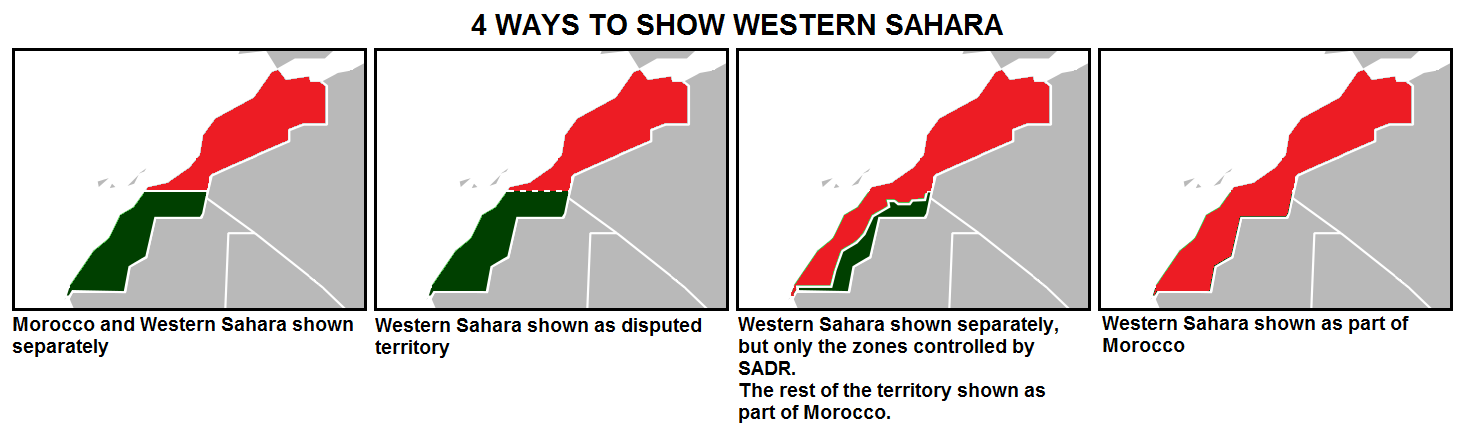
The same territory, drawn according to point of view
CC BY-SA 4.0 — Ma356289 · Wikimedia Commons · This page carries no single map of Western Sahara, because there is no single map that is not a position. This one is a comparison rather than a claim
The documentary evidence behind two narratives, with the accessibility of each original noted. One thing belongs at the top: the framing of this page is itself contested, and from both directions. Sahrawi and Polisario-aligned readers hold that this is not a dispute over territory but an unfinished decolonisation — Western Sahara has been on the United Nations list of Non-Self-Governing Territories since 1963 and has never left it. Morocco holds that there is no open question of title to dispute, that what remains is the terms of autonomy within the Kingdom, and that the name this page uses is itself the other side’s premise — Moroccan officials use the Moroccan Sahara and generally avoid Western Sahara altogether, where using it in Moroccan media is a marker of dissent. Both objections are recorded here rather than answered. Every card in the two narratives carries the other side’s rebuttal; third-party and Sahrawi-voice cards state their own limits instead. This document endorses neither claim.
VOTE Which story do you find more convincing? Naming rule This edition uses Western Sahara, the term used by the United Nations, the International Court of Justice and the European Union. Morocco’s administrative term is الأقاليم الجنوبية, the Southern Provinces, and its political term الصحراء المغربية, the Moroccan Sahara; both appear here only in quotation and attributed. The word occupation is never used in this page's own voice — it is quoted from General Assembly Resolution 34/37 and from Polisario, and attributed. Polisario is described as a party to the dispute, not as the representative of the Sahrawi people, because that characterisation is contested. Polisario is a Spanish acronym — Frente Popular de Liberación de Saguía el Hamra y Río de Oro — built from the names of the two Spanish colonial provinces, which is itself part of its argument: that this is the people of a defined colonial territory. The Sahrawi dialect, Ḥassāniyya, is the other half of that argument, and Morocco's own autonomy plan pledges to promote "the Saharan Hassani cultural heritage" — conceding cultural distinctiveness while denying that it implies separate statehoodThe Secretary-General's strategic review of MINURSO's future mandate, requested by Resolution 2797, was due. This page could not establish whether it has been delivered or what it says.
Follow-up talks in Washington on 23–24 February. Reporting describes the outcome as unclear, with no official or substantive results announced.
The United States convenes ministerial delegations from Algeria, Morocco, Mauritania and Polisario in Madrid — the first in-person meeting of all stakeholders since 2019, co-chaired by the Personal Envoy. Morocco presents a revised and more detailed autonomy proposal.
Polisario's representative replies to Resolution 2797 in a letter to the Council President: "It is referred to as 'basis' — not the basis," and "Resolution 2797 (2025) does not recognise any Moroccan 'sovereignty' over Occupied Western Sahara."
The fiftieth anniversary of the Green March, six days after Resolution 2797.
Resolution 2797 adopted, 11–0 with three abstentions. King Mohammed VI, the same day: "There is a before October 31, 2025 era, and an after." Quotation reported by Moroccan state-aligned media.
The European Court of Justice holds that the EU–Morocco trade and fisheries agreements could not be applied to the territory without the consent of the people of Western Sahara, and that consultation of local populations is not that consent.
Israel recognises Moroccan sovereignty over the territory.
United States Proclamation 10126 recognises Moroccan sovereignty over the entire territory; announced 10 December, published 15 December. It came alongside Morocco's normalisation of relations with Israel.
Morocco rejoins the African Union after thirty-three years, without the SADR being expelled. Both are now members.
The Gdeim Izik protest camp is dismantled; some 3,000 arrests follow and twenty-five Sahrawis are tried, initially before a military court. Casualty figures are disputed across sources.
⇄ The order of the two narrative sections below is randomized on every visit.
A pre-colonial state built on allegiance rather than on borders, whose ties to the territory's tribes the International Court of Justice recorded; a decolonisation completed by 350,000 unarmed civilians rather than by war; an autonomy plan on the table since 2007 that offers a referendum on its own terms; and, in October 2025, a Security Council resolution that named that plan as the basis for negotiation and did not mention a referendum once.
Morocco went to the Court voluntarily: it was Morocco that pressed the General Assembly to refer the questions, after Spain refused its September 1974 invitation to submit the dispute contentiously. Its case rested on the structure of the pre-colonial Moroccan state — a polity founded, as the Court recorded, "on the common religious bond of Islam and on the allegiance of various tribes to the Sultan, through their caids or sheiks, rather than on the notion of territory" — and on the argument that judging it by European territorial criteria imports the wrong test.
After the Advisory Opinion was published on 16 October 1975, Hassan II announced on state television a mass civilian march into Spanish Sahara. It ran from 6 to 10 November with approximately 350,000 unarmed civilian volunteers, about 50,000 of them women, escorted by some 30,000 military and gendarmerie personnel. Marchers carried Qur'ans and Moroccan flags. Hassan II ordered a withdrawal on 18 November, four days after the Madrid Accords were signed. The fiftieth anniversary fell on 6 November 2025, six days after Resolution 2797 — a conjunction Morocco has made central to its messaging since.
The plan offers a Sahara autonomous Region with its own parliament — part elected by the Sahrawi tribes, part by direct universal suffrage, with adequate representation of women — an executive head of government elected by that parliament and invested by the King, and regional courts ruling "in the name of the King." Devolved competences: local administration, local police, economy, budget and taxation, infrastructure, health, education, and culture "including promotion of the Saharan Hassani cultural heritage." Foreign affairs, defence and the King's religious prerogatives remain with the state. Three commitments answer the camps directly: a blanket amnesty (¶31), repatriation of camp residents (¶30), and a Transitional Council to run demobilisation of armed elements (¶32). Paragraph 29 undertakes that the Moroccan Constitution shall be amended and the autonomy Statute incorporated into it.
Signed 4 December 2020, announced on 10 December and published in the Federal Register on 15 December. The proclamation also committed the United States to open a consulate at Dakhla. It came as part of the Abraham Accords package alongside Morocco's normalisation of relations with Israel; Israel issued its own recognition on 17 July 2023.
Adopted 11–0 with three abstentions — Russia, China and Pakistan — at the 10030th meeting; Algeria did not participate. Six operative paragraphs. The preamble affirms that "genuine autonomy under Moroccan sovereignty could constitute a most feasible solution"; operative paragraph 5 requests a strategic review of MINURSO's future mandate within six months. The word referendum does not appear anywhere in the resolution.
Morocco's non-legal argument. West of the berm it has built ports at Laayoune and Dakhla, roads, desalination plants and the Dakhla Atlantic port project; the Bou Craa mine produces roughly three million tonnes of phosphate rock a year, about a tenth of Morocco's output, moved by a conveyor belt of about 100 km described as the world's longest. It points to Sahrawi elected officials in Moroccan institutions and to the Royal Advisory Council for Saharan Affairs as evidence of Sahrawi participation.
A Non-Self-Governing Territory listed since 1963 and never delisted; a court that found no tie of territorial sovereignty; a UN Legal Counsel who found that the 1975 handover transferred nothing; a referendum both parties accepted in 1988 and that has never been held; and a General Assembly that called the situation an occupation and has never rescinded it.
Polisario reproduces this passage almost word for word in its own filings to the Security Council. The supporting reasoning from the body of the opinion is equally quotable: "neither the internal nor the international acts relied upon by Morocco indicate the existence at the relevant period of either the existence or the international recognition of legal ties of territorial sovereignty between Western Sahara and the Moroccan State."
Requested by the Security Council to assess the legality of oil-exploration contracts Morocco had signed with foreign companies, Legal Counsel Hans Corell first had to determine the territory's status. He concluded that the 1975 agreement transferred no sovereignty, conferred administering-power status on nobody, and that the status was in any case not Spain's to transfer unilaterally. On the contracts themselves he concluded they were "not in themselves illegal," but that further activities conducted in disregard of the interests and wishes of the people of Western Sahara would violate international law. His third conclusion is the operative one: the 1975 transfer of administrative authority "did not affect the international status of Western Sahara as a Non-Self-Governing Territory."
The Settlement Plan was accepted by both Morocco and Polisario on 30 August 1988 and endorsed by the Council in Resolutions 658 (1990) and 690 (1991). It provided for a transitional period preparing a referendum in which the people of Western Sahara would choose "between independence and integration with Morocco." The Identification Commission began work in July 1991, started identifying voters in August 1994, was suspended in May 1996, and in 2004 formally completed its work, transferring all documentation to Geneva.
Submitted one day before Morocco's plan and circulated by South Africa as a Council document. Polisario accepted the Baker Plan format explicitly — a choice between "independence, integration into the Kingdom of Morocco and self-governance" — so that Morocco's autonomy appears on the ballot as one of three options. The guarantees offered include mutual recognition of both states' sovereignty and territorial integrity on inherited borders, and rights for the Moroccan population resident in the territory.
The Assembly deeply deplored "the aggravation of the situation resulting from the continued occupation of Western Sahara by Morocco and the extension of that occupation to the territory recently evacuated by Mauritania" and urged Morocco "to join in the peace process and to terminate the occupation of the Territory of Western Sahara." It reaffirmed the inalienable right of the people of Western Sahara to self-determination and independence, and welcomed the Algiers Agreement by which Mauritania withdrew from the conflict and renounced its claim. Adopted 85 to 6 with 41 abstentions.
UNHCR works from a figure of 173,600 Sahrawi refugees in the five Tindouf camps and at Rabuni, hosted by Algeria since 1976; UN and World Food Programme data indicate that roughly 80 to 88 per cent are food insecure or at risk. The camps run their own administration, schools and hospitals, and independent human-rights missions have described them as highly organised with democratic governance structures. The SADR's 1999 constitution commits to eventual multi-party democracy, a market economy and human rights.
Both parties speak for Sahrawis. Neither population has an agreed count, and neither is independently monitored — the mission on the ground has no human-rights mandate, no registration of the refugee population has ever been agreed, and foreign observers have repeatedly been removed from the territory.
MINURSO is the only modern United Nations peacekeeping mission without a human-rights monitoring mandate — a point Amnesty International and Human Rights Watch have raised annually at mandate renewal for over a decade. West of the berm, the Gdeim Izik protest camp of October and November 2010, which reached about 5,000 people with demands centred on discrimination, poverty and human-rights abuses, was dismantled on 8 November with some 3,000 arrests; twenty-five Sahrawis were tried before a military court in 2013 and sentenced to terms of twenty-five to thirty years and life, with allegations of torture by Moroccan security services. The casualties are claimed in irreconcilable numbers: Morocco says its forces used no firearms, that protesters used stones, knives and propane tanks, and counts eleven police killed and 159 wounded plus two protester deaths; Polisario claims thirty-six Sahrawis killed and 723 wounded. Foreign observers have repeatedly been removed: a Swedish photographer expelled in 2010, three Spanish regional parliamentarians detained and expelled without explanation the same year, seventy foreign aid workers expelled without trial in March 2010, and the Moroccan journalist Ali Lmrabet fined and banned from journalism for ten years in 2004 over the terms he used for Sahrawis. Amnesty International documented in March 2022 that a Sahrawi woman activist had been targeted with Pegasus spyware. East of the berm and in Algeria, the refugee population has never been registered — a demand Morocco has pressed for twenty years and which Resolution 2797's preamble now carries.
Two documents each side quotes as vindication, and one pair of documents filed against each other. Pick a reading and watch the highlighter move; the initial selection is random. In the first two, neither side misquotes anything — they quote different sentences of the same paragraph, or different clauses of the same sentence.
Calls upon the parties to engage in these discussions without preconditions, taking as basis Morocco's Autonomy Proposal, with a view to achieving a final and mutually acceptable political solution that provides for the self-determination of the people of Western Sahara, recognizes that genuine autonomy could represent a most feasible outcome… — operative paragraph 3, 31 October 2025
The Council named our plan. For the first time in fifty years the autonomy proposal is what the parties proceed from, and without preconditions means Polisario may not make independence a condition of talking. The preamble seals it: the Council affirms that genuine autonomy under Moroccan sovereignty could constitute a most feasible solution. And the word referendum appears nowhere in the resolution — the two-options era is over.
Read the article, or its absence. The text says as basis — not the basis. The resolution does not recognise any Moroccan sovereignty: that phrase is in the preamble, and preambles are not operative. The operative paragraph says a most feasible outcome, not the. And the aim it names survives intact — a solution that provides for the self-determination of the people of Western Sahara.
Three textual facts here are checkable and neither side disputes them. "Under Moroccan sovereignty" is in the preamble and not in the operative paragraph — Polisario is textually correct that the Council's decision does not name Moroccan sovereignty. "A most feasible outcome," not "the" — the negotiating record shows the 22 October draft said "the most feasible solution" and that it was softened. And "referendum" appears zero times while "self-determination" appears once, in operative paragraph 3 — Morocco is correct that the referendum framing is gone, and Polisario is correct that self-determination survived. The resolution was adopted 11–0 with Russia, China and Pakistan abstaining; Algeria did not participate. Sources for this item: the resolution text and the Security Council Report negotiating history are linked on the Resolution 2797 card; Polisario's reply is on its own news agency, SPS, and is labelled as such.
The materials and information presented to the Court show the existence, at the time of Spanish colonization, of legal ties of allegiance between the Sultan of Morocco and some of the tribes living in the territory of Western Sahara. They equally show the existence of rights, including some rights relating to the land, which constituted legal ties between the Mauritanian entity, as understood by the Court, and the territory of Western Sahara. On the other hand, the Court’s conclusion is that the materials and information presented to it do not establish any tie of territorial sovereignty between the territory of Western Sahara and the Kingdom of Morocco or the Mauritanian entity. Thus the Court has not found legal ties of such a nature as might affect the application of General Assembly resolution 1514 (XV) in the decolonization of Western Sahara and, in particular, of the principle of self-determination through the free and genuine expression of the will of the peoples of the Territory.
Sentence one is a finding. The Court was asked whether ties existed and it found them — legal ties of allegiance, recorded by the Court itself, in a paragraph Polisario also quotes. A pre-colonial state organised around allegiance to a sovereign rather than around borders cannot be measured by a test built for European territorial states; the Court recorded that structure and then applied the test anyway.
Sentence three is the holding. The Court found no tie of territorial sovereignty, and said in terms that it had found no ties of a nature that might affect the application of Resolution 1514 or the principle of self-determination. Note the word some: the ties were to some of the tribes, not to the territory. That is why the Court's answer sends the question back to the population.
Morocco quotes the first sentence, Polisario quotes the third, and nobody misquotes anything — which is why the whole paragraph is reproduced once, uncut, in the third-party section below. Three things worth carrying alongside it. The opinion is advisory and binds nobody. The votes were not close: terra nullius was decided unanimously, ties with Morocco by fourteen to two. And the same opinion contains a sentence Morocco quotes and Polisario does not — that the right of self-determination "leaves the General Assembly a measure of discretion with respect to the forms and procedures by which it is to be realized" — which is where the argument that autonomy can be a form of self-determination begins.
S/2007/206, ¶27: The Region’s autonomy Statute shall be the subject of negotiations and shall be submitted to the populations concerned for a free referendum. This referendum will constitute a free exercise, by these populations, of their right to self-determination… · S/2007/210, ¶7: the choice between independence, integration into the Kingdom of Morocco and self-governance.
We offered a referendum and they refused it. The autonomy statute would be put to the population in a free vote, which the plan itself describes as an exercise of the right to self-determination. What Polisario demands is not a vote but a particular result — and it is asking for a ballot whose electorate has never been agreed and could not be constituted when the United Nations tried for thirteen years.
We put your plan on our ballot. Polisario's proposal offers three options including integration into Morocco, and commits in advance to accepting whatever the vote produces, with guarantees to Moroccan residents and to Morocco itself in the event of independence. A referendum whose only question is how autonomy is administered is not a choice about status — Resolution 1541 (XV) lists three legitimate outcomes for a Non-Self-Governing Territory, and autonomy under the claiming state's sovereignty is not among them.
Both documents are Security Council documents, filed one day apart — Polisario's on 10 April 2007, Morocco's on 11 April — and both use the words self-determination. What separates them is what appears on the ballot. The electorate problem underneath is real and unresolved in both directions: the 1974 Spanish census, the intended baseline, counted roughly 74,000 Sahrawis, while several hundred thousand people now live west of the berm. One body has ruled on who the people are: the European Court of Justice held in October 2024 that the "people of Western Sahara" includes displaced Sahrawis abroad. That answer binds the European Union and nobody else, but it is the only judicial answer there is.
This dispute has more third-party legal material than any other on this site, and it does not point one way. A world court found no tie of territorial sovereignty; a European court found consent absent; the Security Council in 2025 called on the parties to negotiate "taking as basis" Morocco's plan; and the African Union seats both parties as members.
The paragraph both parties quote, reproduced here once and in full so that a reader can see what each side is selecting. The Court also answered the first question put to it: the territory was not terra nullius at the time of Spanish colonisation — that finding was unanimous. On the second question it found ties with Morocco by fourteen votes to two, and ties with the Mauritanian entity by fifteen to one. One further sentence from the same opinion is quoted by Morocco and not by Polisario: the right of self-determination "leaves the General Assembly a measure of discretion with respect to the forms and procedures by which it is to be realized." Morocco leans on that sentence; Polisario leans on the one before it.
Resolution 1514 (XV), the Declaration on the Granting of Independence to Colonial Countries and Peoples, is the instrument against which the Court tested Morocco's claim — which is why no tie of territorial sovereignty mattered: only a pre-existing sovereignty tie could have displaced its application. Resolution 1541 (XV), adopted the next day, sets out three legitimate outcomes of self-determination for such a territory: emergence as a sovereign independent State, free association with an independent State, or integration with an independent State — each requiring a free and informed choice. Western Sahara has been on the Article 73 list since 1963 and is the only such territory in Africa.
Six principles signed in Madrid by Spain, Morocco and Mauritania, in force on 19 November 1975 and registered in the UN Treaty Series as No. 14450. Spain undertook to end its role as administering power; a temporary administration was instituted in which Morocco and Mauritania participated, in collaboration with the Yema'a, the Spanish-created Sahrawi tribal assembly, with Spanish presence to end by 28 February 1976 at the latest. Principle 3: "The views of the Saharan population, expressed through the Yema'a, will be respected." The word sovereignty does not appear in the instrument. It transfers administration, temporarily, and conditions everything on the Yema'a. The UN Legal Counsel found in 2002 that the agreement transferred no sovereignty, conferred administering-power status on nobody, and did not affect the territory's status as a Non-Self-Governing Territory.
The SADR was admitted to the Organisation of African Unity in 1982 and seated in 1984; Morocco withdrew on 12 November 1984, the only state ever to leave the organisation. It returned on 30 January 2017 after a thirty-three-year absence, without the SADR being expelled. Both are now full members of the same fifty-five-member body.
Grand Chamber judgments of 4 October 2024 in the joined fisheries cases C-778/21 P and C-798/21 P and the trade cases C-779/21 P and C-799/21 P, with a companion ruling in Confédération paysanne on labelling. The Court held that Western Sahara has a separate and distinct status under Article 73 of the Charter; that the "people of Western Sahara" as rights-holder includes displaced Sahrawis abroad; that a consultation of populations in the territory is not the consent of its people; and that in the agreements before it the benefit ran to Morocco rather than to the people of Western Sahara.
Established by Resolution 690 of 29 April 1991 to implement the Settlement Plan both parties had accepted in 1988. Its current mandate is to monitor and verify the ceasefire, observe military developments, report on general developments, support confidence-building measures and run a mine-action programme. Its headquarters is at Laayoune, inside the area Morocco controls. Polisario declared the ceasefire over on 13 November 2020 and low-intensity exchanges have continued since; Resolution 2797's preamble nonetheless still speaks of respecting the ceasefire. Operative paragraph 5 requests a strategic review of the mission's future mandate within six months.
Votes per hour. A surge is not hidden here — it is drawn.
One line, from people who voted. No replies. Your side and country are shown with it.
Vote first — this is where a vote gets its reason.
No lines yet.
Method and limits. Compiled 2026-08-24. Seven cautions. First, the framing of this page is contested from both directions and both objections are recorded at the top rather than answered: one side holds that this is an unfinished decolonisation rather than a dispute, and the other holds that there is no open question of title and that the name this page uses is the other side’s premise. Second, the word occupation is never used in this page's own voice; it appears only quoted from General Assembly Resolution 34/37 and from Polisario, and attributed. Nor is Polisario described as the representative of the Sahrawi people, a characterisation Morocco contests — it is described as a party. Third, recognition of sovereignty and endorsement of the autonomy plan are different things and are separated here. Fourth, preambular and operative text are distinguished throughout, and so are the verbs of decision: only paragraph 1 of Resolution 2797 decides anything. Fifth, contested numbers are shown as contested rather than withheld — the territorial split, the recognition count, and both irreconcilable casualty tallies for Gdeim Izik are given with their sources, because a blank is not a neutral position between two numbers; it deletes whichever side's strongest figure was in the disputed pair. Sixth, source alignment is labelled: Moroccan state-aligned outlets, Polisario's own news agency and Sahrawi-solidarity organisations are named as such wherever their material is used. Seventh, no single map of this territory appears here, because there is no single map that is not a position — what is carried instead is a comparison, the same territory drawn according to point of view, and a second image of the berm and the areas on either side of it; both are Wikimedia Commons files under CC BY-SA 4.0 and are credited to their authors in the captions. The three panels showing what each party claims are drawn from the lines those parties publish, and they sit in this dispute's block on the front page. Badges follow the two grades defined in the editorial principles: original published = images or full text publicly available; copies published = the original is lost or unavailable and the text survives in transmission. Where a document was simply not retrieved for this page, that is said in the card's footnotes rather than expressed as a badge. Third-party and Sahrawi-voice cards state their limits in place of a rebuttal, since they are not one party's evidence.
Editorial principles. ① This edition uses the United Nations' name for the territory and quotes each party's own terms attributed. ② The order of the two narrative sections is randomized on every visit. ③ Every dispute is labelled with its de facto controller, and every card in the two narratives carries the other side's rebuttal.
The same territory, drawn according to point of view
CC BY-SA 4.0 — Ma356289 · Wikimedia Commons · This page carries no single map of Western Sahara, because there is no single map that is not a position. This one is a comparison rather than a claim
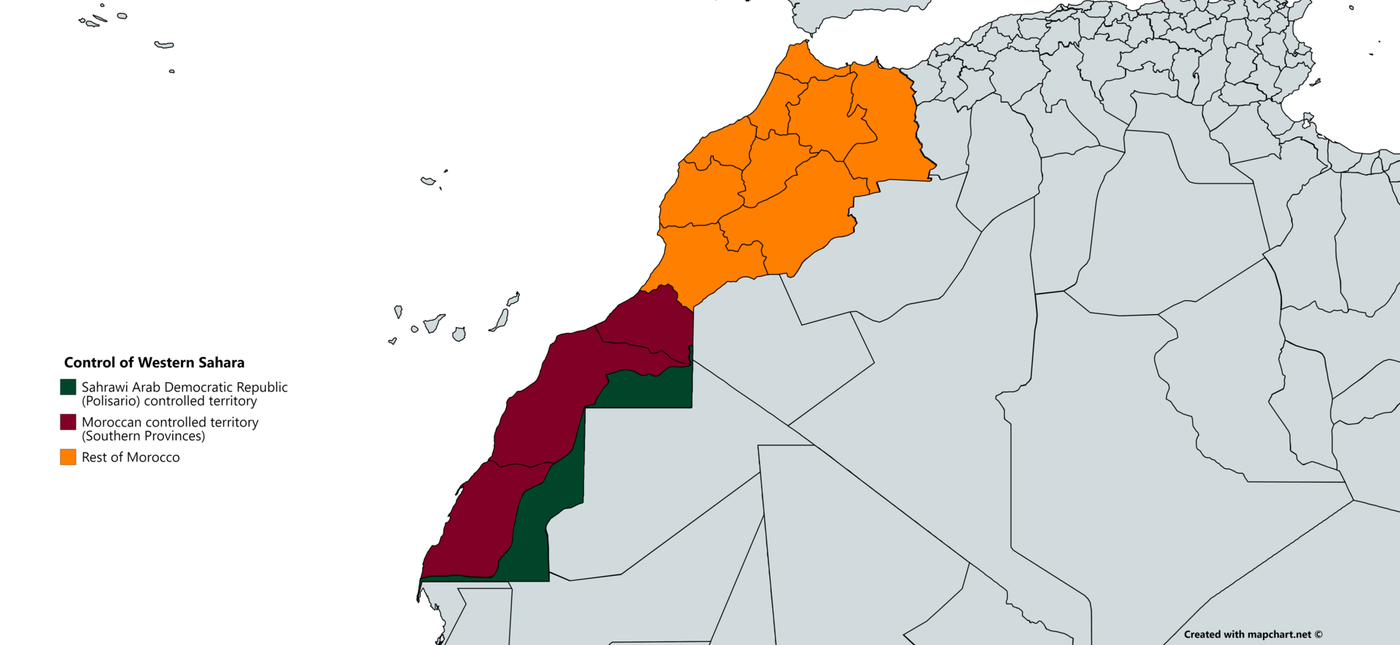
The berm, and the areas on either side of it
CC BY-SA 4.0 — Adam Hegazy337259 · Wikimedia Commons · About 2,700 km, built in six phases between 1980 and 1987. Morocco calls it the security belt; Polisario calls it the wall of shame; the UN names the area beyond it only east of the berm