The documentary evidence behind two narratives, with the accessibility of each original noted. This page distinguishes three things and labels every card with which one it is: what a government asserts, what is documented, and what an international body has determined. That distinction is what makes this subject tractable. Two further statements — who controls the peninsula, and its status under near-universal state practice — are made in this page's own voice rather than attributed; the method note below sets out the test that permits it. Every card in the two narratives carries the other side's rebuttal; the Crimean Tatar section sits between the two narratives because it belongs to neither, and states its own limits instead.
VOTEWhich story do you find more convincing?↓Naming rule There is no neutral English name. This edition uses annexation in its own voice, because that is the term used by the UN General Assembly, the European Union, the European Court of Human Rights and most scholarship, and it describes a legal event rather than passing judgement; Russia's term "reunification" appears in quotation marks and attributed. Crimea and Sevastopol are treated as two names on one page: they voted separately in 2014, were annexed by separate instruments, and are listed separately in every UN and EU document
Russia leads onUkraine leads onread in opposite ways
Current status — as of August 2026 Status as of 2026-08
De facto control 🇷🇺 Russia, continuously since late February 2014. The European Court of Human Rights fixed the start date judicially at 27 February 2014 — the day Russian forces seized the Crimean parliament, and seventeen days before the referendum. Ukraine has not exercised administrative control over any part of the peninsula since2026-08
De jure status Crimea and Sevastopol remain sovereign Ukrainian territory under belligerent occupation, in the view of the UN General Assembly, the European Union, the European Court of Human Rights and near-universal state practice — see the method note for the test this page applies before making such a statement in its own voice2026-08
Russia's arrangement two federal subjects — the Republic of Crimea, capital Simferopol, and the federal city of Sevastopol — within the Southern Federal District. Russian law, currency, courts, conscription and passports have applied since March–April 20142026-08
Ukraine's designation the Autonomous Republic of Crimea and, separately, the city of Sevastopol, which was never part of the Autonomous Republic and is subordinated directly to Kyiv under Article 133 of the Constitution. Ukrainian law calls the peninsula temporarily occupied territory2026-08
Conscription Russia has conscripted at least 30,000 Crimean men through eighteen drafts since 2015, according to the UN human rights office in February 2024. Conscription of protected persons in occupied territory is prohibited by Article 51 of the Fourth Geneva Convention and is a grave breach under Article 1472024-02
Recognition fewer than a dozen states recognise Russian sovereignty, and the exact list is contested — several entries are inferred from voting records rather than from a formal act. The United States has not formally recognised Russian sovereignty over Crimea. Proposals in April and November 2025 would have done so, the first de jure and applying only to the United States, the second de facto; neither was implementedunverified2026-08
The Black Sea Fleet relocated from Sevastopol to Novorossiysk in autumn 2023. As of April 2026 Novorossiysk is its only fully functional Black Sea base, the fleet operates in roughly a quarter of the sea, and seven of twelve landing ships have been destroyed, disabled or put into extended repair. Sevastopol handles little beyond smaller patrol craft2026-04
The Kerch Bridge standing and operational, but heavy lorries are banned outright and fuel is considered too dangerous to move across. Throughput is severely reduced, and its importance has risen because Ukrainian deep strikes have degraded the land-corridor routes2026-05
Power and fuel a regional state of emergency has been in force since 26 June 2026. Sevastopol went fully dark on 27 July; rolling blackouts left roughly six hours of electricity a day that month, and full outages hit Simferopol, Sevastopol, Kerch, Feodosia and Yalta on the nights of 13 and 20–21 August. The Ukrainian commander directing the campaign has said its objective is to make Crimea "an island"2026-08-21
Water Ukraine closed the North Crimean Canal in 2014, cutting about 85% of the peninsula's fresh water for eight years; by 2021 irrigated land had fallen from about 130,000 hectares to 14,000 and mains supply in parts of Crimea was down to three to five hours a day. Russian forces blew the dam on 26 February 2022 and the canal was reopened2026-08
Negotiations no settlement. Trilateral talks in Abu Dhabi in January and February 2026 and in Geneva in February produced prisoner exchanges but no territorial agreement. Russia's standing demand includes international recognition of the annexed territories. Two brief truces, at Orthodox Easter in April and around Victory Day in May 2026, both collapsed2026-08
Crimean Tatars 12.1% of the Autonomous Republic at the 2001 Ukrainian census, or 10.8% of the peninsula including Sevastopol, having been 35.6% in 1897 and 1.6% in 1989. The Mejlis, their elected executive body, was designated extremist by Russian courts in 2016 and remains banned; its leadership is in exile or has been sentenced in absentia2026-08
Monitoring Crimean Solidarity, the main source of figures on political detentions, ceased activity in July 2026. Counts from that source stop there2026-07
⚠ Four cautions. The referendum figures are the organisers': 83.1% turnout and about 97% for accession in the Autonomous Republic. A lower estimate — 30–50% turnout, 50–60% in favour — appeared briefly on the website of Russia's own Presidential Human Rights Council in May 2014 and was removed. Neither is an official finding and this page presents neither unqualified. The 1944 deportation mortality figures measure different things and both are given with their provenance: NKVD registration records give about 14.8% dead in the first year of exile, scholarly totals 18–24%, and a community survey conducted in the 1960s about 46%. The recognition list is contested and no roster is published here. And two items could not be established for this page: the definitive list of states recognising Russian sovereignty, including whether one government's position changed after December 2024, and the vote counts on the most recent General Assembly resolutions concerning Crimea.2026-08
Change log
Full power outages across Simferopol, Sevastopol, Kerch, Feodosia and Yalta on the nights of 13 and 20–21 August.
Crimean Solidarity ceases activity. Sevastopol goes fully dark on 27 July; rolling blackouts leave about six hours of electricity a day.
A regional state of emergency comes into force across the peninsula.
Trilateral talks in Abu Dhabi and Geneva produce prisoner exchanges but no territorial agreement. Russia's standing demand includes international recognition of the annexed territories.
A 28-point US proposal would have recognised Crimea as de facto Russian by the United States and others — a downgrade from the de jure formulation floated in April 2025. Russia rejected the plan as insufficient. Neither proposal was implemented.
The European Court of Human Rights Grand Chamber gives judgment in Ukraine v. Russia (re Crimea), fixing the start of Russian effective control at 27 February 2014 and holding that Russian law did not qualify as law for Convention purposes.
The International Court of Justice gives judgment on the merits: Russia in breach over Ukrainian-language education, and in breach of the Court's 2017 order by maintaining the Mejlis ban — but the ban itself was not found to violate the racial-discrimination convention, and a deterioration in Crimean Tatar-language education was not demonstrated.
The Mejlis of the Crimean Tatar People is designated extremist; Russia's Supreme Court upholds the designation in September.
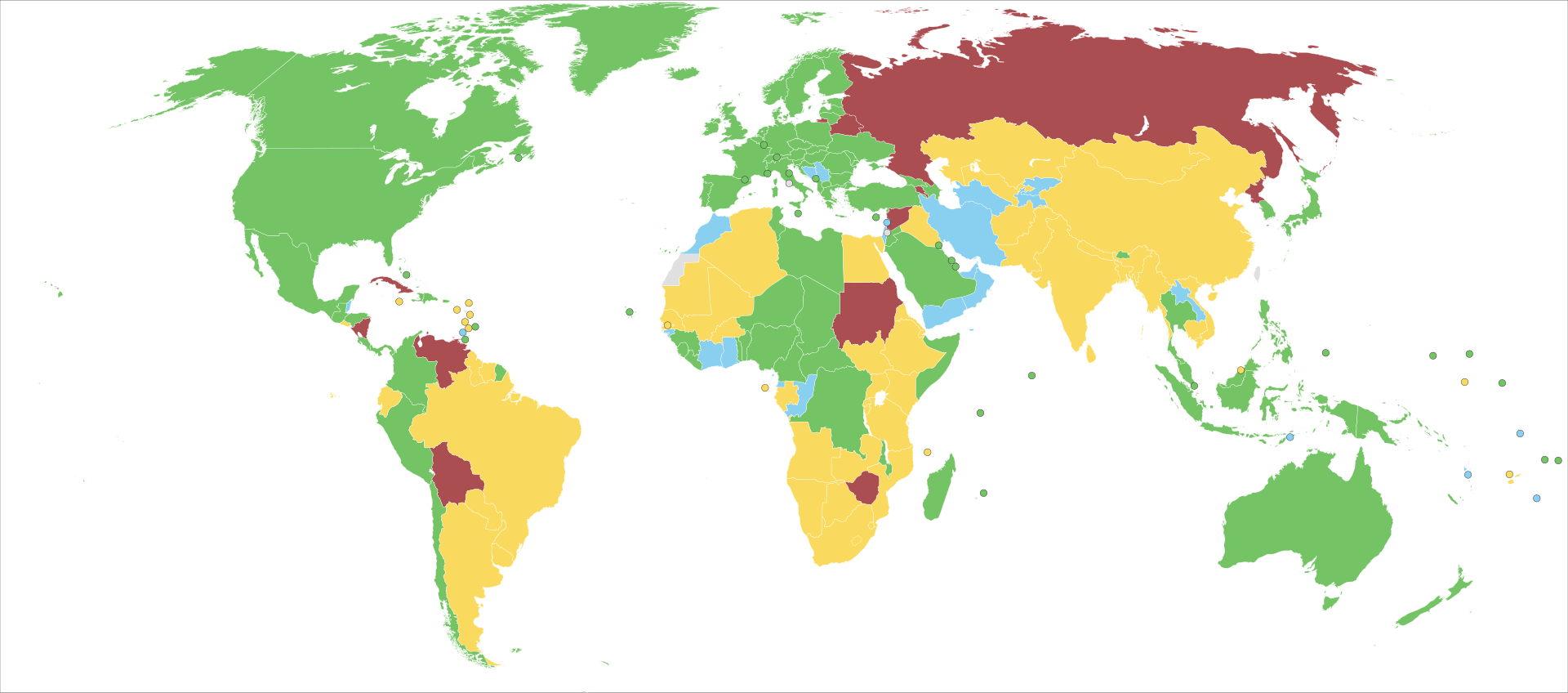
General Assembly Resolution 68/262 adopted, 100–11–58 with 24 not voting: the referendum has no validity and cannot form the basis for any alteration of status.
⇄ The order of the two narrative sections below is randomized on every visit.
Russia's narrative 6 sources
A transfer made in 1954 without the constitutional authority to make it; a population that never consented to being on the other side of a line drawn in a totalitarian state; a precedent the West created at Kosovo and then refused to honour; and a vote in March 2014 that Moscow presents as the correction. The last card in this section is Russia's own record of how the decision was taken.
Putin's address to the Federal Assembly 18 March 2014
Delivered in the Grand Kremlin Palace hours before the Treaty of Accession was signed. It is the foundational text of the Russian case and contains, compressed, every argument Moscow has made since: Orthodox continuity at Chersonesus, Sevastopol as a site of military sacrifice, the 1954 transfer as an illegitimate whim, the 1991 breakup as a national dismemberment — "Millions of people went to bed in one country and awoke in different ones" — the Kosovo precedent, and NATO encirclement.
A referendum was held in Crimea on March 16 in full compliance with democratic procedures and international norms. More than 82 percent of the electorate took part in the vote. Over 96 percent of them spoke out in favour of reuniting with Russia. — and: "In people's hearts and minds, Crimea has always been an inseparable part of Russia."
Meaning
Russia's position that what happened in March 2014 was the correction of a historical error by the people it was done to, rather than an acquisition of territory.
Ukraine rebuts
Ukraine's answer goes to the history first: Chersonesus predates the Russian state by a millennium, and the seat of Volodymyr's realm was Kyiv, not Moscow — so the baptismal claim, on Ukraine's reading, is an argument for Ukrainian rather than Russian continuity. On the figures, the turnout and result quoted here are the organisers' own and are contradicted by an estimate that appeared briefly on Russia's own Presidential Human Rights Council website: 30–50% turnout, 50–60% in favour. And the European Court of Human Rights later found that effective Russian control began on 27 February 2014, seventeen days before the vote.
The Kosovo precedent, invoked in the same speech 18 March 2014
Putin went on to quote the International Court of Justice's advisory opinion of 22 July 2010 — "General international law contains no prohibition on declarations of independence" — and the written statement the United States filed in those proceedings: "Declarations of independence may, and often do, violate domestic legislation. However, this does not make them violations of international law." The quotations are accurate.
the Crimean authorities referred to the well-known Kosovo precedent – a precedent our western colleagues created with their own hands in a very similar situation, when they agreed that the unilateral separation of Kosovo from Serbia, exactly what Crimea is doing now, was legitimate and did not require any permission from the country's central authorities.
Meaning
Russia's most sophisticated legal move, and the one Western officials handle worst. Its force does not depend on the merits of the Crimean vote: it is an argument about consistency.
Ukraine rebuts
Ukraine and Western states distinguish Kosovo on process and on facts — nine years of UN administration under Resolution 1244, a UN-mandated status process, documented atrocities preceding intervention, and no foreign troops in the assembly. The deeper answer is that the rule Crimea engages is neither self-determination nor territorial integrity but the prohibition on acquiring territory by force: Kosovo was not annexed by Albania, while Crimea was annexed by Russia two days after declaring independence. Ukraine notes that Russia argued the anti-secession position in the Kosovo proceedings and still does not recognise Kosovo.
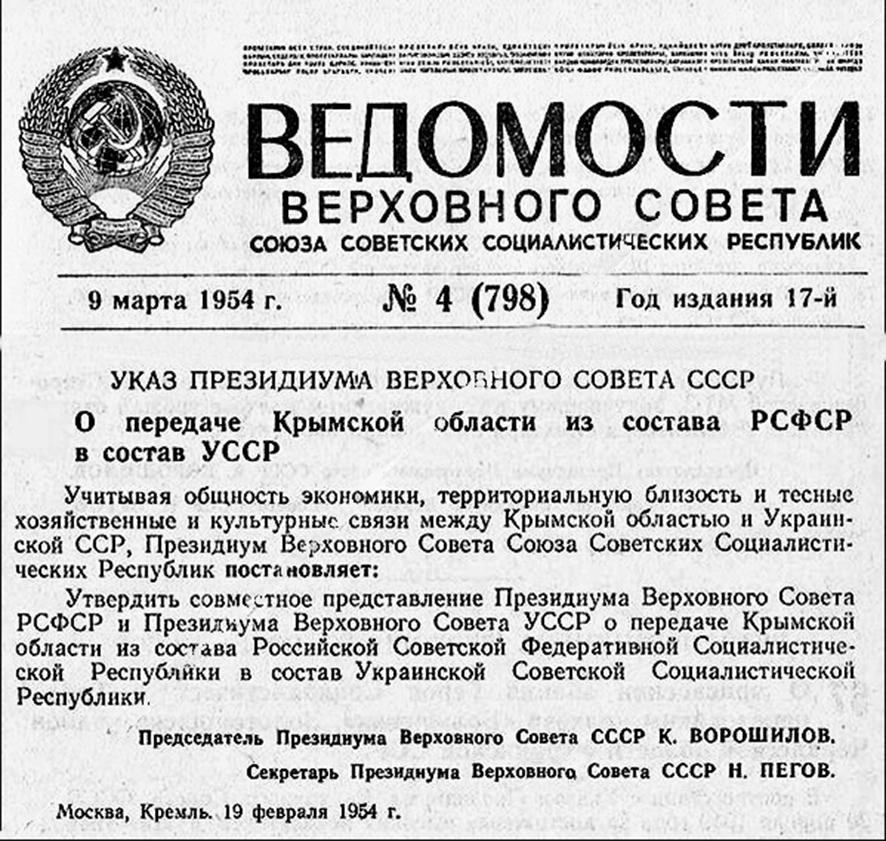
The 1954 transfer as a procedural nullity 1954 · 1992 · 2014
The oldest strand of the Russian claim, and it predates Putin by two decades: on 21 May 1992 the Russian Supreme Soviet adopted Resolution No. 2809-1 declaring the transfer to have "no legal force" from the moment of adoption. The procedural objections are that the transfer was effected by Presidiums rather than by the full Supreme Soviets; that Article 33 of the 1936 USSR Constitution did not vest the Presidium with power to alter republican boundaries; that Article 18 required the consent of the republic concerned; and that no referendum was held. Russia also advances a separate claim to Sevastopol: its parliament resolved on 9 July 1993 that the city had Russian federal status, on the argument that the 1954 transfer did not carry it, since Sevastopol had been administratively distinct since 1948. The Security Council declared that resolution to be without effect. Ukraine's position is that the 1978 Ukrainian SSR constitution listed Sevastopol among its cities of republican subordination and that the question was closed in 1991.
in 1954, a decision was made to transfer Crimean Region to Ukraine, along with Sevastopol, despite the fact that it was a federal city. This was the personal initiative of the Communist Party head Nikita Khrushchev… this decision was made in clear violation of the constitutional norms that were in place even then. The decision was made behind the scenes.
Meaning
If 1954 was void, Crimea was never lawfully Ukrainian and 2014 restored rather than took.
Ukraine rebuts
Ukraine's answer has two limbs. On the facts: the transfer was ratified by the full USSR Supreme Soviet on 26 April 1954 and written into both republican constitutions that June. On the law, and this is the decisive move: whatever happened in 1954 was superseded by Russia's own conduct as a sovereign state — it recognised Ukraine's borders in 1991, in the Budapest Memorandum of 1994, in the Friendship Treaty of 1997 and in the 2003 border treaty. The Vienna Convention bars reopening boundary treaties on changed circumstances.
original publishedasserted by a governmentThe unit transferred was Crimean Oblast, which existed only because the Crimean Autonomous SSR had been abolished in 1945 after the deportation of its titular people — the 1954 argument is conducted between two parties, neither of which was the one dispossessedThe transfer of 1954Scan of the decree — Wikimedia Commons
The Declaration of Independence and the Treaty of Accession 11 and 18 March 2014
The sequence: on 11 March the Supreme Council of Crimea and the Sevastopol City Council adopted a Declaration of Independence expressly invoking the UN Charter and the ICJ's Kosovo opinion; 16 March, referendum; 17 March, independence declared; 18 March, treaty signed in the Kremlin; 19 March, Russia's Constitutional Court ruled the treaty constitutional — unanimously, in under twenty-four hours; 21 March, annexation complete.
Based on the free and voluntary people's will expressed in the Crimean status referendum that was held in the Autonomous Republic of Crimea and Sevastopol on the 16th of March, 2014, during which the Crimean people expressed a desire to reunite with Russia as a federal subject of the Russian Federation — Treaty preamble · Article 1: "The Republic of Crimea is considered accepted to the Russian Federation from the date of the signing of this Treaty."
Meaning
Russia's construction of a formal legal chain: an independent state, a sovereign act of accession, a treaty between two subjects of international law.
Ukraine rebuts
Ukraine's answer is that the chain has no first link. A declaration of independence made under the effective control of a foreign army, by a parliament seized on 27 February, is not the act of a state; and the ICJ opinion it invokes decided only that declarations of independence are not as such prohibited — it said nothing about secession rights, recognition duties, or annexation. The General Assembly resolved on 27 March that the referendum, "having no validity, cannot form the basis for any alteration of the status" of either territory.
The "coup d'état" and the protection of Russians 2014 · 2021
Russia's causal account: Yanukovych's removal on 22 February 2014 was an unconstitutional seizure of power; the Rada's vote the next day to repeal the 2012 language law signalled intent against Russian speakers; Crimea acted defensively. Putin extended the argument in his July 2021 essay On the Historical Unity of Russians and Ukrainians, which asserts that "modern Ukraine was wholly and fully created by Bolshevik, communist Russia."
those who stood behind the latest events in Ukraine had a different agenda: they were preparing yet another government takeover… Nationalists, neo-Nazis, Russophobes and anti-Semites executed this coup. — and: "The new so-called authorities began by introducing a draft law to revise the language policy, which was a direct infringement on the rights of ethnic minorities."
Meaning
The argument that does most work for domestic and non-Western audiences, because it reframes annexation as protection.
Ukraine rebuts
Ukraine concedes the narrower point and denies the conclusion: the 22 February vote did not follow the impeachment procedure in Article 111 of the Constitution, and that irregularity is real. But it does not bear on the annexation question — under the same rule Russia invokes for 1954, a defect in one state's internal process does not transfer territory to another state. On the language law, the repeal was vetoed by the acting president and never took effect. And Russia's stated rationale is undercut by its own record: Putin later said the decision was taken on 22–23 February, three weeks before the referendum and before the Crimean parliament had acted.
Putin's own account, on the Russian record 17 April 2014 · March 2015
Throughout late February and March 2014 Russia denied that the unmarked troops were Russian; Putin told a press conference on 4 March that they were local self-defence units and that the uniforms could be bought in any shop. On 17 April he reversed that on state television. In the March 2015 documentary Крым. Путь на Родину he said that at the end of an all-night security meeting on 22–23 February 2014 he told his security chiefs: "we must start working on returning Crimea to Russia" — three weeks before the referendum, and before the Crimean parliament had done anything.
Of course, the Russian servicemen did back the Crimean self-defence forces… It was impossible to hold an open, honest, and dignified referendum and help people express their opinion in any other way. — "Direct Line", 17 April 2014
Meaning
This card is in Russia's section because it is Russia's record: both statements were made by the President, on state media, and remain published. The site's format rests on the claim that letting a case speak in full is more revealing than paraphrasing it. Here that is literally so — the sequence Moscow describes places the decision before the vote it relies on.
Ukraine rebuts
Russia's answer is that the troops were lawfully there. Under the 1997 Black Sea Fleet agreements Russia was permitted a garrison of up to 25,000 in Crimea, and roughly 20,000 were stationed there — so on Moscow's account there was no invasion, only forces already present securing conditions in which a vote could be held. Ukraine's reply is that the same agreements confined those forces to designated bases and barred any interference in Ukraine's internal affairs: a lease is not authority to leave the base and take the host state's parliament, which is why the European Court treated the operation as the establishment of effective control rather than as garrison duty. And the argument does not reach the second admission — that the decision was taken on 22–23 February, before the Crimean parliament had acted.
original publisheddocumentedThe 17 April 2014 statement is a Kremlin transcript; the 22–23 February account is from the March 2015 state documentary Крым. Путь на Родину, not from a transcript. The Direct Line transcript was checked word for word against kremlin.ru for this page; the site is blocked in some jurisdictions and unreachable from some networks"Direct Line", 17 April 2014 — kremlin.ru
Ukraine's narrative 6 sources
A constitution that reserves changes of territory to the whole nation; a majority of Crimeans who voted for an independent Ukraine in 1991 with no army in the streets; and a Russian signature on the border, four times over — in 1991, in 1994, in 1997 when Russia paid rent for the naval base, and again in 2003.
The Constitution of Ukraine 1996 — Articles 2, 73, 134, 157
Article 138.2 limits the Autonomous Republic's referendum competence to local referendums. The Constitutional Court of Ukraine ruled the Crimean parliament's referendum resolution unconstitutional on 14 March 2014, two days before the vote.
Article 2: "The sovereignty of Ukraine extends throughout its entire territory… The territory of Ukraine within its present border is indivisible and inviolable." · Article 73: "Issues of altering the territory of Ukraine are resolved exclusively by an All-Ukrainian referendum." · Article 134: "The Autonomous Republic of Crimea is an inseparable constituent part of Ukraine and decides on the issues ascribed to its competence within the limits of authority determined by the Constitution of Ukraine." · Article 157.1: "The Constitution of Ukraine shall not be amended, if the amendments… are oriented toward the liquidation of the independence or violation of the territorial indivisibility of Ukraine."
Meaning
Ukraine's position that no vote confined to one region could lawfully alter the territory of the state, and that this was not a rule invented for the occasion — it is the ordinary constitutional arrangement of a unitary state.
Russia rebuts
Russia's answer is that a constitution binds a state's own organs and cannot bind a people exercising self-determination — domestic constitutional law does not govern the question. The research behind this page records no further Russian argument on this card, and none is supplied here.
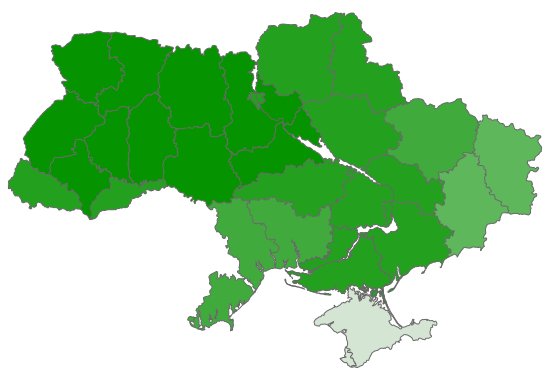
The independence referendum of 1 December 1991 1 December 1991
Nationwide, 90.32% voted to confirm the Act of Declaration of Independence, on 84.18% turnout. The regional figures are what matter here: Crimea voted 54.19% yes on 67.48% turnout — the lowest of any region — and Sevastopol 57.07% yes on 67.51%. At the time, ethnic Russians were roughly 58% of Crimea's population.
Meaning
Ukraine's strongest democratic card, and it is strong precisely because the margin is narrow. A majority of voters in Crimea — and in Sevastopol, the Black Sea Fleet's home port — voted for an independent Ukraine that included them, in a free vote, with no army in the streets. The honest framing is a majority, and a real one, not an overwhelming one.
Russia rebuts
Russia's answer starts with a harder number: eleven months earlier, on 20 January 1991, Crimea voted 94.3% on 81.4% turnout to restore the Crimean Autonomous SSR "as a subject of the Union SSR" — a status outside the Ukrainian SSR. Moscow argues Crimeans in December were voting for a Ukraine still widely expected to remain within a renewed union, not for the separation from Russia that followed, and that a 54% margin shows how contested the arrangement was from the start. Ukraine's reply is that the autonomy was restored within the Ukrainian SSR on 12 February 1991, that the separatist presidency of Yuriy Meshkov in 1994 collapsed within a year, and that the settlement reached in 1998 then held for sixteen years without serious challenge.
The Friendship Treaty, and the rent Russia paid 28 and 31 May 1997
Signed in Kyiv on 31 May 1997 by Kuchma and Yeltsin; ratified by Ukraine in January 1998 and by Russia in February 1999. The linked package of three Black Sea Fleet agreements of 28 May 1997 is the more concrete exhibit, because it is Russia paying rent to Ukraine for Crimean ground: the fleet was split 81.7% to Russia and 18.3% to Ukraine, with Russia paying $526 million in compensation; Russia leased Crimean naval facilities from Ukraine until 2017 at $97 million a year, with caps on its garrison of 25,000 troops. The 2010 Kharkiv Pact extended the lease to 2042.
the High Contracting Parties shall respect each other's territorial integrity and reaffirm the inviolability of the borders existing between them. — Treaty on Friendship, Cooperation and Partnership, Article 2
Meaning
Ukraine's answer to the 1954 argument, and the reason that argument is beside the point: whatever the Presidium did in 1954, Russia as a sovereign state signed the border, ratified it, and then paid to rent land on the other side of it for seventeen years.
Russia rebuts
Russia's account is that the treaty presupposed a Ukraine that would not join NATO or turn its territory into a platform against Russia, and that the change of government in Kyiv in 2014 destroyed the basis on which it was signed. On the treaty's end: it was Ukraine that allowed it to lapse — Poroshenko announced non-renewal in September 2018, the Rada voted 277 to 20, and it expired on 31 March 2019, with Russia's foreign ministry expressing regret. The sequence Ukraine points to is that Russia abrogated the fleet agreements by a Duma vote of 433 to nil on 31 March 2014, thirteen days after the annexation.
The referendum — what was claimed, and what is documented 16 March 2014
The organisers reported 83.1% turnout and about 97% for joining Russia in the Autonomous Republic, and 89.5% turnout with 96.59% in Sevastopol. Against that, an estimate that appeared briefly on the website of Russia's own Presidential Human Rights Council in May 2014, and was then removed, put turnout at 30–50% with 50–60% in favour. Neither figure should be read as an official finding. On the ballot itself the Venice Commission observed that "it is not possible to directly express the wish to maintain the current Constitution" — the two options were alternatives, and a voter content with the existing arrangement had nowhere to put that.
1) Do you support the reunification of the Crimea with Russia as a subject of the Russian Federation? 2) Do you support the restoration of the Constitution of the Republic of Crimea as of 1992 and the status of the Crimea as a part of Ukraine? — the ballot, as recorded by the Venice Commission
Meaning
Ukraine's position is not that Crimeans wanted to remain — it is that this vote cannot tell you what they wanted: no status-quo option, ten days' notice, no independent observation, and a peninsula already under the effective control of another state's forces.
Russia rebuts
Russia's answer is that the result matched what the peninsula had long wanted, and points to a Pew survey conducted in April–May 2014 in which 91% of Crimean respondents called the referendum free and fair. Moscow argues that a procedural complaint about a vote whose outcome nobody seriously disputes is a technicality.
Ukraine's architecture of non-recognition 2014 – present
Ukraine's response has been juridical rather than military. Law No. 1207-VII of 15 April 2014 fixed the term of art as temporarily occupied territory rather than annexed or lost. On 20 March 2014, four days after the referendum, the Rada recognised the Crimean Tatars as an indigenous people of Ukraine; the Law on Indigenous Peoples of July 2021 extended that to Karaites and Krymchaks. The Crimea Platform, launched in Kyiv on 23 August 2021 with delegations from 46–47 states, is built on consolidating non-recognition, sanctions, human rights, Black Sea security and damage assessment.
Meaning
Ukraine's argument that the passage of time cannot cure an unlawful acquisition so long as the international community declines to recognise it — and that non-recognition is a practice requiring maintenance rather than a declaration made once.
Russia rebuts
Russia's answer is that twelve years as of 2026 of administration, currency, courts, passports and conscription are facts on the ground that no declaration reverses, and that a platform of forty-odd states is not the international community. It also puts a humanitarian charge the other way: Ukraine closed the North Crimean Canal in 2014, cutting about 85% of the peninsula's fresh water for eight years, with irrigated land falling from about 130,000 hectares to 14,000 and mains supply in parts of Crimea down to three to five hours a day by 2021, before Russia reopened the canal after taking the headworks in 2022.
Ukraine has taken the dispute to every forum that would hear it: the International Court of Justice under the racial-discrimination and terrorism-financing conventions; the European Court of Human Rights, whose Grand Chamber gave the most comprehensive judgment on Crimea in existence on 25 June 2024; the International Tribunal for the Law of the Sea, which ordered the release of three Ukrainian naval vessels and their crews in May 2019; and arbitration under the Law of the Sea Convention.
Meaning
Ukraine's position that the question is justiciable and has been repeatedly adjudicated, rather than being a political dispute in which each side's account is equally weighted.
Russia rebuts
Russia does not accept the jurisdiction of these bodies over what it regards as its own territory and did not participate after February 2022 and ceased to be a party to the Convention on 16 September 2022. It also notes that Ukraine has not won everything it asked for — the Court declined to indicate measures under the terrorism-financing convention in 2017, rejected parts of the merits case in 2024, and a 2026 arbitral award went partly against Ukraine.
This section is not a subsection of either side, and it sits between the two narratives rather than after them. The Crimean Tatars — Qırımtatarlar — are the peninsula's indigenous people, and their position reduces to neither government's. They are also the party the 1954 argument is conducted about and without.
A third of the peninsula, then 1.6% 1897 · 1944 · 1989 · 2001
The demographic arc states the case without commentary. Crimean Tatars were 35.6% of the peninsula in 1897 and 19.4% in 1939. On 18 May 1944 the entire people was deported to Central Asia; the Crimean Autonomous SSR was abolished the following year, and the unit transferred to Ukraine in 1954 was the oblast that replaced it. By the 1989 census they were 1.6%. They returned from exile in the late 1980s and had rebuilt to about 12% by 2001. The mortality figures are contested and measure different things: the NKVD's own registration records give about 14.8% dead in the first year in Uzbekistan, with scholarly totals of 18–24%, while a community house-to-house survey in the 1960s produced about 46%, the figure adopted in Ukraine's 2015 recognition of the deportation as genocide. The absolute figures for 1944: some 191,000 people evicted, of whom 183,155 were registered on arrival, moved in 67 echelons under State Defence Committee Decree No. 5859ss. Russia's own case on this history is that Putin's Decree No. 268 of 21 April 2014 rehabilitated the Crimean Tatar and other deported peoples — a real decree with a real rationale, since these groups fell outside the 1991 Russian rehabilitation law because Crimea was not then in Russia — and that Crimean Tatar is a state language of the "Republic of Crimea". The chronology is the answer usually given: rehabilitation in April 2014, and the ban on the community's elected body in April 2016.
Value / limits
The fact that reframes the whole dispute: the 1954 transfer is argued between two states, neither of which was the party dispossessed, over a territorial unit that existed only because its titular people had been removed. Its limits: the deportation figures are irreconcilable and both are given with their provenance, since they count different things; the outlier figure of about 423,000 sometimes cited for the deportation is not used here; and this is not a third claim to sovereignty — the Second Qurultay voted in June 1991 for Crimean Tatars to be part of an independent Ukraine. One further caution about counting: Russia's census splits "Crimean Tatars" from "Tatars", which depresses the headline share, so the 2014 figure of 12.6% is not directly comparable with the Ukrainian censuses above.
The Mejlis — the 33-member executive of the elected Qurultay, founded in 1991 — called on all Crimeans, not only Tatars, to boycott every stage of the 2014 referendum. Its chairman Refat Chubarov put Crimean Tatar participation at about 1%; Mustafa Dzhemilev, deported at six months old in 1944 and a Soviet dissident who held a 303-day hunger strike, said 99% did not vote. In 2016 Russian authorities suspended the Mejlis in April and had it designated extremist on 26 April, upheld by Russia's Supreme Court that September. Dzhemilev and Chubarov are barred from Crimea and have been sentenced in absentia; Nariman Dzhelyal, the senior Mejlis figure who stayed, was arrested days after attending the first Crimea Platform summit in 2021 and sentenced to seventeen years, before being released in a prisoner exchange in June 2024. The present-day figures are the sharpest measure of what that ban sits inside: as of 20 April 2026 Crimean Tatars were about 53% of political prisoners — 277 of 520 — from roughly 12% of the population, more than double the 238 recorded in February 2022. Most are prosecuted under Article 205.5 of the Russian criminal code for membership of Hizb ut-Tahrir, an organisation that is legal in Ukraine, so residents are tried as terrorists for conduct that was lawful in the territory before the occupation — and tried at the Southern District Military Court in Rostov-on-Don, outside the occupied territory.
Value / limits
Why the turnout question is not a technicality: the community with most reason to fear Russian rule refused to participate at all, so whatever the vote measured, it did not measure them. Its limits, and they cut in more than one direction. The International Court of Justice found in 2024 that the Mejlis ban was not a violation of the racial-discrimination convention — but the reasoning matters, and without it the finding reads as a vindication it is not: the Court held the ban targeted a political body over its political stance rather than constituting discrimination on grounds of ethnic origin, while also finding that Russia had defied a binding order of the Court by maintaining it. That is a distinction of legal category, not of fact. Against it, the European Court held in June 2024 that the treatment of the Crimean Tatar population was discriminatory under Article 14. The OHCHR's careful formulation is worth quoting whole: "While the Mejlis is not supported by all Crimean Tatars, it is viewed by many as a self-governing and traditional body of an indigenous people." And Crimean Solidarity, the source of the prisoner figures, ceased activity in July 2026, so the counts stop there.
What the Crimean Tatars themselves ask for 1991 · 2025
Crimea is the homeland of the indigenous Crimean Tatar people and an integral part of Ukraine. Accordingly, no one, and under no circumstances, may decide the fate of Crimea except the Ukrainian state and the Crimean Tatar people. — Refat Chubarov, 22 April 2025
That sentence contains two claims rather than one. The first aligns with Kyiv. The second does not: it asserts that Ukraine alone cannot dispose of Crimea either. The Qurultay's standing demand is for Crimean Tatar national-territorial autonomy within Ukraine, which would require constitutional amendments Kyiv has never passed. The Second Qurultay voted in June 1991 for Crimean Tatars to be part of an independent Ukraine, and that has not changed.
Value / limits
The place where the Crimean Tatar position is genuinely irreducible to either state's. On territorial integrity the Mejlis and Kyiv are aligned; on the mechanism of self-government in a restored Ukrainian Crimea, the question is open and has been since 1991. Its limits: this research could not establish the 2025–26 state of that internal question, so this page asserts neither full alignment nor a split; and the demand is for autonomy within Ukraine, not for a third sovereignty.
Three arguments where the facts are largely agreed and the disagreement is about which test applies. Pick a reading and watch the highlighter move; the initial selection is random.
① Was the 1954 transfer valid?
The transfer was effected by Presidiums, not by the full Supreme Soviets. Article 33 of the 1936 USSR Constitution did not vest the Presidium with power to alter republican boundaries; Article 18 required the consent of the republic concerned; no referendum was held. It was ratified by the full USSR Supreme Soviet on 26 April 1954 and written into both republican constitutions that June. Russia then recognised the border as a sovereign state in 1991, 1994, 1997 and 2003.
A nullity from the moment of adoption. That is not a retrospective claim: Russia's own Supreme Soviet said so on 21 May 1992, twenty-two years before the annexation. A decision taken behind closed doors in a totalitarian state, by organs without the constitutional power to take it, cannot be the foundation of a border.
The 1954 question was closed by Russia's own signature. Whatever the Presidium did or did not have power to do, Russia recognised Ukraine's borders four times as a sovereign state — most concretely in 1997, when it began paying rent to Ukraine for a naval base on the territory it now says was never Ukrainian. The Vienna Convention bars reopening boundary treaties on changed circumstances.
The facts here are agreed; the fight is over whether Soviet constitutional formality is the right test at all. That cuts both ways: if Soviet legality was largely a fiction, then no Soviet-era territorial act can be validated by procedure — including the ones Ukraine relies on. The decisive move is temporal rather than archival. And the uncomfortable third fact belongs here: the unit transferred was Crimean Oblast, which existed only because the Crimean Autonomous SSR had been abolished in 1945 following the deportation of its titular people.
② Self-determination, or territorial integrity?
The ICJ, 22 July 2010: "General international law contains no prohibition on declarations of independence." The United States, in the same proceedings: "Declarations of independence may, and often do, violate domestic legislation. However, this does not make them violations of international law." Nine years of UN administration under Resolution 1244; a UN-mandated status process; no foreign troops in the assembly. Kosovo was not annexed by Albania.
The West wrote this rule and then refused to live with it. Unilateral separation without the parent state's consent was declared legitimate at Kosovo, by the same states now objecting, and the ICJ agreed that no prohibition exists. The quotations are accurate and they are theirs.
The rule Crimea engages is a different one. Territorial integrity binds states in their relations with each other; self-determination outside the colonial context means internal self-determination — autonomy, language, representation — and external secession as a right has never been established. What Crimea engages is the prohibition on acquiring territory by force and the duty not to recognise such acquisitions. Kosovo declared independence and was recognised; Crimea declared independence and joined Russia two days later.
This is Russia's strongest genuine argument and the page states it in full rather than deflecting, because deflecting here costs more credibility than conceding. Each side is also inconsistent, and the inconsistency should be named: Russia argued the anti-secession position in the Kosovo proceedings and still does not recognise Kosovo; Western states that recognised Kosovo while calling it sui generis opened a door their own lawyers warned them about. Ukraine recognises neither Kosovo nor Crimea.
③ Why did Russia's own signature stop counting?
Treaty on Friendship, Cooperation and Partnership, 31 May 1997, Article 2: "the High Contracting Parties shall respect each other's territorial integrity and reaffirm the inviolability of the borders existing between them." Ratified by Russia in February 1999. Russia leased Crimean naval facilities from Ukraine until 2017 at $97 million a year. The treaty presupposed a Ukraine that would not become a platform against Russia. The government it was signed with was removed on 22 February 2014 in a manner that did not follow Article 111.
The basis of the treaty was destroyed. Russia signed with a Ukraine that was neutral and friendly. What replaced it in February 2014 was, on Moscow's account, an unconstitutional government aligned against Russia — and no treaty obliges a state to honour terms whose premise the other party has removed.
A signature is not conditional on liking the other side's government. Russia ratified the border, then leased land on the far side of it for twenty years and extended the lease to 2042 in 2010. If the 1954 transfer was void, Russia spent two decades paying rent for its own territory. The Vienna Convention specifically excludes boundary treaties from the changed-circumstances rule.
Ukraine concedes that the removal of Yanukovych on 22 February 2014 did not follow the impeachment procedure in Article 111 of its own Constitution. Ukraine's answer is that the concession costs it nothing, because the same principle Russia invokes for 1954 — that a defect in one state's internal procedure does not transfer territory to another state — applies here with equal force.
Third-party views 7 sources
Several international bodies have ruled on aspects of this dispute, and their findings are not uniformly favourable to either party. Where they have determined something, this section says so; where a question was left open — including the question of title, which none of them was asked — it says that too.
General Assembly Resolution 68/262 27 March 2014
underscores that the referendum held in the Autonomous Republic of Crimea and the city of Sevastopol on 16 March 2014, having no validity, cannot form the basis for any alteration of the status… calls upon all States, international organizations and specialized agencies not to recognize any alteration of the status…
Adopted 100 in favour, 11 against, 58 abstentions, 24 not voting, of 193 members. The eleven against were Armenia, Belarus, Bolivia, Cuba, North Korea, Nicaragua, Russia, Sudan, Syria, Venezuela and Zimbabwe. The Assembly route was taken because Russia vetoed a Security Council draft sponsored by 42 states.
Value / limits
The instrument the whole architecture of non-recognition rests on, and it should be read honestly in both directions. 100 of 193 is a bare majority of the membership, not the world: 93 states did not vote yes, 58 of them by abstaining. But abstention on a territorial-integrity resolution is not endorsement of annexation, and several of the largest abstainers — India, China, Brazil and South Africa among them — affirmed territorial integrity as a principle at the same time. Only 11 backed Russia. General Assembly resolutions are recommendatory rather than binding; what this one established is a practice of non-recognition, and the practice widened rather than eroded — the comparable vote on the full-scale invasion, on 2 March 2022, was 141 in favour, 5 against and 35 abstentions.
¶1 — "The Russian Federation, the United Kingdom of Great Britain and Northern Ireland, and The United States of America reaffirm their commitment to Ukraine… to respect the independence and sovereignty and the existing borders of Ukraine." · ¶2 — "…reaffirm their obligation to refrain from the threat or use of force against the territorial integrity or political independence of Ukraine."
Signed as Ukraine acceded to the Nuclear Non-Proliferation Treaty and gave up the world's third-largest nuclear arsenal. Paragraph 4 commits the signatories to seek immediate Security Council action if Ukraine should become the victim of aggression involving nuclear weapons.
Value / limits
The document most often invoked and most often misdescribed, and its legal character is genuinely contested rather than settled. Against its being binding: it creates no enforcement mechanism, and the commitments largely restate obligations that already existed under the UN Charter. For it: it is registered in the UN Treaty Series at volume 3007, No. I-52241, with the entry "Entry into force: 5 December 1994 by signature" — the standard formula for a treaty in simplified form — paragraph 2 uses the word obligation, and the Vienna Convention provides that a treaty's designation does not determine its character. What it unambiguously records is that Russia reaffirmed Ukraine's existing borders in exchange for Ukraine giving up the world's third-largest nuclear arsenal. The fair summary is that the document promised something real and small.
The European Court of Human Rights — Ukraine v. Russia (re Crimea)nos. 20958/14 and 38334/18 — 25 June 2024
Russia "had exercised extraterritorial jurisdiction over Crimea between 27 February 2014, the date from when Russia had had 'effective control', until 26 August 2015" — a conclusion the Court found continued to hold afterwards · and, on the applicability of Russian law: "Russian law could not be regarded as 'law' within the meaning of the Convention."
The most detailed judicial finding on Crimea in existence. Its jurisdictional holding fixes the start of Russian effective control at 27 February 2014 — seventeen days before the referendum. Its holding on Russian law has little precedent: because Russia extended its law to Crimea in contravention of the Convention read with international humanitarian law, that law did not qualify as law for Convention purposes. The Court found violations across the Convention. Among them: enforced disappearances and the failure to investigate them; torture and ill-treatment of Ukrainian political prisoners; the retroactive application of Russian criminal law; the automatic imposition of Russian citizenship with no effective opt-out and the transfer of some 12,500 prisoners into penal facilities inside Russia; raids on eight of ten madrassas; the closure of all Ukrainian television and the warning of outlets for using the words "annexation" or "temporary occupation"; discriminatory treatment of the Crimean Tatar population, with a finding that between 15,000 and 30,000 Crimean Tatars were believed to have fled; large-scale expropriation without compensation; Ukrainian-language education "almost disappearing from Crimea"; and, under Article 18, that prosecutions had the ulterior predominant purpose of "punishing and silencing any political opposition." The Court also ordered Russia to secure the safe return of the transferred prisoners.
Value / limits
The single most consequential third-party determination here, and the one most often overstated by those citing it. The Court did not rule on sovereignty — it said so expressly, holding that its use of international humanitarian law "had no bearing on the issues pertaining to Crimea's status under international law, which… were outside the scope of the case." Its jurisdiction is over human rights, and 'effective control' is a test for who is answerable under the Convention, not a finding about title. Saying otherwise is the most common error in advocacy on this side and the easiest to refute. What it does establish judicially is that Russian control preceded the vote, and what conditions under that control have been.
The International Court of Justice — including what Ukraine lost 2017 · 2024
In April 2017 the Court ordered Russia, by thirteen votes to three, to refrain from limiting the Crimean Tatar community's ability to conserve its representative institutions including the Mejlis, and unanimously to ensure the availability of education in Ukrainian. It declined to indicate any measures under the terrorism-financing convention. On the merits in January 2024 the result was split: Ukraine won on Ukrainian-language education, the Court finding Russia in breach of the racial-discrimination convention — instruction in Ukrainian fell from 12,694 students in 2013–14 to 197 fully instructed in Ukrainian in 2022–23, one tenth of one per cent — and found that Russia had breached the 2017 order by maintaining the Mejlis ban. Ukraine lost on two findings Russia deploys hardest: the Court held the Mejlis ban was not itself a violation of the convention, and that a deterioration in Crimean Tatar-language education had not been demonstrated.
Value / limits
Carried here in full because a page that omits the adverse findings can be discredited with a single link. The result is genuinely split and neither party's summary of it is complete. Its limit is one both parties tend to elide: the conventions the Court had jurisdiction under concern racial discrimination and terrorism financing. It was never asked, and never answered, who holds sovereignty over Crimea.
The arbitral award of 2026 — a partial loss for Ukraine PCA Case No. 2017-06 — award 22 April 2026
In Coastal State Rights in the Black Sea, Sea of Azov and Kerch Strait, the tribunal exercised jurisdiction over claims that did not require a determination of sovereignty, rejecting Russia's jurisdictional objections. On the merits it held that the Sea of Azov constituted shared internal waters as of 2016 and that the Kerch Strait is not an international strait under Article 37 of the Law of the Sea Convention. It rejected Ukraine's navigation and control claims, found only environmental breaches, and declined to award reparations, holding declaratory relief sufficient. The award was published on 15 June 2026.
Value / limits
Carried because a page that presents documentary cases rather than a brief has to carry the results that went the other way, and this is the most recent of them. Its limits: the tribunal expressly confined itself to claims that did not require deciding who holds Crimea, so it says nothing about title in either direction; and its jurisdictional holding — that such claims could be heard at all — was itself a loss for Russia.
The Venice Commission 21 March 2014 — Opinion 762/2014
"The Constitution of Ukraine, like other constitutions of Council of Europe member states, provides for the indivisibility of the country and does not allow the holding of any local referendum on secession from Ukraine… Only a consultative referendum on increased autonomy could be permissible under the Ukrainian Constitution." · and: "circumstances in Crimea did not allow the holding of a referendum in line with European democratic standards."
Adopted at the Commission's plenary session on the request of the Council of Europe's Secretary General, five days after the vote. It addressed both the constitutional question and the conditions on the ground, and observed that the ballot offered no way to express a wish to keep the existing arrangement.
Value / limits
The most precise contemporaneous assessment of the referendum's legality, from a body whose whole function is advising on constitutional standards. Its limits: the Commission advises, it does not adjudicate, and its opinion binds nobody. It also addressed the question put to it — whether the referendum was compatible with the Ukrainian constitution and European standards — rather than the question of who holds Crimea.
Non-recognition has held. Formal recognition of Russian sovereignty is confined to fewer than a dozen states, and the exact list is contested — several entries are inferred from voting records or ambiguous statements rather than from any formal act, and at least one government's position may have changed with a change of government. This page does not publish a roster. The sanctions architecture is territorial rather than merely personal, which is itself a collective form of non-recognition.
Value / limits
The measure of whether non-recognition is a real practice or a form of words, and after twelve years as of 2026 the answer is that it has held. Its limits are worth stating plainly: non-recognition has not changed the facts on the ground, has costs of its own, and is not the same thing as a legal determination — it is what states do, and states can change what they do. Two things this page could not establish and does not assert: the definitive recognition list, and the vote counts on the most recent General Assembly resolutions concerning Crimea.
Votes per hour. A surge is not hidden here — it is drawn.
Why people voted
One line, from people who voted. No replies. Your side and country are shown with it.
Vote first — this is where a vote gets its reason.
No lines yet.
The frozen record — never edited, never deleted
Method and limits. Compiled 2026-08-24. This page is built differently from the others on this site, for reasons the subject forces. First, two statements about the status of the territory are made in this page's own voice rather than attributed to a party: Russia has exercised effective control since February 2014, and Crimea and Sevastopol remain sovereign Ukrainian territory under occupation in the view of the General Assembly, the European Union, the European Court of Human Rights and near-universal state practice. Filing the second under Ukraine's side would misdescribe who holds it. But the warrant is narrower than 'international law says so', and this page should state the test rather than the conclusion, because no tribunal has determined title — the European Court said the status question was outside the scope of its case, the International Court of Justice was never asked it, and the Venice Commission advises rather than adjudicates. What carries the sentence is a conjunction of four things: a near-universal practice of non-recognition stable over twelve years; determinations by several independent bodies on the constituent facts, including that effective control began on 27 February 2014 and that the referendum had no validity; a contrary position held by the acquiring state and fewer than a dozen others, several of them inferred rather than formally declared; and an available factual sentence conceding what the other party actually holds, which is stated first above. Where those four do not all hold, this move is not available, and on this site it is not used elsewhere. Second, every card is labelled with which of three things it is — asserted by a government, documented, or determined by an international body — because that distinction is what makes this subject tractable. The label describes what the card's principal source is, not how strong that side's case is. Russia's cards are mostly government assertion because its case rests on statements of position; Ukraine's are mostly documentary because its case rests on instruments. Both sides' cards contain argument in their Meaning rows regardless of the label. Third, the strongest Russian self-refutation is inside Russia's own section rather than in a rebuttal column, because it is Russia's record: the President said on state television that servicemen backed the self-defence forces, that no other means were possible, and that the decision was taken on 22–23 February, before the vote. Documentation without rebuttal is amplification; documentation with rebuttal is examination, which is why no narrative card here is published without one. Fourth, the adverse findings are carried on both sides — the Court of Justice held the Mejlis ban was not a convention violation and that a deterioration in Crimean Tatar-language education was not demonstrated, and Ukraine's eight-year cut of the North Crimean Canal is recorded in the status block. A page that omits these can be discredited with one link. Fifth, contested numbers are labelled with whose they are: the referendum figures are the organisers', the lower estimate is one that appeared briefly on a Russian state body's website and was removed, and neither is an official finding. The 1944 mortality figures are given with their provenance because the archival and community counts measure different things. Sixth, two of Ukraine's cards carry a further answer inside the rebuttal that follows them, attributed to Ukraine and visible as a change of speaker; none of Russia's cards carries one. That asymmetry is a fact about this dossier rather than a rule, and it is stated here because a rebuttal that is answered and a rebuttal that stands are not the same thing. Badges follow the two grades in the editorial principles: original published = images or full text publicly available; copies published = the original is lost or unavailable and the text survives in transmission.
Editorial principles. ① This edition uses annexation in its own voice as a legal-descriptive term, and Russia's "reunification" in quotation marks and attributed. ② The order of the two narrative sections is randomized on every visit; the Crimean Tatar section sits between them and is not randomized, because it belongs to neither. ③ Every card is labelled asserted, documented or determined, and every card in the two narratives carries the other side's rebuttal.
The transfer decree, 1954
Public domain · Decree of the presidium of the Supreme Council of the USSR · Wikimedia Commons · The document both sides argue about — Russia on whether the Presidium had the power to issue it, Ukraine on whether that question survived four later treaties
The independence referendum, 1 December 1991 — by region
CC BY-SA 4.0 — DooplissForce · Wikimedia Commons · Crimea is the lightest region on the map: 54.19% yes, the narrowest margin in the country, and a majority all the same
Resolution 68/262 — how the Assembly voted
CC BY-SA 3.0 — B1mbo · Wikimedia Commons · 100 in favour, 11 against, 58 abstentions, 24 not voting. The map shows both how wide the majority was and how many states declined to take a position