The documentary evidence behind three narratives, with the accessibility of each original noted. There is no neutral vocabulary here: no neutral word for what has been declared in the north, none for the line, none for half the towns, and none for what happened in July 1974. This page cannot avoid taking positions by being careful — only by taking them visibly and in both directions. Every card in the three narratives carries the other parties' rebuttals; where two parties argue alike, a statement of where they diverge; and where the research records no position for a party, a statement that it does not. Third-party cards state their own limits instead. This document endorses no claim.
VOTEWhich story do you find more convincing?↓Naming rule Where a neutral form exists this edition uses the European Union's, from Protocol 10 to the 2003 Act of Accession: "areas of the Republic of Cyprus in which the Government of the Republic of Cyprus does not exercise effective control." It is the EU's own construction and legally exact within EU law, and it is used here for that reason — but it is not neutral to everyone: its premise that these are areas of the Republic of Cyprus is precisely what the Turkish and Turkish Cypriot sides reject. Place names are doubled at first mention, because the doubling is itself the fact. This edition writes Türkiye in its own voice for the present-day state, Turkey for the 1960 signatory and inside quotations and case names where the source does.
the Republic leads onTurkish Cypriots lead onTürkiye leads onread in opposite ways
Current status — as of August 2026 Status as of 2026-08
De facto control the island is divided. In the European Union's own formula, the north comprises "areas of the Republic of Cyprus in which the Government of the Republic of Cyprus does not exercise effective control." They are administered by the Turkish Cypriot authorities, and the European Court of Human Rights held in 1996 that Türkiye exercises "effective overall control" and is answerable for their acts2026-08
Territory the north covers 3,355 km², about 36.3% of the island's 9,251 km²; the UK Sovereign Base Areas about 254 km², roughly 2.7%. The area under the Republic's effective control is about 57%, a figure derived rather than published — the remainder is the buffer zone, whose area is given below2025-09
The buffer zone extends approximately 180 km from Kato Pyrgos on the northwest coast to Dherinia on the east, and varies from less than 20 metres in Nicosia to some 7 km near Athienou. UNFICYP describes it as covering "about 3 per cent of the island, including some of the most valuable agricultural land", but publishes no area in km²; the figure of 346 km² in wide circulation traces to no primary source and is not used here2026-08
Recognition the Republic of Cyprus is recognised by every state as the government of the whole island except Türkiye. The Turkish Republic of Northern Cyprus, declared 15 November 1983, is recognised by Türkiye alone; Security Council Resolution 541 called the declaration legally invalid and Resolution 550 called on states not to assist it2026-08
Turkish forces no party publishes a figure. Estimates from adversarial sources converge: the UN Secretary-General reported "a little under 30,000" in 1994; Council of Europe rapporteurs about 30,000 in 1992 and 2003; PRIO 25,000–30,000; the Republic's information office "more than 30,000" in July 2026, while Greek Cypriot defence sources in August 2025 gave about 30,000 and called 100,000 impossible2026-07
Population of the north the last actual census was on 4 December 2011: 286,257 de jure, 294,906 de facto. The latest official figure is a projection for end-2024 of 489,308. There has been no census in fifteen yearsunverified2024-12
Citizenship in the north, 2011 census 190,494 held northern citizenship (66.55%), 80,550 were citizens of Türkiye (28.13%), and 15,215 were third-country nationals (5.32%). No comparable breakdown has been published since2011-12
Settlers — the sharpest number war on the island the Republic's foreign ministry speaks of "the mass transfer of more than 160,000 Turks from Turkey" (August 2024). The 2011 census recorded 80,550 citizens of Türkiye resident in the north. A Council of Europe rapporteur declined a figure in 1992; the 2003 report adopted 115,000, which its own memorandum attributes to the Republic of Cyprus rather than to the Assembly. The researcher Mete Hatay puts those of Turkish ancestry at 60,000–62,000. The Turkish Cypriot side rejects "settler" as a categoryunverified2024-08
Turkish Cypriots holding Republic documents more than 100,000, though no ministry has published an authoritative number; Republic civil-registry data reported in 2018 gave 110,734 identity-card holders and 83,950 passport holders. Of 58,637 Turkish Cypriots on the roll for the 2014 European Parliament election, 1,869 votedunverified2018-04
Crossing points nine are open. No new crossing has opened since 12 November 2018, and the Secretary-General reported in July 2026 that there had been "no significant developments during the reporting period" on opening more. The terminology is itself contested — the Republic says crossing points, the Turkish Cypriot side says border gates2026-07
UNFICYP created by Resolution 186 of 4 March 1964 for a period of three months, now in its sixty-third year. Strength as at 12 December 2025: 723 military and 59 police2025-12
UNFICYP mandate renewed by Resolution 2815 on 30 January 2026, by 13 votes to none with two abstentions, running to 31 January 20272026-01
The missing of the 2,002 on the Committee's official list — 1,510 Greek Cypriots and 492 Turkish Cypriots — 1,062 have been formally identified and returned to their families; 1,713 sets of remains have been exhumed or received since 20062026-01
Property claims the Immovable Property Commission had concluded 3,660 cases by 21 August 2026, awarding £680,817,812. Of those, 17 involved restitution of any kind — seven restitution, eight restitution with compensation, one partial and one deferred to a settlement. Of 513 applications concerning Varosha, 41 of them for property in the reopened area, the Council of Europe's rapporteur reported in June 2024 that none had been fully processed2026-08-21
Varosha / Maraş fenced since August 1974 and still closed to its inhabitants after fifty-two years. A beach strip was reopened following an announcement made in Ankara on 6 October 2020, and a further phase was announced on 20 July 2021; the Security Council condemned the announcement and called for its immediate reversal and for the transfer of the area to UN administration. Turkish Cypriot authorities and Turkish agencies report roughly five million visitors since; there is no independent countunverified2026-08
Varosha, on the ground the Secretary-General reported no steps toward reversal, continuing renovation, CCTV installation, recurring commercial drone overflights, and four prefabricated concrete firing positions stretching nearly 4 km along the northern ceasefire line, "which remains a military violation." The United Nations "continues to hold the Government of Türkiye responsible for the situation in Varosha"2026-07
Talks Tufan Erhürman, elected in October 2025 on a federal platform and in office since 24 October, and President Nikos Christodoulides were due to meet under UN auspices on 26 August 2026 to prepare an expanded conference; as of 24 August nothing had been agreed. The Secretary-General leaves office at the end of 2026, which is itself a driver of urgency2026-08-24
⚠ Six numbers on this page are weaker than they look, and the weakness runs in both directions. The Varosha visitor count originates entirely with Turkish Cypriot authorities and Turkish agencies; there is no independent count, and it appears above as their claim. The area of the north comes from the CIA World Factbook, discontinued on 4 February 2026, its Cyprus page last updated 17 September 2025; the Republic's share is derived, not published, and one project source gives 59% rather than 57%. The buffer zone's area is widely quoted at 346 km² but traces to no primary source; UNFICYP publishes none, so none is given here. The population of the north rests on projections — there has been no census since 2011, and a figure of 590,000 circulating as a 2025 projection is a politician's remark reported in the press, not a statistical estimate. The troop figure is published by no party, so it appears above only as an attributed range. And the number of Turkish Cypriots holding Republic documents varies from 97,000 to 360,000 across Greek Cypriot sources quoted on a single day in 2021, none of them official. Separately: this page's naming follows the EU's Protocol 10 formula where one exists, but there is no neutral toponymy on this island — using one set of place names implies the other set is void.2026-08
Change log
Guterres concludes a visit and states he has the consensus of both sides and the guarantors to move to a five-plus-one meeting. He also records being "deeply concerned over unilateral actions by both sides in and around the buffer zone."
A Republic of Cyprus foreign ministry release, replying to Türkiye's rejection of the European Parliament resolution, refers to "the occupied areas of the Republic of Cyprus" and "the secessionist entity".
The European Parliament passes a resolution condemning "the military invasion by Türkiye and the continued illegal occupation"; Türkiye's foreign ministry rejects it.
Resolution 2815 renews the UNFICYP mandate to 31 January 2027, 13–0 with two abstentions (Pakistan, Somalia).
Türkiye's foreign ministry spokesperson: "We reject the expressions such as 'occupation', 'invasion' and 'division'… The sole 'occupation' on the Island stems from the Greek Cypriot side's usurpation of the organs of the partnership state in 1963."
Tufan Erhürman takes office as Turkish Cypriot leader.
Tufan Erhürman defeats Ersin Tatar 62.76% to 35.81% on 64.87% turnout — the widest margin in any Turkish Cypriot leadership election, and a defeat for a candidate Erdoğan had openly backed. Erhürman supports a federal settlement.
Tatar announces a further phase of the Varosha reopening and invites displaced Greek Cypriots to apply to the Immovable Property Commission for their own homes. The Security Council responds with a presidential statement restating Resolution 550.
A beach strip at Varosha is reopened to visitors.
The most recent crossing point opens. None has opened since.
⇄ The order of the three narrative sections below is randomized on every visit.
The Republic of Cyprus 6 sources
An unlawful use of force in 1974 produced a situation — displacement, settlement, attempted secession — that has never been remedied, and every fact on the ground since is a further consequence of the original wrong rather than a new starting point. The Security Council has said twice that the second state is legally invalid, and no state but one has recognised it.
Security Council Resolution 360 16 August 1974
Adopted the day the second Turkish operation ended, 11–0 with three abstentions. Its predecessor, Resolution 353 of 20 July 1974, adopted unanimously, had already demanded "an immediate end to foreign military intervention in the Republic of Cyprus" and the withdrawal of foreign military personnel present otherwise than under international agreements. Resolution 365 of 13 December 1974 endorsed General Assembly Resolution 3212 (XXIX).
Records its formal disapproval of the unilateral military actions undertaken against the Republic of Cyprus. — operative paragraph 1 · and paragraph 3: "…whose outcome should not be impeded or prejudged by the acquisition of advantages resulting from military operations."
Meaning
The Republic's position is that the Council addressed the action while it was happening, disapproved it, and expressly denied that military advantage could prejudge the outcome — so nothing acquired in August 1974 can ripen into title.
Türkiye rebuts
Read the language closely: the Council used neither "invasion" nor "aggression" nor "occupation" of Türkiye's action in any 1974 resolution. Resolution 353 demands an end to intervention "that is in contravention of the provisions of paragraph 1" — a conditional Türkiye reads as leaving intervention authorised by the 1960 agreements intact — and expressly excludes forces present "under the authority of international agreements," which Türkiye says covers its own. "Formal disapproval" is the weakest formula in the Council's vocabulary. Ankara adds an argument about what the Council did not do: it said nothing when a NATO-member junta overthrew the Cypriot president five days earlier, and nothing when the partnership was destroyed in 1963.
Turkish Cypriots rebut
The research behind this page does not record a Turkish Cypriot position on this resolution separate from Ankara's; the argument above is made by both in the same terms. What it does record as distinctly theirs is that no 1974 resolution addresses the eleven years before it — see the report of September 1964 in their own section.
Around 150,000–170,000 Greek Cypriots fled north to south in 1974 — more than a quarter of the island's population — and some 45,000–50,000 Turkish Cypriots moved south to north. The Republic describes the mainland-origin population of the north as "illegal settlers" who "entered and remain illegally on the island," and puts the occupied area at "nearly forty percent" of its sovereign territory.
In July 1974 Turkey invaded the Republic of Cyprus. — Cyprus High Commission, "The Cyprus Question", enumerating the consequences as "military occupation, forcible division, population displacement, ethnic segregation, massive violation of human rights, colonization, attempted secession, cultural destruction, and property usurpation."
Meaning
The Republic's case is a single continuous legal proposition rather than a set of grievances: the wrong of 1974 has never been undone, so everything downstream is consequence, not fact.
Turkish Cypriots rebut
The narrative begins in 1974 and is silent on 1963–74 — the enclave decade the United Nations itself described as a veritable siege, and the 364 Turkish Cypriot dead of 1963–64. On displacement, Turkish Cypriots note the movements were bidirectional and were formalised by the Vienna III agreement on voluntary population exchange in 1975, agreed by both sides. On settlers they argue that many mainland-origin residents are now second- and third-generation Cypriot-born, and that the numbers are contested — the researcher Mete Hatay calls the settler count a "war of numbers."
Türkiye rebuts
Türkiye's foreign ministry answered this directly on 8 January 2026: "We reject the expressions such as 'occupation', 'invasion' and 'division'… The sole 'occupation' on the Island stems from the Greek Cypriot side's usurpation of the organs of the partnership state in 1963." On territory it notes that "nearly forty percent" is the high end; the standard figure, including the Republic's own current publications, is about 36%.
The High-Level Agreements of 1977 and 1979 12 February 1977 · 19 May 1979
Makarios and Denktaş agreed four guidelines in 1977: a bicommunal federal republic; territorial adjustment by reference to economic viability, productivity and land ownership; discussion of freedom of movement, settlement and property; and a central government with powers sufficient to safeguard the unity of the country. In 1979 Kyprianou and Denktaş added human rights, demilitarisation, guarantees of independence and territorial integrity, and priority for the return of Ammochostos / Varosha to its lawful inhabitants. The Secretary-General confirmed in 2004 that the Annan Plan "conforms to the Council's long-held vision of a settlement, itself based on" these agreements.
…an independent, non-aligned, bicommunal, federal republic. — first guideline, Makarios–Denktaş, 1977
Meaning
The Republic's answer to the two-state proposal: federation is not a Greek Cypriot preference imposed on the other side but the basis the Turkish Cypriot leader himself signed, twice, and which the Council has restated for forty years.
Turkish Cypriots rebut
Denktaş agreed to federation as a partnership of two politically equal peoples, and the Turkish Cypriot case is that what has been offered ever since is a unitary state with minority protections wearing federal vocabulary. Turkish Cypriots add that the Greek Cypriot electorate itself voted down the only federation ever put to it, 75.8% to 24.2%, in 2004 — after which the federal track was closed by the other side's hand.
Türkiye rebuts
Türkiye's position since the collapse at Crans-Montana in 2017 is that the federal framework was tried for forty years and failed, and Erdoğan stated in July 2021 that talks can resume only on a two-state basis. Ankara maintains that the 2017 talks collapsed on security and guarantees rather than on federation, and that the Greek Cypriot demand of zero guarantees and zero troops was a demand for unilateral disarmament.
The buffer-zone killings at Deryneia / Derinya 11 and 14 August 1996
During an anti-occupation motorcycle rally, Tassos Isaac, 24, was caught in barbed wire inside the UN buffer zone on 11 August 1996 and beaten to death by a crowd including Turkish Cypriot counter-demonstrators and members of the Turkish ultranationalist Grey Wolves. Three days later, at Isaac's funeral, his cousin Solomos Solomou, 26, climbed a flagpole at a Turkish military post to pull down the Turkish flag and was shot dead in front of television cameras. Cypriot police identified two men from photographic evidence, both of whom went on to hold office in the northern administration. Neither has been tried.
Meaning
For Greek Cypriots these two deaths are the emotional centre of the post-1974 grievance in a way that territorial percentages are not: unarmed civilians killed inside a UN-supervised zone, on camera, with no prosecution in thirty years. For the Republic they are the answer to any suggestion the line is peacefully managed.
Turkish Cypriots rebut
The Turkish Cypriot account is that these were not peaceful civilians but participants in a rally that had been cancelled by agreement between the Cypriot government and the organisers precisely because it was expected to provoke violence, and that a splinter group pressed into the buffer zone regardless. On Solomou specifically: he was shot while climbing a pole at a military post to seize the flag of another state's armed forces — on this account a hostile act at a military position rather than a protest.
Türkiye's position
Türkiye has not published a separate account of the two deaths; the research behind this page records no Turkish government statement on them distinct from the Turkish Cypriot one, and none is supplied here.
original publisheddocumentedThe identification of the two men rests on Cypriot police attribution from photographic evidence and has never been tested at trialDeath of Tassos IsaacKilling of Solomos Solomou
Varosha / Maraş — the fenced city 1974 · 1984 · 2020
Varosha was the Mediterranean's premier resort quarter, with a peak population of about 39,000, abandoned in August 1974 and fenced by the Turkish army; its inhabitants have never been permitted to return. The reopening of a beach strip was announced in Ankara on 6 October 2020 — the United Nations confirmed the location of the announcement — a beach strip opened on 8 October — a Council of Europe report gives 9 October — with Ersin Tatar, then prime minister, elected Turkish Cypriot leader ten days later, and a further phase was announced on 20 July 2021, inviting displaced Greek Cypriots to apply to the Immovable Property Commission for their own homes. Turkish Cypriot authorities said in January 2026 that close to five million people had visited; there is no independent count. In July 2026 the Secretary-General reported no steps toward reversal, continuing renovation, CCTV installation, recurring commercial drone overflights, and "four prefabricated concrete firing positions… stretching nearly 4 km along the northern ceasefire line, which remains a military violation."
Considers attempts to settle any part of Varosha by people other than its inhabitants as inadmissible and calls for the transfer of that area to the administration of the United Nations. — Security Council Resolution 550, 11 May 1984, operative paragraph 5 · and S/PRST/2021/13, 23 July 2021: the Council condemns the announcement, calls for its immediate reversal and for that of all steps taken since October 2020, and stresses the transfer of Varosha to UN administration
Meaning
The Republic argues this is the case that needs least interpretation: a city whose inhabitants are identified and excluded for fifty-two years, a Security Council resolution that names it, and a reopening to visitors carried out by the party excluding them.
Turkish Cypriots rebut
Varosha was offered as a confidence-building measure repeatedly — in 1979 under the High-Level Agreement, in the UN packages of the 1980s and 1990s, and in the Annan Plan, under which it would have been returned. Each time, Turkish Cypriots say, the Greek Cypriot side declined terms because accepting them would have implied recognition; after forty-five years of refusal the chip was spent. The reopening is legally routed rather than lawless: property claims go to the Immovable Property Commission, which the European Court accepted in Demopoulos as an accessible and effective framework. The Republic's answer to that last point is in the document this card links: the Council of Europe's rapporteur reported in June 2024 that of 513 applications concerning Varosha, 41 relating to property in the reopened area, "none of the Varosha cases have been fully processed."
Türkiye's position
The 2020 reopening was announced in Ankara — the Security Council's presidential statement refers to "the announcement in Ankara on 6 October" — and Erdoğan appeared alongside Ersin Tatar at the further announcement of 20 July 2021. The Secretary-General reported in July 2026 that "the United Nations continues to hold the Government of Türkiye responsible for the situation in Varosha." Ankara has published no argument on Varosha separate from the Turkish Cypriot one.
original publisheddocumentedThe Varosha application figures come from Council of Europe Doc. 16004 of 10 June 2024; the Council of Europe hosts return 403 to automated requests and the document is cited here rather than linkedThe European Court accepted the Immovable Property Commission as an effective remedy in Demopoulos (2010). Of 3,660 cases the Commission had concluded by 21 August 2026, 17 involved restitution of any kind — see the third-party sectionResolution 550 — full text (PDF)S/PRST/2021/13
The missing, and the Committee on Missing Persons 1963–64 · 1974 · ongoing
Of the 2,002, some 1,510 are Greek Cypriots and 492 Turkish Cypriots, disappeared in 1963–64 and 1974. The Committee is bicommunal, works under UN auspices, and neither attributes responsibility nor prosecutes — a design choice that is the only reason it functions. In Cyprus v. Turkey (2001) the European Court found continuing violations of Articles 2, 3 and 5, not for the deaths themselves but for the failure to investigate and for the suffering inflicted on relatives left in ignorance.
To date, of the 2,002 missing persons on the Committee's official list, 1,062 have been formally identified and their remains returned to their families for dignified burials… Since the start of its operations in 2006, the Committee has exhumed or received the remains of 1,713 persons on both sides of the island. — UN document S/2026/8
Meaning
The Republic's argument for continuity: a wrong that is still producing effects is not a historical event that time can settle.
Turkish Cypriots rebut
492 of the missing are Turkish Cypriots, most disappeared in 1963–64 and in the August 1974 killings at Maratha / Muratağa, Santalaris / Sandallar, Aloda / Atlılar and Tochni / Taşkent — and Turkish Cypriots argue their missing are systematically absent from international discussion of "the missing in Cyprus." The Committee is scrupulously bicommunal precisely because both communities have lists.
Türkiye rebuts
Türkiye argues its cooperation is real and demonstrable — access to military zones in the north has been granted for exhumations — and that the Court's 2001 finding concerned a period before that cooperation began.
The 1960 state was a partnership of two peoples, not a unitary state with a minority. When one partner took the machinery in 1963 the partnership dissolved, and what followed was eleven years in enclaves that the United Nations itself called a veritable siege. In 2004 they voted to dissolve their own state and were left isolated anyway. In 2025 they voted out the leader Ankara had backed.
The Secretary-General's report S/5950 — "veritable siege" 10 September 1964
U Thant's report on UNFICYP, ten years before 1974. It continues that the policy "has definitely caused much hardship in the Turkish population… and would no doubt lead to a new eruption of fighting if continued." The same report records UNFICYP's damage survey — 527 houses destroyed and 2,000 damaged by looting. Between 20,000 and 30,000 Turkish Cypriots, roughly 18% of the island's population, were confined to enclaves covering about 3% of its area; 103–109 villages were abandoned. The dead of 1963–64: 364 Turkish Cypriots and 174 Greek Cypriots.
…the conclusion seems warranted that the economic restrictions being imposed against the Turkish communities in Cyprus, which in some instances have been so severe as to amount to veritable siege, indicate that the Government of Cyprus seeks to force a potential solution by economic pressure as a substitute for military action. — paragraph 223
Meaning
The Turkish Cypriot case that 1974 did not begin in 1974: a UN document, not a partisan one, describing what the eleven preceding years were.
The Republic rebuts
Three answers, and the first two are in the same document. Paragraph 224: "the Government of Cyprus has substantially relaxed these economic restrictions and that supplies are now flowing into the Turkish Cypriot areas." Paragraph 222 records that UNFICYP met "great resistance, and indeed sometimes adamant refusal from both the Government authorities and the Turkish Cypriot leadership" — the obstruction was not one-sided. And the Republic's structural answer: a report criticising a government's conduct toward its own citizens is not a finding that the government was illegitimate — the same report addresses it throughout as "the Government of Cyprus."
Türkiye's position
Türkiye makes the 1963 argument in its own terms rather than through this report: its foreign ministry said on 8 January 2026 that "the sole 'occupation' on the Island stems from the Greek Cypriot side's usurpation of the organs of the partnership state in 1963." On this point Ankara and the Turkish Cypriots do not diverge.
The Akritas Plan drafted 1963; published April 1966
An internal paper of the Greek Cypriot underground, signed "The Chief AKRITAS," attributed to Interior Minister Polykarpos Georkadjis and published by the Nicosia newspaper Patris in April 1966. It sets out a staged programme: amend the 1960 constitution, remove Turkish Cypriot veto rights, and — if Turkish Cypriots resist — deliver a swift retaliatory attack on their strongholds before international intervention could be organised, then move to enosis, union with Greece.
Meaning
For Turkish Cypriots this is the document that reframes everything downstream: proof that the thirteen constitutional amendments of 30 November 1963 were not a good-faith fix for governmental deadlock but a step in a plan whose terminus was union with Greece, and that the December 1963 violence was executed rather than spontaneous.
The Republic rebuts
Three lines. On provenance: the document surfaced three years after the events, in a newspaper, at a moment of Makarios–Grivas rivalry, with credible suspicion that Grivas supplied it to damage Makarios; it has never been authenticated from a government archive. On text integrity: even sympathetic scholarship notes the plan "has been rendered notorious by quotation, misquotation and mutilation" — the most-cited passages are the most-mutilated. On substance: Greek Cypriots characterise it as a contingency defence plan rather than an offensive programme.
Türkiye's position
The research behind this page records no Turkish government statement on the Akritas Plan. The document's use in this dispute is Turkish Cypriot, and no Ankara position is supplied here.
copies publisheddocumentedThe text circulates in newspaper and secondary reproduction; no government-archive original has been produced, and the Republic disputes both its provenance and the integrity of the circulating textProvenance and the disputes over the text
The declaration of 15 November 1983 15 November 1983
Drafted 5 November and adopted ten days later by the Turkish Cypriot legislature, with forty signatories. It succeeded the Turkish Federated State of Cyprus of 1975. The declaration states explicitly that the new state's birth would not obstruct a future federal partnership between two equal peoples but would enable it — independence has always been presented as a bargaining posture rather than a final secession.
Turkish Cypriot people, in exercise of their inherent sovereign rights and right to self-determination, culminated in the Turkish Republic of Northern Cyprus (TRNC) on 15 November 1983. — TRNC foreign ministry
Meaning
The core claim: the 1960 Republic was a partnership of two peoples, not a unitary state with a minority; when one partner seized the machinery in 1963 the partnership dissolved, and what survived was two peoples, each entitled to self-determination.
The Republic rebuts
Security Council Resolution 541 of 18 November 1983, adopted 13–1 with Pakistan against and Jordan abstaining, operative paragraph 2: "Considers the declaration referred to above as legally invalid and calls for its withdrawal"; paragraph 7: "Calls upon all States not to recognize any Cypriot State other than the Republic of Cyprus." Its preamble holds the declaration incompatible with the 1960 treaties — the same treaties Türkiye invokes for 1974. The Republic's substantive answer is that self-determination exercised in territory cleared of its Greek Cypriot inhabitants by force and sustained by a foreign army is not self-determination but its simulation.
Türkiye's position
Türkiye recognised the declaration and remains the only state that does. Its own case for 1974 rests on the Treaty of Guarantee, which it holds was in force at the time; what it dates to 1963 is the collapse of the bicommunal partnership the treaties were built around, not of the treaties themselves. The research behind this page records no Turkish response to Resolution 541's reasoning distinct from the Turkish Cypriot one.
The Annan Plan vote, and what followed 24 and 26 April 2004
On 24 April 2004 Turkish Cypriots approved the plan 64.9% to 35.1%; Greek Cypriots rejected it 75.8% to 24.2%. Under the plan the Turkish Cypriot constituent state would have shrunk to 28.5% of the island and roughly a third of Turkish Cypriots would have been relocated. Seven days later Cyprus entered the European Union, divided. The EU General Affairs Council declared itself "determined to put an end to the isolation of the Turkish Cypriot community"; the Turkish Cypriot position is that this has not happened.
I welcome the decision of the Turkish Cypriots. They have clearly and convincingly come out in favour of the reunification of Cyprus in a bicommunal, bizonal federation. They have done so despite the pain and dislocation that would have been caused by the relocation of about one third of the Turkish Cypriots under the plan. — UN document S/2004/437, paragraph 87 · and paragraph 90: "…this vote has undone whatever rationale might have existed for pressuring and isolating them."
Meaning
The Turkish Cypriot argument that the obstacle to settlement is demonstrably not them: they voted to dissolve their state, accept relocation and shrink their territory, and the isolation continued while the side that voted no acceded to the Union a week later.
The Republic rebuts
A referendum is not a blank cheque. Greek Cypriots were asked to dissolve a recognised state days before accession and to accept a permanent Turkish troop presence, continuing guarantee rights, the return of only some of the displaced and the legalisation of a large settler population. The same UN report records that "Greek Cypriots rightly expect the international community to respect their decision" (paragraph 84). And the isolation is not an embargo but the consequence of Resolutions 541 and 550, which oblige states not to assist the entity.
Türkiye's position
The research behind this page records no separate Turkish government statement on the 2004 result. What it does record is a later divergence: after Crans-Montana in 2017 Türkiye moved away from the federal framework the 2004 plan embodied and has not returned to it, while the Turkish Cypriot vote of 2025 returned a leader who supports it.
The Direct Trade Regulation proposed 7 July 2004 — still pending
Two months after the referendums the European Commission proposed a regulation on direct trade with the north, COM(2004) 466. It has never been adopted and never been withdrawn. It remains before the European Parliament's trade committee with the status "awaiting committee decision," carried across five parliamentary terms, most recently recorded on 13 November 2024 — twenty-two years pending. What did pass was the aid instrument, Regulation 389/2006, worth roughly €449 million.
Meaning
The Turkish Cypriot argument that the promise of April 2004 was not broken by an event but by an absence: the Council declared itself determined to end the isolation, the Commission proposed the instrument that would have done it, and nothing has happened to it since.
The Republic rebuts
The obstacle is legal, not political. The Commission's own explanatory memorandum conceded that the legal basis "can only be Article 133 EC" — the trade article, which treats the north as a third country, and which is precisely what Resolutions 541 and 550 forbid states to do. The European Parliament's legal affairs committee rejected the alternative basis by 18 votes to 5 with 1 abstention on 19 October 2010.
Türkiye's position
Ankara supports direct trade and cites the pending regulation as evidence that the isolation is maintained by choice. The research behind this page records no Turkish argument on the legal-basis question distinct from the Turkish Cypriot one.
Sovereign equality and the two-state proposal since 2020
After the collapse of talks at Crans-Montana in 2017 Türkiye moved away from the federal framework, and from 2020 the Tatar administration adopted the two-state position with it. The stated ask is that the Security Council itself acknowledge sovereign equality and equal international status before negotiations resume — that is, that the question of status be settled first rather than last.
The essence of our new proposal is to secure the inherent and undeniable sovereign equality and equal international status of the State of the Turkish Cypriot people. — TRNC foreign ministry · and: "The Cyprus problem is a problem of status. The two Sides will never be in a position to reach an agreement so long as the international community continues to recognize the Greek Cypriot Administration as the only legitimate authority on the island."
Meaning
The argument that fifty years of negotiation failed because they began from a premise one side rejects: that there is one state with a communal problem inside it, rather than two entities whose relationship has to be defined.
The Republic rebuts
This inverts the agreed basis. In 1977 and 1979 both leaders agreed Cyprus would be "an independent, non-aligned, bicommunal, federal republic"; the Council has restated that basis for nearly fifty years and the Annan Plan was built on it. Türkiye signed up to federation and left it only after failing to obtain the federation it wanted. And the proposal asks the Council to reverse Resolutions 541 and 550 — to reward a declaration it has twice called legally invalid.
Türkiye's position
Ankara advanced the same position and has not retracted it: Erdoğan stated in July 2021 that talks can resume only on a two-state basis, and the Turkish foreign ministry restated the underlying framing on 8 January 2026, after the Turkish Cypriot election. On the settlement framework this is now the clearest divergence between Türkiye and the Turkish Cypriot electorate.
original publishedasserted by a governmentThe Turkish Cypriot electorate voted against the leadership most identified with this proposal on 19 October 2025, 62.76% to 35.81% — see the following card. The proposal is set out here because it defined the Turkish Cypriot administration's policy from 2020 to 2025 and remains Türkiye's positionTRNC foreign ministry — two-state vision
The election of 19 October 2025 19 October 2025
Tufan Erhürman of the Republican Turkish Party defeated the incumbent Ersin Tatar 62.76% to 35.81% on a turnout of 64.87% — the widest margin in any election for the Turkish Cypriot leadership, and a defeat for a candidate Erdoğan had openly backed. He took office on 24 October 2025. Erhürman favours a federal settlement and has resumed talks within United Nations parameters, while insisting on prior agreement on political equality and on not reopening an open-ended process. A meeting with President Christodoulides under UN auspices was set for 26 August 2026 to prepare an expanded conference.
Meaning
The Turkish Cypriot answer to being described as Ankara's proxy: the clearest available evidence that the electorate's position and Türkiye's are not the same thing, produced by the electorate itself against Ankara's stated preference.
The Republic's position
The research behind this page records no Republic of Cyprus statement responding to the election. Its standing position is that the settlement basis rests on the 1977 and 1979 agreements and the Council's restatements of them, and that a change of leadership does not alter the legal status of the northern entity.
Türkiye's position
Ankara has not published a retraction of the two-state position; its foreign ministry restated the underlying framing on 8 January 2026, after the election. The research behind this page records no Turkish statement abandoning the two-state basis, and none is supplied here.
A treaty signed by Cyprus itself reserved to each guarantor the right to act when the constitutional order was overthrown. In July 1974 a coup aimed at union with Greece overthrew it, consultation with the other guarantors failed, and Türkiye acted. It has never accepted that what followed is described by the words the other side uses for it.
Treaty of Guarantee, Article IV 16 August 1960
Signed at Nicosia by Cyprus, Greece, Turkey and the United Kingdom; UN Treaty Series vol. 382, No. 5475. Article I binds Cyprus not to join any union with another state and to prohibit activity promoting union or partition. Article II has the three powers guarantee Cyprus's independence, territorial integrity and constitutional order. Turkey invoked Article IV on 20 July 1974, five days after the Greek junta's coup deposed Makarios and installed Nikos Sampson.
In the event of a breach of the provisions of the present Treaty, Greece, Turkey and the United Kingdom undertake to consult together with respect to the representations or measures necessary to ensure observance of those provisions. In so far as common or concerted action may not prove possible, each of the three guaranteeing Powers reserves the right to take action with the sole aim of re-establishing the state of affairs created by the present Treaty.
Meaning
The load-bearing structure of the Turkish legal case: Türkiye's foreign ministry states that it "intervened as a Guarantor Power on 20 July 1974 in conformity with its rights and obligations" — a treaty right the Republic itself signed, exercised after the constitutional order it guaranteed had been overthrown by a coup aimed at the very union the treaty prohibits. Ankara adds that the Council's own Resolution 353 excludes from its withdrawal demand forces present "under the authority of international agreements."
The Republic rebuts
Three arguments in ascending force. Article IV authorises "action," not war, and cannot be read to license the seizure of 36% of a country. Even if it did, a bilateral treaty cannot derogate from Article 2(4) of the UN Charter, a jus cogens norm, and Article 103 makes Charter obligations prevail. Decisively, Article IV permits action "with the sole aim of re-establishing the state of affairs created by the present Treaty" — the junta collapsed on 23 July 1974 and constitutional government was restored, so the second phase in August had no treaty basis.
Turkish Cypriots concur
Turkish Cypriots rely on the same treaty and add a point Ankara does not need: that withdrawal in August 1974 without a settlement would have returned them to the enclaves of 1963–74. Their argument runs through what the eleven preceding years were rather than through the treaty text alone.
The Geneva Declaration and the second phase 30 July – 16 August 1974
The junta fell on 23 July and constitutional government was restored under Clerides. At Geneva II, Turkish Foreign Minister Turan Güneş tabled plans on 13 August; Clerides asked for 36 to 48 hours to consult Athens and Güneş refused. Turkish forces advanced the same night and stopped on the line that still exists, holding about 36–37% of the island.
…two autonomous administrations — that of the Greek-Cypriot community and that of the Turkish-Cypriot community. — Geneva Declaration, 30 July 1974, linking withdrawal to "a just and lasting settlement acceptable to all parties concerned"
Meaning
Türkiye's answer to the charge that the second phase exceeded the treaty: the "state of affairs created by the Treaty" was not merely a lawful president in Nicosia but the bicommunal partnership, dead since 1963 and not restorable in forty-eight hours — and the Geneva Declaration's own reference to two autonomous administrations conceded the principle before the advance began.
The Republic rebuts
By 14 August the junta was gone and constitutional government restored: the state of affairs was already re-established, so the second phase was a territorial seizure rather than a treaty action. The Republic reads the three-week gap as proof of premeditation, and notes that Resolution 360 was adopted the day the advance stopped, recording that the outcome "should not be impeded or prejudged by the acquisition of advantages resulting from military operations."
Turkish Cypriots concur
Turkish Cypriots make the same argument about the interval and add that the cantonal scheme Güneş tabled was not what they wanted — they sought a bizonal federation — so the second phase is not straightforwardly an execution of Turkish Cypriot policy either.
original publisheddocumentedThe killings of August 1974 belong to this period on both sides and are recorded in the first battleground below rather than inside either narrativeThe Turkish foreign ministry reorganised its site and the Cyprus pages cited here now return 404. The link is to the Internet Archive capture of 19 April 2026, whose content was checked against what is quoted.UNFICYP's account of summer 1974Turkish foreign ministry — the Cyprus issue (archived)
The Turkish foreign ministry's formulation 8 January 2026
Ankara's standing terminological position, restated in January 2026. It calls the Republic of Cyprus "the Greek Cypriot Administration." Since Erdoğan's statement of July 2021 that talks can resume only on a two-state basis, Türkiye has not returned to the federal framework, and it did not retract that position after the Turkish Cypriot election of October 2025.
We reject the expressions such as 'occupation', 'invasion' and 'division', regarding the Island of Cyprus… These terms in no way reflect the historical and current realities on the Island. The sole 'occupation' on the Island stems from the Greek Cypriot side's usurpation of the organs of the partnership state in 1963. — spokesperson Öncü Keçeli
Meaning
Türkiye's position that the dispute is not about 1974 at all: the rupture is dated to 1963, and every word used to describe 1974 presupposes the conclusion it is offered to prove.
The Republic rebuts
The Republic's own usage inverts each term — it writes of "the occupied areas of the Republic of Cyprus" and "the secessionist entity" — and it points to Resolution 550, whose preamble refers to "the occupied part of the Republic of Cyprus," and to the European Court's finding that Türkiye exercises effective overall control and is responsible for the acts of the northern administration.
Turkish Cypriots diverge
On terminology the Turkish Cypriot position is close to Ankara's. On the settlement framework it is no longer the same: the electorate voted in October 2025 for a leader who supports a federal settlement, which Türkiye abandoned in 2017 and has not resumed.
The two-state turn in Ankara's own voice July 2021 – 2026
After the collapse of the Crans-Montana talks in 2017 Türkiye moved away from the federal framework and has not returned to it. The European Parliament passed a resolution on 8 July 2026 condemning "the military invasion by Türkiye and the continued illegal occupation"; the Turkish foreign ministry rejected it. On 5 August 2025 Türkiye's Supreme Military Council elevated the Cyprus Turkish Peace Force Command from Major-General to Lieutenant-General level.
Talks can resume only on a two-state basis. — President Erdoğan, July 2021
Meaning
Ankara's position that fifty years of negotiation on a federal premise produced nothing, and that the framework rather than the parties was the obstacle. It is also the clearest measure of the distance between Türkiye's policy and the Turkish Cypriot vote of October 2025.
The Republic rebuts
The federal basis was agreed by the Turkish Cypriot leader himself in 1977 and 1979, restated by the Security Council for nearly fifty years, and built into the Annan Plan. Abandoning it after failing to obtain the federation Türkiye wanted is not a finding that federation failed. The Republic adds that the elevation of the command is an intensification, not a step toward settlement.
Turkish Cypriots diverge
This is the point of clearest divergence. The Turkish Cypriot electorate removed the leader most identified with the two-state position in October 2025 and elected one who supports a federal settlement. Ankara has published no retraction of the two-state position since.
original publishedasserted by a governmentThe Turkish foreign ministry reorganised its site and the Cyprus pages cited here now return 404. The link is to the Internet Archive capture of 19 April 2026, whose content was checked against what is quoted.Turkish foreign ministry — the Cyprus issue (archived)
Türkiye before the European Court 1996 · 2001 · 2010 · 2014
Türkiye's objections to the Strasbourg case law, which it has not accepted but has continued to litigate within. It argues that the Court held it responsible for a territory it does not administer while expressly refusing to rule on why its army is there — responsibility without adjudication of the underlying question. On the missing it notes the Court found no substantive Article 2 violation and no violation established by actual detention: the violations are of the procedural duty to investigate, a distinction routinely dropped in political usage. On the €90 million just-satisfaction award of 2014 — the first ever granted in an inter-State case, thirteen years after the merits — its position is that the award is unprecedented, is used politically, and cannot be separated from a comprehensive settlement.
Meaning
Türkiye's argument that the judgments allocate responsibility without deciding the question that produced it, and that the Court itself resolved the property issue in 2010 by accepting the northern commission.
The Republic rebuts
A state that exercises effective overall control is answerable for what happens under it; that is the holding, and declining to rule on the lawfulness of the intervention narrows the judgment rather than weakening it. The Court found fourteen violations in Cyprus v. Turkey, including in respect of the enclaved Greek Cypriots of the Karpas, whose treatment it held amounted to degrading treatment. On the award, the Republic's position is that a judgment is not a bargaining chip.
Turkish Cypriots' position
Turkish Cypriots make a distinct objection: they are not parties to these cases and cannot appear, yet the judgments determine the property regime under which they live.
original publishedasserted by a governmentThe widely repeated statement that Türkiye has never paid the €90 million is well established in reporting but could not be verified against a Committee of Ministers execution document in this research, and is not asserted hereLoizidou v. Turkey, merits 1996 (PDF)Cyprus v. Turkey, just satisfaction 2014 (PDF)
Inside the buffer zone 1 source
Over ten thousand people live or work inside the zone that separates the two administrations. They belong to neither narrative and are governed by neither.
The villages in the middle since 1964
More than 10,000 people live or work inside the UN buffer zone, in Athienou, Pyla / Pile, Deneia and Troulloi. Pyla / Pile is the only village on the island where both communities still live side by side. Roughly a thousand incidents a year occur inside the zone. UNFICYP describes it as covering about 3 per cent of the island, including some of the most valuable agricultural land.
Value / limits
Included because a page about a line should record that people live on it. Its limits: this is not a claim to sovereignty and no organised movement advances one; the residents are governed by the Republic, by the northern administration or by neither depending on where they stand; and the Secretary-General's July 2026 report records being "deeply concerned over unilateral actions by both sides in and around the buffer zone" — the zone is contested by both, not neutral ground held in trust.
Three moments the parties read in opposite directions. Pick a reading and watch the highlighter move; the initial selection is random. Each item names whose reading is on offer, because on this island the two parties who often argue alike do not always do so.
① July–August 1974 — one event, or two?
Art. IV — each of the three guaranteeing Powers reserves the right to take action with the sole aim of re-establishing the state of affairs created by the present Treaty. · The junta fell on 23 July; constitutional government was restored under Clerides. · Geneva Declaration, 30 July: "two autonomous administrations." · 13 August: Clerides asks for 36–48 hours to consult Athens; Güneş refuses. Turkish forces advance that night and stop on the present line.
The state of affairs was the partnership, not the president. Phase one is not seriously arguable: a treaty breach had occurred, consultation had failed, and Article IV reserves unilateral action. As for phase two — the bicommunal partnership had been dead since 1963, Clerides had no mandate to restore it in forty-eight hours, the Geneva Declaration already spoke of two autonomous administrations, and withdrawal without a settlement would have returned Turkish Cypriots to the enclaves.
By 14 August there was nothing left to re-establish. The junta was gone and constitutional government restored, so the sole aim Article IV permits had been achieved without a further advance. What followed took another third of the island and has never been given back. The three-week interval is not evidence of a negotiation the other side refused to conclude; it is evidence of preparation.
The research is explicit that the two phases should not be treated as one event, and that the killings of August 1974 belong here and must be carried together: 126 Turkish Cypriots killed at Maratha / Muratağa, Santalaris / Sandallar and Aloda / Atlılar on 14 August 1974 and 85 at Tochni / Taşkent; and, on the other side, the disappearances and the displacement of some 150,000–170,000 Greek Cypriots. The Security Council's own contemporaneous language is the neutral anchor — Resolution 360 records "formal disapproval of the unilateral military actions" and warns against advantages acquired by military operations. Both sides point at the same three-week gap and read it in opposite directions.
② 1963–64 — forced out, or walked out?
30 November 1963: Makarios proposes thirteen constitutional amendments — removing the vetoes, abolishing separate municipalities, ending the separate-majority requirement, moving the civil service from the guaranteed 70:30 ratio to the demographic 82:18. 21 December: a police check at the edge of the Turkish quarter of Nicosia ends with two Turkish Cypriots shot dead. Within days the violence has spread. Over the following weeks the Vice-President, ministers, MPs and civil servants cease to participate in the Republic's institutions. By 1964, 25,000–30,000 Turkish Cypriots are in enclaves on about 3% of the island. Dead: 364 Turkish Cypriots, 174 Greek Cypriots.
They were driven out. Contemporary press reported threats, shootings and attempted arson, and that 25,000 Turks had already been forced from their homes. The amendments were the Akritas Plan's second step and the violence its third; the United Nations itself later described the result as a veritable siege. You do not walk out of a state that is shelling your neighbourhoods.
They walked out, and it was organised. The amendments addressed a constitution that had genuinely deadlocked — separate municipalities and separate majorities had paralysed taxation and administration by 1963. The withdrawal was simultaneous rather than a flight; it created the vacancy that made the Republic look mono-communal, and it was followed by a parallel administration, arms imports and the Kokkina bridgehead. Turkish Cypriots never resumed their seats even when invited and even after the violence subsided.
This is the load-bearing disagreement, not a preliminary one. Everything downstream depends on it: if Turkish Cypriots were expelled, the Republic after 1963 is a rump that usurped a bicommunal state and 1974 is a rescue; if they withdrew, the Republic is continuous and legitimate and 1974 is an invasion of a functioning state. Neither side can concede the point without conceding the whole case, which is why sixty-three years of negotiation have not resolved it. Türkiye's position here is the Turkish Cypriot one.
③ April 2004 — whose referendum proves what?
Turkish Cypriots approved the plan 64.9% to 35.1% — Greek Cypriots rejected it 75.8% to 24.2%. Same day, same plan, opposite verdicts. Under the plan the Turkish Cypriot constituent state would have shrunk to 28.5% of the island and about a third of Turkish Cypriots would have been relocated. Cyprus entered the European Union seven days later, divided.
We voted to dissolve our own state. We accepted the relocation of a third of our people and a shrunken territory, and we were rewarded with continued isolation, while the side that voted no entered the Union a week later. The Secretary-General wrote that the vote "has undone whatever rationale might have existed for pressuring and isolating them." The obstacle to settlement is demonstrably not us.
A cheap yes is not evidence of good faith, and an informed no is not rejectionism. The plan gave Türkiye permanent guarantee rights and a continuing troop presence, returned only some of the displaced, legalised a large settler population, and required dissolving a recognised state days before accession. The Secretary-General's own report grants the point: "Greek Cypriots rightly expect the international community to respect their decision."
The cleanest battleground on this page, because the neutral document contains both verdicts. S/2004/437 welcomes the Turkish Cypriot vote at paragraph 87, says the isolation rationale is undone at 90, calls the Greek Cypriot rejection a "major setback" at 83, respects it at 84, criticises the Greek Cypriot campaign at 65–71, and at 85 makes the observation neither side quotes: "the sheer size of the 'No' vote raises even more fundamental questions… While they strongly state their wish to reunify, many see in a settlement very little gain, and quite a lot of inconvenience and risk."
Third-party views 6 sources
Unusually, much of the third-party record here is judicial rather than diplomatic — and the same court did not rule the same way twice. In 1996 it held Türkiye answerable for the north; in 2010 it told Greek Cypriot property owners to apply to the northern commission first.
Resolutions 541 and 550 — the non-recognition architecture 18 November 1983 · 11 May 1984
Considers the declaration referred to above as legally invalid and calls for its withdrawal… Calls upon all States not to recognize any Cypriot State other than the Republic of Cyprus. — 541, paragraphs 2 and 7 · "Condemns all secessionist actions… declares them illegal and invalid… calls upon them not to facilitate or in any way assist the aforesaid secessionist entity." — 550, paragraphs 2 and 3
The legal frame within which everything else on this page operates. 541 was adopted on 18 November 1983 by 13 votes to 1, Pakistan against and Jordan abstaining; 550 on 11 May 1984 by 13 to 1, Pakistan against and the United States abstaining. Read the escalation: 541 deplores and considers the declaration legally invalid; 550, after 541 was ignored, condemns. Note also the Council's careful vocabulary: 541 speaks of "the Turkish Cypriot authorities" and 550 of "the Turkish Cypriot leadership"; neither states that Türkiye occupies the north, though 550's preamble refers to "the occupied part of the Republic of Cyprus."
Value / limits
Decisive on recognition and deliberately narrow elsewhere. Three things sharpen it without softening it. Both resolutions were adopted under Chapter VI rather than Chapter VII: they bind as Council determinations but carry no enforcement. 541 grounds invalidity in the 1960 treaties rather than in a general prohibition on secession — which is why the Turkish argument that the 1960 order had already collapsed engages the reasoning rather than evading it. And the United States abstained on 550. Its further limits run in both directions: the resolutions determine the status of the declaration but not what happened in 1963 or 1974, and the Council has never characterised the Turkish action in the terms either party prefers. They also have a practical consequence the Turkish Cypriot side experiences daily — the isolation the Republic describes as the automatic consequence of law is, from the north, a set of obligations imposed on third states that no vote of theirs can lift.
Resolution 186 and UNFICYP — the mission that predates the line 4 March 1964
Recommends that the stationing of the Force shall be for a period of three months… — paragraph 6 · and paragraph 2: "Asks the Government of Cyprus, which has the responsibility for the maintenance and restoration of law and order, to take all additional measures necessary to stop violence and bloodshed in Cyprus"
Adopted unanimously on 4 March 1964, ten years and four months before the events of July 1974. UNFICYP was created for the intercommunal violence of 1963–64; the buffer zone it now polices did not exist when it was mandated. The three months are in their sixty-third year. Current strength is 723 military and 59 police personnel as at 12 December 2025; the mandate was renewed by Resolution 2815 on 30 January 2026, 13–0 with two abstentions, running to 31 January 2027.
Value / limits
The single most useful corrective to a page that could otherwise read as though the dispute began in 1974: the United Nations was already there, for a conflict between the island's two peoples, a decade earlier. Its limits: paragraph 2 addresses the Government of Cyprus as responsible for law and order, which the Republic reads as recognition of its continuity and the Turkish Cypriot side reads as the Council accepting a body from which its own community had been excluded. The mission's presence also freezes what it stabilises, which is an argument both sides make when it suits them.
The European Court — Loizidou and Cyprus v. Turkey1996 · 2001
It is not necessary to determine whether, as the applicant and the Government of Cyprus have suggested, Turkey actually exercises detailed control over the policies and actions of the authorities of the 'TRNC'. It is obvious from the large number of troops engaged in active duties in northern Cyprus that her army exercises effective overall control over that part of the island. Such control… entails her responsibility for the policies and actions of the 'TRNC'. — Loizidou v. Turkey, Grand Chamber, 18 December 1996, §56
The Court added, immediately afterwards, that "in view of this conclusion the Court need not pronounce itself on the arguments… concerning the alleged lawfulness or unlawfulness under international law of Turkey's military intervention in the island in 1974." In Cyprus v. Turkey (2001) it found fourteen violations, including in respect of the enclaved Greek Cypriots of the Karpas, whose living conditions it held amounted to degrading treatment, and continuing violations in respect of the missing — for the failure to investigate rather than for the deaths themselves. It awarded €90 million in just satisfaction in 2014.
Value / limits
The most authoritative third-party determination on this page, and the reason the Republic's case has a judicial anchor. Its limits are real and cut against over-reading it. The Court expressly declined to rule on whether the 1974 intervention was lawful — the question both parties most want answered. Its jurisdiction is over human rights, not sovereignty, and it has never held that the north's institutions are void, only that Türkiye is answerable for them.
Demopoulos and the Immovable Property Commission 1 March 2010
The Court finds that Law no. 67/2005 provides an accessible and effective framework of redress in respect of complaints about interference with the property owned by Greek Cypriots. — Grand Chamber, §127 · and §112: "the Court would eschew any notion that military occupation should be regarded as a form of adverse possession by which title can be legally transferred to the invading power"
The decision that Greek Cypriot property owners must exhaust the northern commission before Strasbourg will hear them. The Court also observed at §111 that "with the passage of time the holding of a title may be emptied of any practical consequences." Of 3,660 cases concluded by 21 August 2026, with £680,817,812 awarded, 17 involved restitution of any kind — seven restitution, eight restitution with compensation, one partial, one deferred to a settlement. Two qualifications the decision itself carries: it was taken by a majority, not unanimously, and §128 states that it is "not to be interpreted as requiring that applicants make use of the IPC. They may choose not to do so and await a political solution." The Republic told the Council of Europe's Committee of Ministers in 2026 that the commission does not constitute an effective domestic remedy.
Value / limits
The single most contested item on this page, and the figure decides the argument rather than the doctrine. The Court accepted a mechanism said to encompass restitution, exchange and compensation; in practice the remedy has been cash for title in more than 99.5% of concluded cases. Its limits, stated in both directions: the Court did not legitimise the northern administration and said so expressly at §112, but the practical effect of §111 and §127 is that time and a commission have converted a property claim into a payment — which is precisely what the Republic means when it says the passage of time is being made to create rights.
The Annan Plan report, and the European Union's formula 24 April 2004 · 1 May 2004
In the referenda, on the Greek Cypriot side, the plan was rejected by 75.8 per cent of voters and approved by 24.2 per cent of voters. On the Turkish Cypriot side, the plan was approved by 64.9 per cent of voters and rejected by 35.1 per cent of voters. — S/2004/437, paragraph 72 · Protocol 10 to the Act of Accession, Article 1(1): "The application of the acquis shall be suspended in those areas of the Republic of Cyprus in which the Government of the Republic of Cyprus does not exercise effective control."
Simultaneous referendums on 24 April 2004; the island acceded to the European Union seven days later, divided. Protocol 10's formula — and its inverted form, "areas not under the effective control of the Government of the Republic of Cyprus" — is the most-used neutral construction available, and this page adopts it.
Value / limits
The most useful neutral document on the page because it contains both parties' conclusions and refuses to reconcile them: it welcomes the Turkish Cypriot vote, calls the Greek Cypriot rejection a major setback, and then says the rejection must be respected. Its limits: the report is the work of the plan's own author, which both sides note when the passages are unhelpful to them, and Protocol 10's formula settles vocabulary rather than substance — it describes where EU law is suspended, not who is entitled to what.
No party publishes a figure. Published estimates run from 25,000 to 40,000, and the spread exists inside the Greek Cypriot establishment as well as between the parties. The UN Secretary-General reported "a little under 30,000" in 1994; Council of Europe rapporteurs recorded about 30,000 in 1992 and again in 2003; PRIO gave 25,000–30,000 in 2017; the United States Congressional Research Service said "about 36,000" in 2009. The Republic's information office says "more than 30,000" in its July 2026 booklet, while Greek Cypriot defence sources in August 2025 gave about 30,000 and called 100,000 impossible — and Greek Cypriot diplomatic sources quoted in the same article gave 40,000.
Value / limits
The reason this dispute's most-quoted number should be read as a range: no party publishes one, none has been independently audited, and the divergence is not simply between the two sides. Its limits: the Council of Europe rapporteur's ratio of one soldier per six civilians is widely quoted, but that sentence was dropped from the finally adopted Recommendation 1197 of 1992, which says only that "a fairly visible presence of Turkish armed forces is also to be noted." The figure of 100,000 in circulation is supported by no source located here.
original publishedEvery source here is a published original; what is uncertain is the number, not the textThe Council of Europe rapporteurs’ reports are cited rather than linked; assembly.coe.int returns 403 to automated requestsS/1994/680 — Secretary-General (PDF)
Which story do you find more convincing?
Past records are archived forever
counting — split shown once enough votes are in
The last 24 hours
Votes per hour. A surge is not hidden here — it is drawn.
Why people voted
One line, from people who voted. No replies. Your side and country are shown with it.
Vote first — this is where a vote gets its reason.
No lines yet.
The frozen record — never edited, never deleted
Method and limits. Compiled 2026-08-24. Six cautions. First, this page departs from its own source material in structure: the research groups Türkiye and the Turkish Cypriots as one side, and this page separates them. The reason is a divergence the grouping cannot show — Ankara abandoned the federal framework after 2017 and has not returned, while the Turkish Cypriot electorate removed the leader most identified with the two-state proposal in October 2025, defeating a candidate Türkiye's president had openly backed. Second, the split has an arithmetic consequence and it runs against the Republic: with three sections, the Republic's cards are answered by two other parties each, while the Turkish Cypriot and Turkish cards are sometimes answered by one, the other slot recording agreement or recording that no position exists. Readers should weigh rebuttals by substance rather than by count. Third, where the research records no position for a party, this page says so rather than supplying one, and it does not split a jointly recorded rebuttal in two — an earlier draft of this page did both, and it produced four invented Ankara positions. Fourth, there is no neutral vocabulary: the EU Protocol 10 formula is used where one is needed, with its own premise flagged, and place names are doubled at first mention. Fifth, the figures for troops and for the population that came from Türkiye are ranges and are attributed source by source, because no party publishes either and neither has been independently audited. Sixth, the Akritas Plan is carried at the lower badge grade for an accessibility reason: no archive original has been produced and the text survives in newspaper and secondary transmission. Badges follow the two grades defined in the editorial principles: original published = images or full text publicly available; copies published = the original is lost or unavailable and the text survives in transmission. Third-party cards state their limits in place of a rebuttal, since they are not one party's evidence.
Editorial principles. ① No vocabulary here is neutral; where a neutral form exists this edition uses the EU's Protocol 10 formula, and doubles place names. ② The order of the three narrative sections is randomized on every visit. ③ Every dispute is labelled with its de facto controller, and every card in the three narratives carries the other parties' rebuttals, or a statement of divergence where they argue alike.
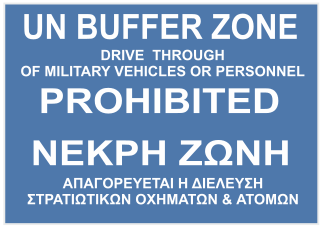
The buffer zone
Public domain · Andrikkos · Wikimedia Commons · UNFICYP describes the zone as running about 180 km and covering "about 3 per cent of the island, including some of the most valuable agricultural land"; it publishes no area in km²
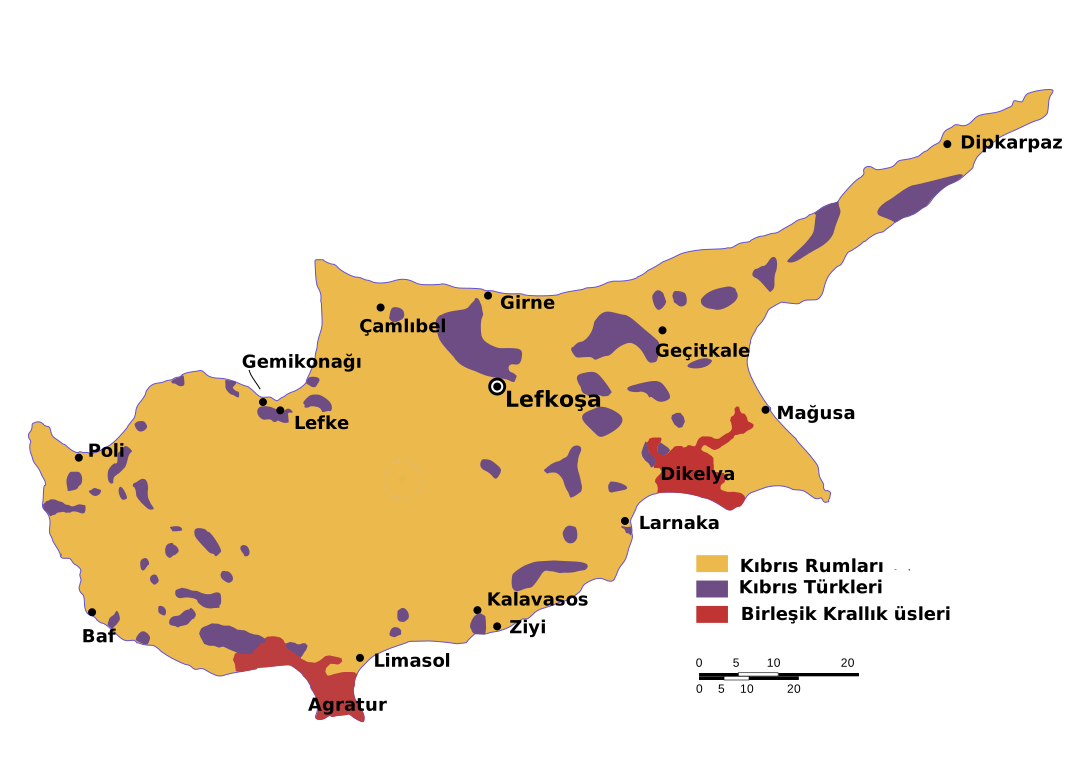
The two communities in 1973 — the year before the line
Public domain · Badseed (modified) · Wikimedia Commons · Both communities lived across the whole island. Whichever account of 1963–64 a reader accepts, the separation that followed is visible as a change in this pattern
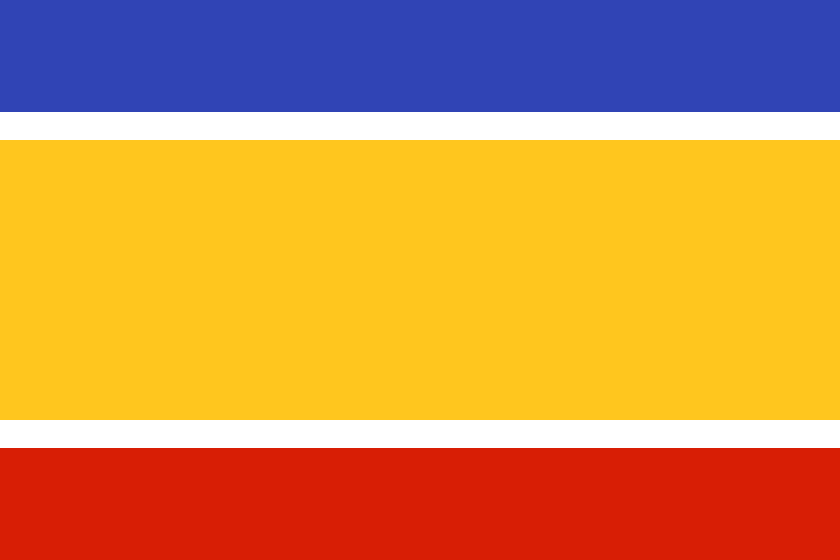
The flag of the United Cyprus Republic
Public domain · United Nations (design). Gabbe (SVG file) · Wikimedia Commons · Designed for a state that would have existed had the 2004 referendums passed. Turkish Cypriots voted 64.9% in favour; Greek Cypriots 75.8% against