The documentary evidence behind both official narratives, with the accessibility of each original noted. Every card in the two narratives carries the other side's rebuttal; third-party cards state their own limits instead. This document endorses neither claim.
VOTEWhich story do you find more convincing?↓Naming rule The International Court of Justice, before which this case was argued in May 2026, avoids both parties' names and writes "the territory in dispute" — this English edition leads with the neutral river name · The order of the two narrative sections below is randomized on every visit
Current status — as of August 2026 Status as of 2026-08
De facto control 🇬🇾 Guyana administers the whole territory except Ankoko Island, which 🇻🇪 Venezuela has occupied and administered since October 19662026-08
Ankoko Island Venezuela maintains military installations and an airstrip; a Center for Strategic and International Studies report documented new construction there including a tank base2024-02
Military posture Venezuela deployed 5,600 personnel in December 2023; the United Kingdom sent HMS Trent the same month, United States Southern Command has conducted joint operations with the Guyana Defence Force, and Brazil reinforced its Boa Vista garrison in February 20242024-02
Territory about 159,500 km² west of the Essequibo River — roughly two-thirds of Guyana's land area, administered as six of its ten regions, with the exception of Ankoko Island. Venezuela's agent at the May 2026 hearings wore a map pin giving the claimed territory as 160,000 km²unverified2026-08
Population about 125,000 residents, some 15.8% of Guyana's population, holding Guyanese citizenship. No vote on the territory's status has ever been held among them — not in the 2023 Venezuelan referendum, and not in the May 2025 governor election2026-08
Before the International Court of Justice Guyana applied on 29 March 2018; the Court found jurisdiction on 18 December 2020 and rejected Venezuela's preliminary objection 14–1 on 6 April 2023, the sole dissent being that of a judge ad hoc. Written pleadings closed with Venezuela's Rejoinder on 11 August 2025 and the merits were argued on 4–11 May 2026. No judgment has been delivered and no date has been announced2026-07-31
Venezuela's posture at the Court the unusual hybrid of appearing while denying jurisdiction: it filed a Counter-Memorial in April 2024 and a Rejoinder in August 2025, and pleaded orally on 6 and 11 May 2026 through its agent Samuel Moncada, while maintaining by formal letters that it never consented to adjudicationunverified2026-05
Venezuela's government Nicolás Maduro was captured during United States strikes on 3 January 2026 and Vice-President Delcy Rodríguez was sworn in as acting president on 5 January. The claim survived the change intact: the post-Maduro government sent its agent to The Hague in May 2026 to argue it, and to reject the Court's jurisdiction. The constitutional situation remains unresolved and this page takes no view on itunverified2026-08
Guyana's position the 1899 Award is valid and binding and the boundary is settled; the case is to have that confirmed rather than reopened2026-05
Venezuela's position the Award is a nullity procured by fraud and procedural failure; the Geneva Agreement of 1966 is the governing instrument and requires a practical settlement reached by agreement2026-05
Provisional measures in force the order of 1 December 2023, reaffirmed unanimously on 1 May 2025, requires Venezuela to refrain from altering the situation in which Guyana administers the territory; the added measure on the elections passed 12–3. Venezuela held the vote regardless on 25 May 20252026-07-31
Oil the offshore Stabroek Block discovery of 2015 transformed the stakes; the disputed maritime projection off the Essequibo coast is the practical reason the dormant claim reactivated2026-08
⚠ This page describes a case that has been fully argued and is awaiting judgment. The merits were heard at the ICJ on 4–11 May 2026 and Guyana's foreign ministry has said publicly it expects a decision by year's end. Everything here bearing on the legal outcome is provisional by definition and may be overtaken without warning. Two further cautions: the December 2023 referendum turnout is genuinely contested, and the official and independent figures are set out side by side rather than reconciled; and the common shorthand "Guyana administers all of it" is inaccurate because of Ankoko Island.2026-08
Change log
Oral hearings on the merits close after six sessions (CR 2026/24–29). Guyana pleaded on 4 and 8 May, Venezuela on 6 and 11 May. Judgment reserved.
Delcy Rodríguez sworn in as acting president of Venezuela, two days after United States strikes and the capture of Nicolás Maduro. Venezuela's Essequibo claim is unchanged by the transition.
Irfaan Ali re-elected in Guyana (PPP/C, 36 of 65 seats, 55.31%); inaugurated 7 September. Guyana's position carries continuity through to the judgment.
Venezuela files its Rejoinder, completing the written round on the merits.
Guyana files its Reply on the merits.
Venezuela holds the governor election despite the 1 May order. Admiral Neil Villamizar declared elected with about 97%, at twelve polling centres inside Bolívar state — none in the disputed territory — among roughly 21,000–21,500 voters. CARICOM condemned the vote as defiance of the Court.
The Court reaffirms its 2023 provisional measures unanimously and orders Venezuela, by 12 votes to 3, to refrain from conducting or preparing elections in the territory in dispute. The three dissenters agreed with the measure's content and objected only that the 2023 order already covered the situation.
Guyana requests new provisional measures after Venezuela's electoral council schedules a Guayana Esequiba governor election.
The Organic Law for the Defence of Guayana Esequiba enters into force, creating Venezuela's twenty-fourth state with its capital at Tumeremo — a town inside Bolívar state, not inside the claimed territory.
Argyle Declaration: Ali and Maduro commit before regional facilitators not to threaten or use force. The ICJ question is left unresolved.
Consultative referendum held two days after the Court's first provisional measures order. Official results report over 95% Yes on all five questions at 51.01% turnout; the opposition leader Henrique Capriles calculated participation nearer 10%. No vote was held in the territory itself.
Guyana licenses six foreign oil companies to drill in waters Venezuela claims — the step the research identifies as directly preceding the referendum.
⇄ The order of the two narrative sections below is randomized on every visit.
Guyana's narrative 6 sources
A unanimous arbitral award made by a tribunal both parties agreed in advance to accept as final; a boundary Venezuela then helped physically demarcate and signed off on; fifty-seven years of silence; and a treaty in which Venezuela agreed that if the parties could not choose a means of settlement, the Secretary-General would choose for them.
The Treaty of Washington, Article XIII 2 February 1897
Signed at Washington by Julian Pauncefote for Britain and José Andrade for Venezuela; ratifications exchanged 14 June 1897. Article II fixed the tribunal: two jurists nominated by Britain's Privy Council, two nominated by the President and Justices of the US Supreme Court "on the part of Venezuela," and a fifth chosen by those four. Article IV set a fifty-year rule of prescription that Britain had insisted on.
The High Contracting Parties engage to consider the result of the proceedings of the Tribunal of Arbitration as a full, perfect, and final settlement of all the questions referred to the Arbitrators.
Meaning
Guyana's case is that Venezuela signed as a sovereign state, agreed in advance to accept the result as full, perfect and final, and obtained a substantial win under the treaty's prescription rule — the entire mouth of the Orinoco. On that case a state cannot accept the benefit of an arbitration and repudiate the burden sixty-three years later.
Venezuela rebuts
Article XIII presupposes a genuine arbitration. Venezuela's central complaint is Article II itself: not one Venezuelan sat on the tribunal. Venezuela was "represented" by two United States Supreme Court justices nominated by the US government — a state which, as Venezuela reads the 1895 crisis, was pursuing its own hemispheric interests. Venezuela argues it was coerced and deceived into the treaty in the first place, and that Article IV's fifty-year prescription rule was itself a term Britain extracted in order to legitimise the very encroachment Venezuela was protesting.
A unanimous award signed by all five arbitrators — Fyodor de Martens, Melville Weston Fuller, David J. Brewer, Russell of Killowen and Richard Henn Collins. It fixed the line by geographic description, granted Venezuela the entire mouth of the Orinoco and Point Barima, granted Britain the land east to the Essequibo, reserved Brazilian questions and guaranteed free navigation.
Meaning
Guyana's case is that this is a valid international arbitral award — unanimous, made by a tribunal both parties consented to, and therefore res judicata. Guyana's May 2026 pleading asked the Court to affirm the Award's legal validity and binding effect.
Venezuela rebuts
Venezuela argues the award is a nullity. As pleaded before the ICJ, it alleges it was "coerced and deceived" into the Washington Treaty; that there were "improper communications between the legal counsel of the United Kingdom and the arbitrators that it had appointed"; and that Britain knowingly submitted doctored and falsified maps. Venezuela also emphasises that the award gave no reasons at all — a wholly unreasoned line, which it says is itself a procedural failure.
original publisheddetermined by an international bodyThe award's silence on reasoning is undisputed; what it signifies is notUN RIAA vol. XXVIII (PDF)
Demarcation and Venezuelan sign-off 1900–1905
Venezuela participated in the physical demarcation of the awarded line for nearly four years, and its own commissioners signed the resulting map and coordinates in a joint agreement of 1905. Venezuela then treated the boundary as settled for the following fifty-seven years.
Meaning
Guyana's central evidentiary argument, and the spine of its May 2026 oral case: on Guyana's account Venezuela did not merely fail to object — it executed the award on the ground, with its own surveyors.
Venezuela rebuts
Venezuela's answer has two limbs. Demarcating a line one believes to be fraudulent is not consent to the fraud, and a state that does not yet know it was defrauded cannot acquiesce in it; Venezuela's position is that it learned the decisive facts only when the Mallet-Prevost memorandum was published in 1949, and protested formally in 1962. And it points to what it was in those years: a small, militarily weak state that had just been subjected to the Anglo-German-Italian naval blockade of 1902–03, in the middle of the demarcation period. Acceptance under those conditions, it argues, carries little evidentiary weight.
The Geneva Agreement, Article IV(2) signed 17 February 1966
Signed by Michael Stewart for the United Kingdom, L.F.S. Burnham for British Guiana and Ignacio Iribarren Borges for Venezuela; in force on signature, registered by Venezuela on 5 May 1966, with Guyana becoming a party on independence that month. Article IV(2) provides that if the parties cannot agree a means of settlement, the choice passes to the Secretary-General.
…they shall refer the decision as to the means of settlement to an appropriate international organ upon which they both agree or, failing agreement on this point, to the Secretary-General of the United Nations.
Meaning
Venezuela freely agreed that if the parties could not choose a means of settlement, the Secretary-General would choose for them — and judicial settlement is expressly among the means listed in Article 33 of the Charter. On Guyana's reading, Venezuela consented in 1966 to whatever the Secretary-General later chose.
Venezuela rebuts
Venezuela reads Article IV(2) as conferring only the power to choose a means, not the power to confer jurisdiction on a court. On that reading, once the Secretary-General designated the ICJ the parties still had to conclude a special agreement to seise it, and a unilateral application cannot substitute for one. Venezuela also argues Article I frames the object as reaching a practical settlement by agreement, not a judgment imposed on one party.
The sequence the treaty prescribes was run to exhaustion: Mixed Commission 1966–1970 with no solution; Protocol of Port of Spain in 1970 imposing a twelve-year moratorium; Venezuela terminating it in December 1981 so that Article IV resumed in 1982; the parties failing to agree; referral to the Secretary-General, accepted by Pérez de Cuéllar in 1983; good offices chosen in 1990 and run through a succession of Personal Representatives; and finally, after 52 years, the choice of judicial settlement.
Meaning
Guyana's framing is that this was not a shortcut but the opposite: every non-judicial means the Geneva Agreement provided was tried first, in the order the treaty sets out, before the Secretary-General exercised the power Venezuela gave him.
Venezuela rebuts
Venezuela contends the good offices process was never genuinely exhausted — it was terminated by the Secretary-General rather than concluded — and that Ban Ki-moon's 2015 "Way Forward" improperly pre-committed the outcome by announcing the Court in advance, converting the Secretary-General from a neutral chooser into an advocate for one party's preferred forum.
original publisheddetermined by an international bodyICJ — case 171
The Court's rulings on jurisdiction 18 December 2020 · 6 April 2023
In 2020 the Court held that it has jurisdiction over the validity of the 1899 Award and the related settlement of the land boundary, though not over Guyanese claims arising from events after the Geneva Agreement. In 2023 it disposed of Venezuela's indispensable-third-party objection by fourteen votes to one, reasoning that because Articles II and IV of the Geneva Agreement provide no role for the United Kingdom, and it was itself a party to that Agreement, the UK had accepted that the controversy would be settled between Guyana and Venezuela.
Meaning
Guyana's position is that the jurisdictional question has now been argued twice and decided twice, and that Venezuela has had two full opportunities to contest it.
Venezuela rebuts
Venezuela maintains it never consented to adjudication and that a court cannot bootstrap its own jurisdiction. It reiterated this by formal letters in March 2025 and again in oral argument in May 2026, and points to the third question of the 2023 referendum as popular ratification of the refusal. It also argues the United Kingdom remains an active party: Article VIII made Guyana a party in addition to the United Kingdom rather than in substitution for it, so the United Kingdom's rights and obligations regarding the 1899 Award were never transferred to Guyana.
original publisheddetermined by an international bodyVenezuela nonetheless filed a Counter-Memorial on the merits in April 2024 and a Rejoinder in August 2025ICJ judgment, 6 Apr 2023 (PDF)
Venezuela's narrative 6 sources
A colonial boundary that moved as Britain surveyed it; an arbitration with no Venezuelan on the bench that produced an unreasoned line; an insider's posthumous account of how that line was fixed; and a 1966 treaty in which Britain itself agreed the nullity contention was a live controversy.
The Schomburgk Line as a moving, unilateral line 1814 · 1835–1840 · 1886
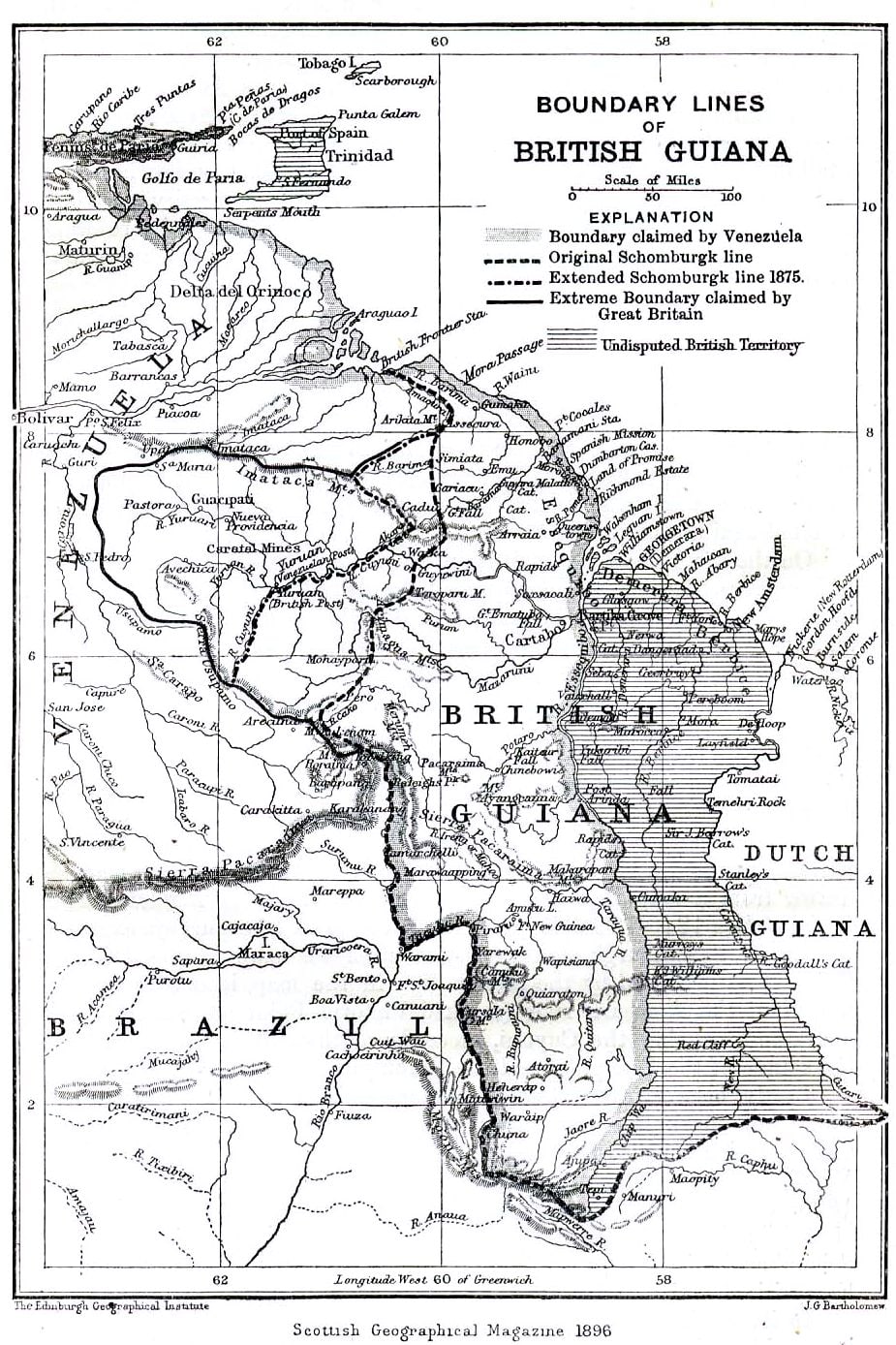
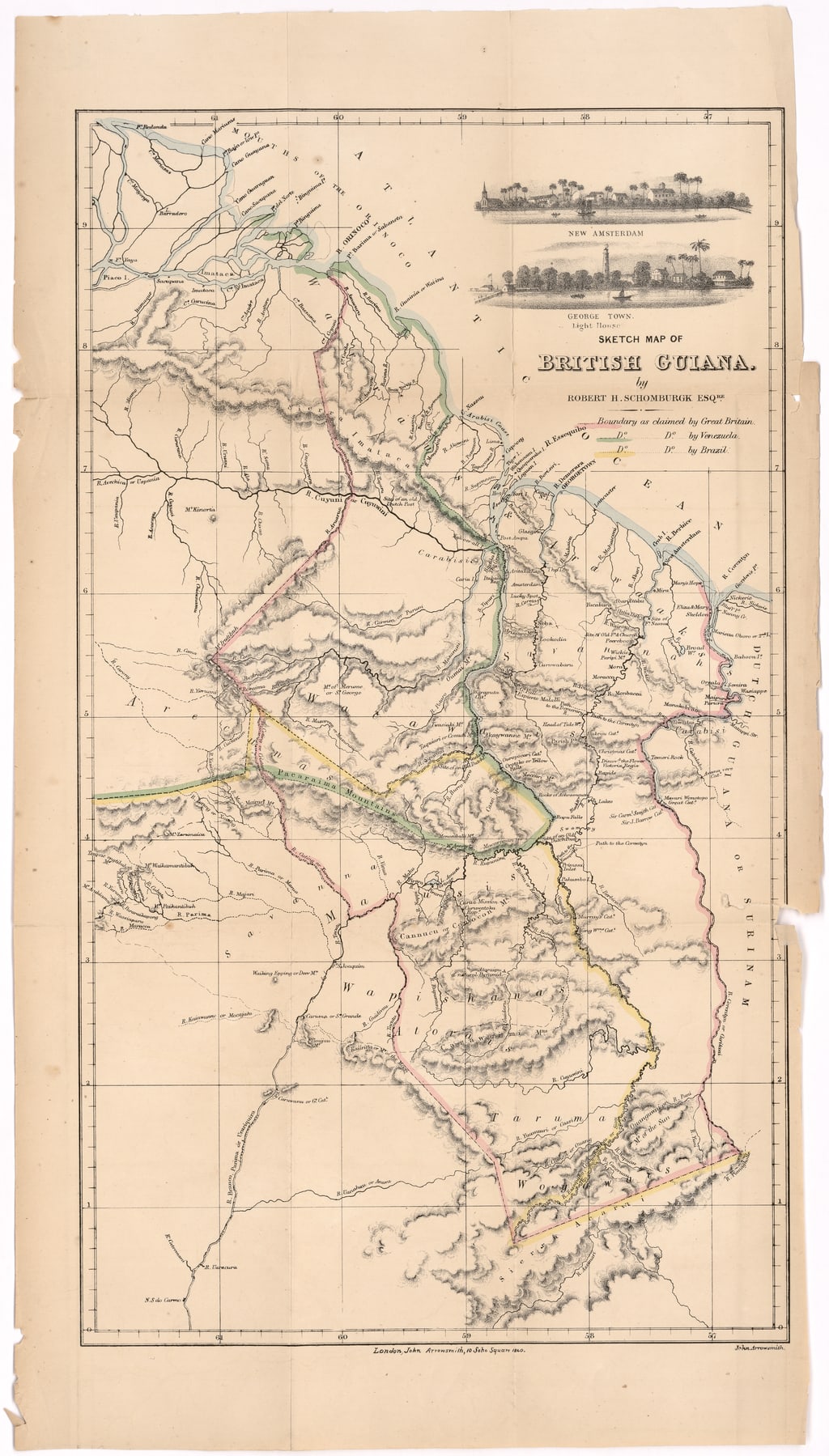
Britain acquired Essequibo, Demerara and Berbice from the Netherlands under the Anglo-Dutch Treaty of 1814. Robert Hermann Schomburgk surveyed for the Royal Geographical Society from 1835 and was commissioned by the British government in 1840 to survey the colony's boundaries. His 1840 sketch was the only publicly available version until 1886. Britain declared the line British Guiana's provisional frontier in October 1886; Venezuela severed diplomatic relations in February 1887.
Meaning
Two arguments. On title, Venezuela claims by uti possidetis juris as successor to the Spanish Captaincy General, whose jurisdiction it says ran to the Essequibo River, and argues the Dutch never effectively occupied the interior Britain later claimed. On conduct, Venezuela says the line moved substantially westward over the period as gold was found in the Cuyuni basin — and a boundary that expands each time its author redraws it is a claim, not a boundary.
Guyana rebuts
The tribunal was expressly directed by Article III of the Washington Treaty to investigate and ascertain the extent of the territories lawfully claimable by the Netherlands or by Spain at the time Britain acquired the colony — that is, the uti possidetis question was precisely what the arbitrators were appointed to decide, and they decided it. Guyana adds that the award did not ratify the Schomburgk Line: it moved the boundary off the Cuyuni to the Wenamu, and gave Venezuela the Orinoco mouth, neither of which a purely British-drawn line would have done.
The Mallet-Prevost memorandum written 1944; published 1949
Severo Mallet-Prevost was junior United States counsel for Venezuela at the Paris arbitration. In 1944 he wrote a memorandum to be opened only after his death; he died in 1948 and it was published in 1949 in the American Journal of International Law, introduced by his law partner and executor Judge Otto Schoenrich. It describes the award as the product of a political bargain rather than adjudication.
Meaning
Venezuela treats it as the hinge of its entire case: an insider's account converting the award from res judicata into a fraud. On Venezuela's account everything downstream — the 1962 repudiation, the Geneva Agreement, the refusal of jurisdiction — follows from it.
Guyana rebuts
Guyana's answer has several limbs. The memorandum is second-hand hearsay about private conversations, written some forty-five years after the events by a partisan participant and released only after its author's death, so that he could never be cross-examined; it is uncorroborated by any contemporaneous record; it was written in 1944, as Venezuelan interest in the Orinoco region was rising with oil; and even if its account were true, the conduct alleged is that of the arbitrators rather than of the United Kingdom, and falls below the threshold international law sets for annulling an award. Both sides' archives were opened for exactly this question in the Tripartite Examination of 1963–65, concluded 3 August 1965: the United Kingdom's expert — who also acted for British Guiana — found no evidence supporting the nullity contention, while Venezuela's experts maintained that the Award was null and void.
original publisheddocumentedThe document's existence and contents are undisputed; its truth was not established on the record as it stood when this dossier was compiledMemorándum de Mallet-Prevost (es)
The repudiation at the United Nations February – November 1962
Venezuela formally raised the dispute at the UN in February 1962, as British Guiana moved toward independence, and reiterated it before the Special Political Committee in February and November of that year. It has never since accepted the 1899 line.
There was no arbitral award, properly speaking. There was a settlement. There was a political compromise… — Foreign Minister Marcos Falcón Briceño, UN Special Political Committee, 12 November 1962
Meaning
Venezuela's position is that the objection is not opportunistic post-oil revisionism but a formal, publicly stated legal position taken before Guyanese independence — and therefore before there was any Guyanese title to disturb.
Guyana rebuts
The memorandum was published in 1949 and Venezuela said nothing for thirteen years — and then spoke only as British Guiana approached independence, when a new and weaker neighbour was about to replace a great power. Guyana also points to Britain's answer of 13 November 1962, which emphatically rejected the allegation that the tribunal had reached its result by anything other than adjudication.
Venezuela's central textual argument. The United Kingdom — the very state that obtained the 1899 award — signed a treaty in 1966 whose opening article names the nullity contention as the live subject-matter of a controversy requiring resolution. Article V(2) further provides that no acts or activities taking place while the Agreement is in force shall constitute a basis for asserting, supporting or denying a claim to territorial sovereignty, or create any rights of sovereignty in those territories.
A Mixed Commission shall be established with the task of seeking satisfactory solutions for the practical settlement of the controversy between Venezuela and the United Kingdom which has arisen as the result of the Venezuelan contention that the Arbitral Award of 1899 about the frontier between British Guiana and Venezuela is null and void.
Meaning
If the 1899 award were genuinely final and res judicata, there would have been nothing to negotiate in 1966 and no reason for Britain to sign anything. The Geneva Agreement is, on this reading, Britain's own admission that the question was open.
Guyana rebuts
Article I describes the controversy — it identifies what the parties disagree about — without conceding that the contention is correct. Agreeing a mechanism for resolving a claim is not agreeing the claim has merit. Guyana adds that Article IV supplies the mechanism, that Venezuela invoked and exhausted it, and that Article V(2) cuts against Venezuela too: it equally deprives the 2023 decrees, the 2024 Organic Law and the 2025 elections of any sovereignty-creating effect.
Held two days after the Court's first order of provisional measures. Official results reported Yes majorities of 96–98% on each of five questions, with turnout given as 51.01% of an electorate of 20.7 million and officials citing over 10.5 million votes.
Meaning
Venezuela's framing is democratic legitimacy: the claim is not a government policy but a ratified national will — which is why officials describe the May 2025 election for a governor of the claimed territory as fulfilling a constitutional mandate established by the referendum.
Guyana rebuts
The turnout is heavily disputed: the opposition leader Henrique Capriles calculated actual participation at about 10.2%, and the electoral council published and then deleted figures suggesting roughly two million votes per question were being reported as 10.5 million voters. And no vote was held in the territory itself — none of the roughly 125,000 residents took part in a referendum about their own sovereignty. CARICOM said the exercise "has no bearing on international law."
original publisheddocumentedOfficial turnout figures are contested and were altered after publication2023 Venezuelan referendum
The Organic Law for the Defence of Guayana Esequiba adopted 21 March 2024; in force 3 April 2024
The National Assembly created the territory as Venezuela's twenty-fourth state, vested executive, legislative and judicial prerogatives, authorised the President to prohibit contracts with entities operating under Guyanese concessions, and ordered that every map of Venezuela show the territory as an integral part of the nation. The designated capital, Tumeremo, lies inside Bolívar state rather than inside the claimed territory.
Meaning
Venezuela's framing is formal incorporation in domestic law — the instrument that, on its account, converts the claim from a diplomatic position into an administrative fact.
Guyana rebuts
Article V(2) of the Geneva Agreement provides that no act performed while the Agreement is in force can create or support a sovereignty claim — which on Guyana's reading deprives the 2023 decrees, this law and the 2025 elections of any effect on title. Guyana's further answer is administrative rather than textual: it administers the six regions, whose residents hold Guyanese citizenship and vote in Guyanese elections, while the twenty-fourth state has no administrative presence in the territory it names.
About 125,000 people live in the territory. Neither government has ever put its status to them, and neither is represented by them. This section records that as a fact rather than as an argument for either side.
The people the case is about as of 2026
The residents are Guyanese citizens, about 15.8% of Guyana's population, living across six of Guyana's ten regions and voting in Guyanese general elections. They did not vote in Venezuela's December 2023 referendum, which was not held in the territory; they did not vote in the May 2025 election for a governor of Guayana Esequiba, whose twelve polling centres were all inside Bolívar state. They are not a party in the proceedings between the two states at the International Court of Justice; that case is between states, about a boundary.
Value / limits
Included because any framing that treats the territory as empty ground between two governments is inaccurate, and would be attacked as such — fairly. Its limits: no residents' self-determination claim appears in this dossier's sources, and neither government treats the residents as a party. Guyana points to their citizenship as evidence of its administration; Venezuela points to the same population as people it says were placed under an administration imposed by a void award. The fact is stated here so that neither use of it stands unqualified.
Where the two sides read the very same instrument in opposite ways — pick a reading and watch the highlighter move. The initial selection is random. Unusually for this site, these readings were argued before a court in May 2026; see the status block above for where the case stands.
① The 1899 Award — res judicata, or a nullity?
Treaty of Washington, Art. XIII: The High Contracting Parties engage to consider the result of the proceedings of the Tribunal of Arbitration as a full, perfect, and final settlement of all the questions referred to the Arbitrators. · Art. II (summary): two jurists nominated by Britain's Privy Council, two nominated by the President and Justices of the US Supreme Court "on the part of Venezuela," and a fifth chosen by those four. · The Award of 3 October 1899 states a line and gives no reasons.
Full, perfect, and final. Venezuela signed that clause as a sovereign state, took the benefit of the award — the whole mouth of the Orinoco — then helped demarcate the line on the ground and said nothing for fifty-seven years. International law protects arbitral finality for a structural reason: without it, states could submit disputes and reopen the ones they lost. And unreasoned awards were normal practice in nineteenth-century boundary arbitration: the silence is a period convention, not evidence of collusion.
Not one Venezuelan sat on the tribunal, and the award gives no reasons at all. An arbitration where one party has no national on the bench, producing an unreasoned unanimous line, is a diplomatic settlement wearing judicial clothes. Finality presupposes a genuine adjudication; fraud and excess of authority are recognised grounds of nullity.
Both facts Venezuela highlights are verifiable from the primary documents — the tribunal's composition from the treaty text, the award's silence from the award itself — and neither is disputed. What they signify is the whole case.
② The Geneva Agreement (1966) — which article governs?
Art. I — A Mixed Commission shall be established with the task of seeking satisfactory solutions for the practical settlement of the controversy … which has arisen as the result of the Venezuelan contention that the Arbitral Award of 1899 … is null and void. · Art. IV(2) — … to an appropriate international organ upon which they both agree or, failing agreement on this point, to the Secretary-General of the United Nations. · Art. V(2) — No acts or activities taking place while this Agreement is in force shall constitute a basis for asserting, supporting or denying a claim to territorial sovereignty … or create any rights of sovereignty in those territories…
Article IV(2) is the operative machinery. Venezuela agreed that if the parties could not choose a means, the Secretary-General would choose — and judicial settlement is among the Charter's listed means. Article I merely describes what the parties disagree about; naming a contention is not conceding it. And Article V(2) cuts against Venezuela: it voids the 2023 decrees, the 2024 law and the 2025 elections as sources of title.
Britain signed a treaty saying the nullity contention was the controversy. If the award were final there would have been nothing to negotiate in 1966. And Article IV(2) lets the Secretary-General pick a means, not confer jurisdiction on a court: once he named the ICJ, a special agreement was still needed to seise it. Article I frames the object as a practical settlement by agreement, not a judgment imposed on one party.
The 1966 text is not in dispute and both sides quote it constantly. The Court decided this argument against Venezuela on jurisdiction in 2020 and 2023; the merits were argued in May 2026. See the status block for the current position.
③ The Mallet-Prevost memorandum (1949) — what does it prove?
Written in 1944 by Venezuela's own junior counsel at the arbitration, sealed for posthumous release, published in 1949 after his death. Second-hand, about private conversations, forty-five years after the events, uncorroborated by any contemporaneous record, and its author never cross-examined. It explains two otherwise odd features of the award — its unanimity and its silence.
Hearsay from an interested party, released beyond challenge. Both archives were opened for exactly this question in 1963–65 and the United Kingdom's expert found no evidence supporting it. A memorandum cannot overturn a unanimous award that the complaining state executed on the ground with its own surveyors and then accepted for fifty-seven years.
An insider's account with no motive to fabricate against his own former client. He was there, he wrote privately rather than for advantage, he instructed that it be released only after his death — and his account is the only one that explains why five arbitrators agreed unanimously on a line and then declined to give a single reason for it.
No verbatim extract of the memorandum is reproduced here, so the passage above is this site's summary of a contested account rather than the document's own words. Venezuela's experts in the same 1963–65 examination maintained that the Award was null and void, and the United Kingdom's expert also acted for British Guiana. The neutral statement is narrower than either side's: the document exists, its contents are undisputed, and its truth was unproven on the record as it stood when this dossier was compiled. Both parties argued it before the Court in May 2026.
Third-party views 7 sources
This dispute has been argued before a court. That changes what neutrality requires: the question is not which side is right but what the record actually establishes, and on the central allegation it establishes less than either party claims.
The United States forces the arbitration 1895–96
In the Venezuela Crisis of 1895 Secretary of State Richard Olney asserted that "the United States is practically sovereign on this continent, and its fiat is law"; President Cleveland took the matter to Congress in December 1895, accusing Britain of having extended the Schomburgk Line "in some mysterious way." Britain accepted arbitration in January 1896.
Value / limits
The decisive third-party intervention: without American pressure there is no arbitration at all, and therefore no 1899 award to argue about. Its limit is that the United States was not disinterested — it was asserting the Monroe Doctrine — and that the same pressure produced the tribunal composition Venezuela now objects to. This card records how the arbitration came to exist; it says nothing about whether its result was right.
Under Article II the tribunal comprised Lord Russell of Killowen, Lord Chief Justice of England, and Sir Richard Henn Collins, both nominated by the Judicial Committee of the Privy Council on Britain's part; Chief Justice Melville Weston Fuller and Justice David J. Brewer of the United States Supreme Court, nominated on Venezuela's part; and Fyodor de Martens of Russia as the fifth, chosen by the other four.
Value / limits
A genuinely shared artefact: the composition is verifiable from the treaty text alone and both sides build on it. Venezuela reads it as an arbitration in which one party had no national on the bench, producing a line with no reasons attached. Guyana reads it as the composition Venezuela itself accepted by treaty, with two justices of a state that had just intervened on Venezuela's behalf — and adds that unreasoned awards were normal practice in nineteenth-century boundary arbitration, so the silence is a period convention rather than evidence of collusion. Its limit is that the document settles nothing between them: both readings are fully available from the text, which is what makes this a battleground rather than a resolved question.
What the memorandum can and cannot establish assessment
In its favour: the author was present, was Venezuela's own counsel, had no obvious motive to fabricate against his former client's interest, wrote privately with instructions for posthumous release rather than for contemporaneous advantage, and gave an account that explains both the award's unanimity and its silence. Against it: it is second-hand about private conversations, written decades later, uncorroborated by any contemporaneous document, its author was never cross-examined — and when both parties' archives were opened and searched for precisely this purpose in the Tripartite Examination of 1963–65, concluded 3 August 1965, the United Kingdom's expert found no evidence supporting the nullity contention, while Venezuela's experts maintained their view.
Value / limits
The most useful neutral card here, because the correct framing is narrower than either party's. It is not "Venezuela alleges, Guyana denies": the document exists and its contents are undisputed; what is unproven — and on the record as it stood when this dossier was compiled, unprovable — is whether its account is true. Its limit is that this framing satisfies neither side. Guyana regards even neutral treatment as lending credibility to an uncorroborated allegation. Venezuela objects in the opposite direction: that the expert who found no evidence was searching the archives of the state accused of the fraud, on that state's behalf, and that the absence of a written record of a private conversation is precisely what one would expect to find. Both objections are reasonable.
The law on the nullity of arbitral awards doctrine
International law protects arbitral finality strongly, for a structural rather than formal reason: finality is what gives arbitration its legal value, since without it states could submit disputes and reopen the ones they lost. Finality is nonetheless not absolute — recognised grounds of nullity include fraud, corruption, excess of authority and a serious departure from a fundamental rule of procedure.
Value / limits
The honest assessment cuts both ways. The doctrine gives Venezuela a legally available theory — fraud and excès de pouvoir really are grounds, and a wholly unreasoned award really can raise a procedural-failure question — but not an easy evidentiary path, because the governing precedent, Arbitral Award Made by the King of Spain (Honduras v. Nicaragua), ICJ 1960, sets the bar high and generally cuts Guyana's way: the conduct between 1899 and 1962 is the kind that case treats as fatal to a later challenge. Guyana's structural difficulty is the mirror image: it must persuade the Court that acquiescence binds a party which says it was defrauded and did not know it. Its limit as a neutral source is that stating the doctrine predicts nothing, and this dossier does not attempt to.
Presidents Ali and Maduro met at Argyle in St Vincent and the Grenadines, facilitated by Prime Ministers Ralph Gonsalves and Roosevelt Skerrit, with Celso Amorim as Brazil's envoy and the UN Secretary-General observing. Eleven points were agreed, including a mutual commitment not to threaten or use force and to refrain from escalation.
Value / limits
The one moment at which both heads of state jointly committed, before neutral facilitators, to non-use of force. Its limit is stated plainly: it did not resolve the underlying question at all. Guyana continued the case; Venezuela continued to reject jurisdiction; and the 2024 Organic Law followed three months later.
What the regional bodies said, and did not say 2023–2025
CARICOM criticised the December 2023 referendum and condemned the May 2025 election as defiance of the Court; OAS Secretary General Luis Almagro called the referendum illegal under the 1966 Geneva Agreement; Commonwealth Secretary-General Patricia Scotland opposed it. Brazil reinforced its northern border in February 2024. The Argyle process was facilitated by CARICOM and CELAC office-holders with Brazil and the UN Secretary-General present.
Value / limits
The clearest measure of regional opinion on Venezuela's recent conduct — and lopsided against it. Three structural reasons matter for reading it. CARICOM is an organisation of which Guyana is a member and Venezuela is not. The OAS under Almagro was in open conflict with Caracas over unrelated matters. And almost none of these statements assess whether the 1899 award was valid: they address Venezuela's methods, not its historical claim, which is the distinction Venezuela draws in reply and which this card does not resolve.
Venezuela has occupied and administered Ankoko Island since October 1966 — five months after Guyanese independence and eight months after the Geneva Agreement. It maintains military installations and an airstrip there; a Center for Strategic and International Studies report of February 2024 documented new construction including a tank base.
Value / limits
The reason the shorthand "Guyana administers all of it" is inaccurate: this is the only part of the territory Guyana does not administer. Guyana does not accept the occupation; Venezuela treats the island as its own territory. Neither government's legal characterisation of it is set out in this dossier's sources. Its further limit is that Article V(2) of the Geneva Agreement, which both sides invoke elsewhere, cuts against reading the occupation as creating title — and equally against reading Guyanese administration elsewhere as creating title.
Votes per hour. A surge is not hidden here — it is drawn.
Why people voted
One line, from people who voted. No replies. Your side and country are shown with it.
Vote first — this is where a vote gets its reason.
No lines yet.
The frozen record — never edited, never deleted
Method and limits. Compiled 2026-08-24 from a three-track research pass (Guyanese grounds / Venezuelan grounds / third parties). Three cautions specific to this dispute. First, this dossier's legal material is provisional — the status block above carries the dated position of the proceedings and is the only place on this page where that position is stated. Second, the central allegation is undecided rather than disproved — the Mallet-Prevost memorandum exists and its contents are undisputed, but its truth was unproven on the record as it stood when this was compiled, and this dossier says so rather than resolving it in either direction. Third, administration of the territory is not uniform; the status block states who controls what, and as of when. Badges follow the two grades defined in the editorial principles: original published = images or full text publicly available; copies published = the original is lost or unavailable and the text survives in transmission. Third-party and residents' cards state their limits in place of a rebuttal, since they are not one side's evidence.
Editorial principles. ① Name order follows the language edition; this English edition leads with the neutral river name, as the Court itself avoids both parties' terms. ② The order of the two narrative sections is randomized on every visit. ③ Every dispute is labelled with its de facto controller, and every card in the two narratives carries the other side's rebuttal.
Four competing lines, 1896 — Bartholomew, Scottish Geographical Magazine
Public domain · Wikimedia Commons · The lettered lines run from the British extreme claim to the Venezuelan extreme claim; the 1899 award drew its boundary inside that fan
Schomburgk's own sketch map, 1840
Public domain · Schomburgk, Robert H. (Robert Hermann), Sir, 1804-1865 · Wikimedia Commons · The version publicly available until 1886 — the map at the centre of the dispute over whether the line moved